
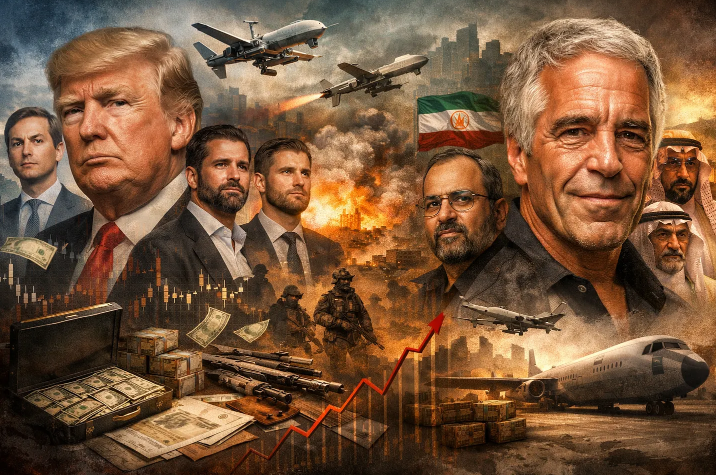
From the orbit of Donald Trump to the enduring networks once tied to Jeffrey Epstein, geopolitical turmoil is again enriching those closest to power.
From Iran-Contra to 2026: The Return of Familiar Players in a Profiteering Machine
As the United States engages in active conflict with Iran in April 2026, a familiar pattern of high-level enrichment is emerging. Significant financial gains are being reported among those in President Trump’s inner circle, fueled by allegations of insider trading and strategic timing. Key players include Jared Kushner, whose private equity fund, Affinity Partners, has seen massive inflows during his diplomatic negotiations with Saudi Arabia and Israel, and Donald Trump Jr. and Eric Trump, whose sudden pivot into drone technology has coincided with lucrative new government contracts.
This ecosystem of influence echoes the rise of Jeffrey Epstein. Long before he was a household name, Epstein’s ascent was fueled by deep Middle Eastern connections—specifically his ties to Israeli intelligence and 1980s arms-dealing networks. His transformation from a dismissed Bear Stearns employee into a global power broker was rooted in the illicit international arms trafficking and money-laundering operations of the Iran-Contra era.
Key Insights
- Affinity Partners and Middle East Investment: As of March 2026, Affinity Partners’ assets under management surged to $6.2 billion, a 30% year-on-year increase. Notably, 99% of this capital originates from foreign sources, primarily the sovereign wealth funds of Saudi Arabia ($2 billion), the UAE, and Qatar. These gains have tracked suspiciously close to Kushner’s role as a “peace envoy,” triggering congressional investigations into the commingling of personal profit and diplomatic influence.
- Trump Family Drone Investments: Donald Trump Jr. and Eric Trump have moved aggressively into the defence sector, backing Florida-based Powerus. The company, which builds autonomous heavy-lift drones and interceptors, is currently pitching systems to Gulf states under Iranian threat. It is also pursuing a “reverse merger” with the Trump-linked Aureus Greenway Holdings to go public.
- Government Contractors: While the Trump brothers hold advisory roles at Unusual Machines, other firms like XTEND—an Israeli AI drone company—have already secured major Pentagon contracts. Eric Trump reportedly invested in XTEND just 11 days before the U.S. and Israel launched the largest joint drone strikes in military history against Iranian targets.
- The Ehud Barak Connection: Former Israeli PM and Defence Minister Ehud Barak was one of Epstein’s closest associates. While Barak claimed they met in 2003, evidence suggests their relationship dates back to the 1980s via shared involvement in the Iran-Contra scandal.
- The Douglas Leese & Khashoggi Links: In the early ‘80s, Epstein worked as a consultant for British arms dealer Douglas Leese. Through his firm, Intercontinental Assets Group, Epstein also reportedly “bounty hunted” for Adnan Khashoggi, the Saudi arms dealer central to Iran-Contra who netted hundreds of millions in commissions from U.S. giants like Lockheed Martin and Raytheon (RTX).
- Southern Air Transport: During the Iran-Contra affair, weapons were moved by Southern Air Transport, a former CIA-owned airline. Following the scandal, the airline relocated to Columbus, Ohio, to fly cargo for Les Wexner’s The Limited—the exact period during which Epstein held total power of attorney over Wexner’s financial empire.
The Modern Parallel
Epstein’s 1980s background explains his mastery of international money flows and the leverage he held over the elite. Today, the parallels are striking: Jared Kushner, Steve Witkoff, and the Trump sons are simultaneously managing business deals and political negotiations in the Middle East. Furthermore, the Foreign Corrupt Practices Act—originally enacted to curb Khashoggi-era corruption—was recently weakened under the Trump administration, effectively lowering the barriers for the very type of conflict-of-interest profiteering we see today.
Related:
- The Architecture of a Crisis Manufactured by Hostile Foreign PowersAn Exclusive Evidence-Based Exposé on the Hidden Forces, Intelligence Networks, and Propaganda Machinery Fueling Unrest in Iran — Framed by the West as a ‘Popular Uprising’.
- The New York Times shatters the propaganda myth of an Iranian popular uprisingA rare correction from a major outlet—and a turning point in the discourse on Iran
- The Invisible Hand: How Israel Orchestrates the Terror Groups It Claims to FightUncovering why ISIS and Al-Qaeda never attack Israel and how state-sponsored terrorism fuels the “Greater Israel” project—amid a seemingly coordinated media blackout keeping the issue under wraps.
- The Making of a Nemesis: How the United States Created the Iran It Now FearsAmerica’s 70-Year Campaign Against Iran: From Destroying Democracy to Engineering Collapse—And Why the Next Version Could Be Even More Dangerous
- A War to Topple Iran That Toppled the Non-Proliferation Regime InsteadIn the attempt to stop a bomb Iran wasn’t building, Israel and the U.S. have ended the era of nuclear restraint.
- The Snapback of Sanctions: Escalation Against IranAfter years of violating their own commitments, the US and Europe are projecting their behavior onto Iran in order to pave the way for the next conflict.
- Unplugging the WestIran Ditches U.S. GPS for China’s BeiDou — Sparking a Global Rebellion Against Western Tech Dominance and Control
- Iran, Israel, and the Geopolitical Chessboard: A Manufactured CrisisFrom Nuclear Hysteria to Regime Change, How the Empire Recycles Old Playbooks to Block a New Eurasian Order
- Washington’s Oil Blockade: It Is Intended To Strangle Iran, Hit China’s Industry And It Will Massively Endanger Global Peace And StabilityAlthough the recent moves by the US empire in its desperate attempt to maintain world domination are highly dangerous, they receive little attention in the mainstream media.
- Rerouting Global Trade: The Rise of the Eurasian CorridorBypassing US Maritime Chokepoints Through Steel and Strategy