
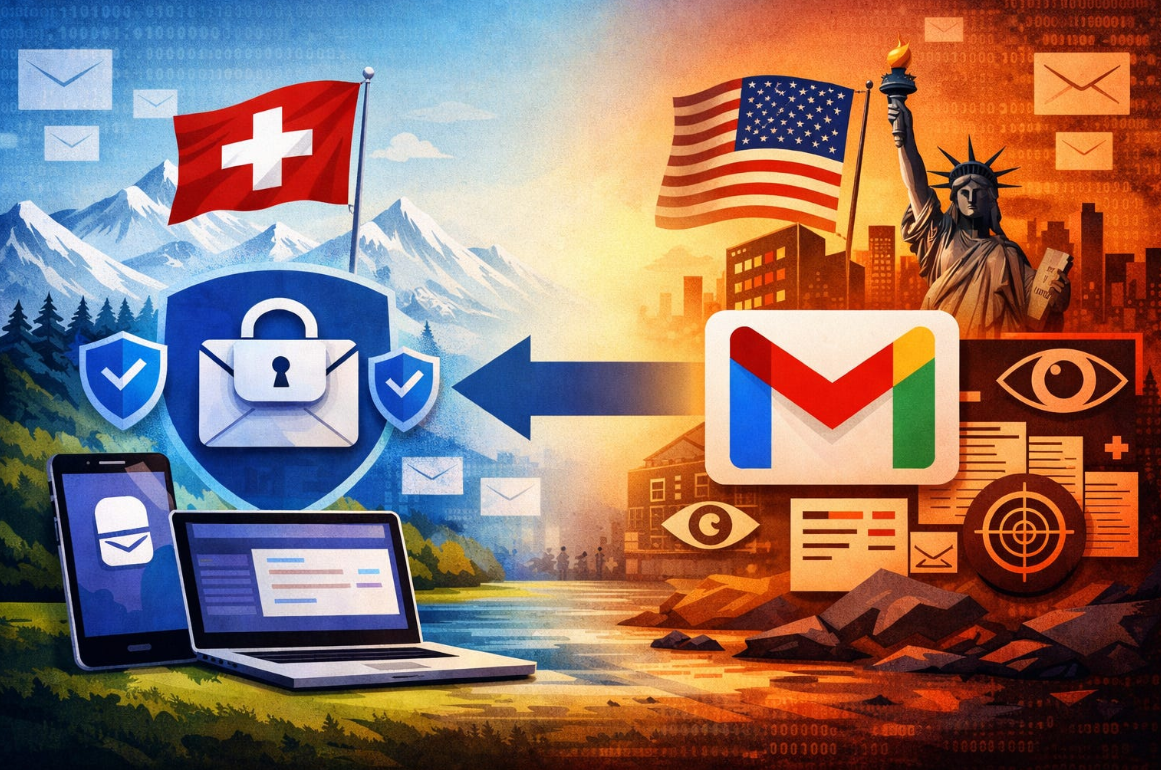
Encrypted emails are the first step toward combating mass surveillance, but there’s a catch!
Escape the Surveillance Machine: Why Switching Your Email Matters
We live in a world where “The Quiet Rise of a Full‑Spectrum Surveillance State” isn’t just a warning—it’s reality. Predictive policing, zero-click phone hacks, massive data hoards, and cross-agency tracking are merging into a single, intrusive system. Years after investigative reporters like Whitney Webb sounded the alarm, the most immediate step you can take to protect yourself starts with your inbox.
Proton Mail, a Switzerland-based email service, offers a simple way out. Its Easy Switch tool lets you transfer messages and contacts from Gmail or other providers in minutes, giving you a fresh start without losing your digital life.
Most of our daily digital activity relies on U.S.-based tech services—but convenience often comes at the cost of privacy. Gmail, for instance, reads and scans your messages to fuel advertising and train AI models and may share them with the US government.
Proton Mail flips that model: built in Switzerland, it funds its operations through paid subscriptions rather than data exploitation, offering encrypted email, VPN, password management, and cloud storage. A free version is available, too—proof that privacy doesn’t have to cost a fortune. However, there are important caveats to consider, which we will discuss later on.
At the same time, the broader digital landscape reveals how aggressively user data is harvested. LinkedIn, owned by Microsoft since 2016, was recently the focus of an investigation by the German nonprofit Fairlinked e.V.. The report, titled BrowserGate, outlines what may be one of the most far-reaching cases of corporate data extraction uncovered to date. According to the findings, each time one of LinkedIn’s roughly one billion users visits the platform, hidden code scans their browser for installed extensions, encrypts this information, and sends it not only to LinkedIn’s servers but also to external companies — including a U.S.–Israeli cybersecurity firm. This creates the possibility that both U.S. and Israeli governmental actors could indirectly gain access to this data through those firms. Users are neither informed nor asked for consent, and LinkedIn’s privacy policy makes no mention of the practice.
In an era where your digital footprint is constantly tracked — often silently — switching your email isn’t just a preference. It’s a small but powerful act of autonomy.
End-to-End Encrypted Email with Swiss Data Protection
Proton Mail provides secure email with built-in end-to-end encryption (E2EE) and a Zero-Access architecture. Emails are encrypted on the sender’s device before transmission. Unlike Gmail, Proton cannot read the contents of messages. Full E2EE applies when both sender and recipient use Proton Mail.
The service automatically blocks email trackers (such as spy pixels and tracking links), includes phishing-detection features, and displays no advertisements—even for free users. Proton Mail is accessible via a web interface and dedicated apps for Android and iOS.
Migration with Easy Switch
Easy Switch is a built-in tool that allows users to transfer data from other email accounts. It supports:
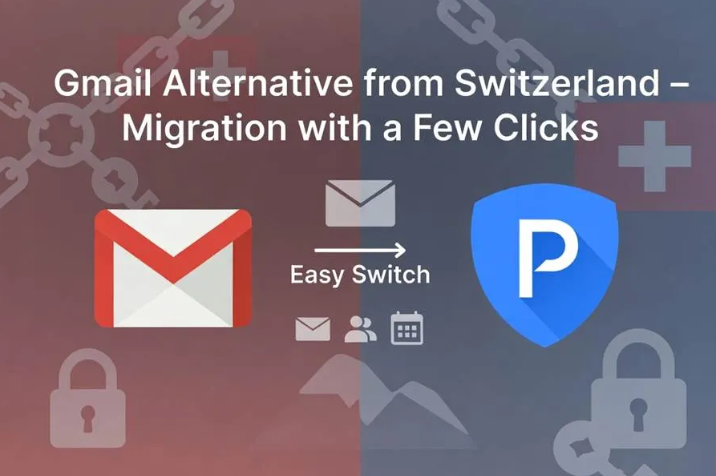
Automatic forwarding of new Gmail messages to a Proton Mail inbox, while keeping the Proton address hidden from Google.
Importing existing emails, contacts, and calendars.
The import process runs in the background on Proton’s servers, and all data is encrypted upon arrival. Users may migrate specific folders or date ranges. Easy Switch works not only with Gmail but also with Outlook, Yahoo, and other IMAP-compatible services.
Storage Considerations
The free version of Proton Mail includes up to 1 GB of email storage. New users typically start with 500 MB and can reach the full capacity by completing a few onboarding steps. For users with large Gmail archives, this may not be enough. It can help to review, delete, or archive old messages in Gmail before migration or to import only selected folders.
Paid plans offer more storage and additional features:
Mail Plus: 15 GB total storage (shared with Proton Drive); €4.99/month or €3.99/month annually.
Proton Unlimited: 500 GB total storage (across Proton services); approximately €12.99/month or €9.99/month annually.
Paid plans also include alias management (Hide-My-Email), support for desktop clients via Proton Mail Bridge, and the ability to use custom domains.
Conclusion
The ability of the U.S. government to compel Google to hand over Gmail data has led many users to explore alternatives with stronger privacy features. Proton Mail, based in Switzerland and equipped with robust end-to-end encryption, is one option worth considering. The service’s Easy Switch tool further simplifies the process of migrating from Gmail and other email providers.
Caveat and Broader Context
Another Swiss company, Crypto AG, was secretly controlled for decades by the CIA and Germany’s BND. I previously detailed this in an article published in CovertAction Magazine — a magazine founded by former CIA personnel and whose editorial board includes John Kiriakou, the whistleblower who exposed the agency’s torture program.
For decades, it sold compromised encryption devices to around 120 countries, allowing U.S. intelligence to access their supposedly secure communications. Only countries like China, Russia, and North Korea avoided the trap by developing their own encryption systems.
The case illustrates how global surveillance often exploits weaknesses in devices and infrastructure, not just in encryption algorithms, making cybersecurity less reliable than many assume.
Disclosures from former NSA contractor Edward Snowden further revealed the extent of worldwide surveillance. Smartphones may capture audio even when they appear to be off, and household devices—from TVs to smart speakers—can be repurposed into monitoring tools. Systems such as Palantir aggregate and analyze vast amounts of personal data to create detailed individual profiles.
Given the ongoing efforts by the US government and other governments to massively expand surveillance capabilities, caution is advisable. It is impossible to know with certainty who will control Proton Mail in the future or whether the service could ever be compromised by intelligence agencies or tools such as Palantir.
Users should therefore remain aware that no email service — regardless of its current jurisdiction or technical protections — is completely immune to future political, legal, or technological pressures.
Related:
- Pre‑Crime America: The Quiet Rise of a Full‑Spectrum Surveillance StatePredictive policing, zero‑click phone hacks, mega‑databases, and cross‑agency tracking are merging into a unified system of control—years after investigative reporters warned this day would come.
- Unplugging the WestIran Ditches U.S. GPS for China’s BeiDou — Sparking a Global Rebellion Against Western Tech Dominance and Control
- Russia, China, and North Korea did not fall into a trap set by the U.S., but 120 other nations did!And be warned: Encryption is unsafe and cyber-security is a myth!