
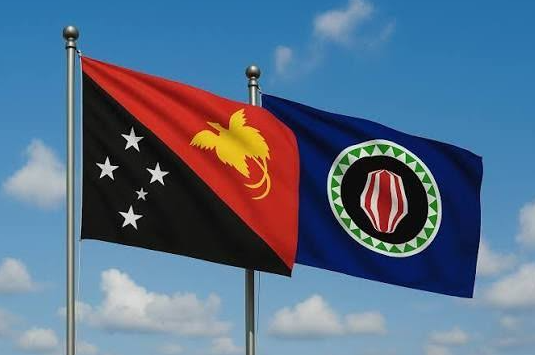
Bougainville has been here before in one form or another: promised timelines, political frameworks, carefully worded commitments that suggest movement without ever fully guaranteeing arrival. The latest version of that story now puts independence somewhere around 2030, with a staged transition into self-governance beginning in 2027 under President Ishmael Toroama. On paper it looks like progression. On the ground it still looks like a region balancing between historical grievance, political patience, and the limits of what can realistically be built in time.
The language is structured, almost administrative, but Bougainville has never really behaved like an administrative problem. It is a place shaped by conflict, referendum politics, and an unusually strong sense of direction that still collides constantly with practical constraints.
From secession attempt to referendum mandate
The independence question in Bougainville did not begin with modern political negotiation. It stretches back to the moment of Papua New Guinea’s independence in 1975, when Bougainville briefly declared itself the Republic of the North Solomons. That early attempt was quickly dismissed, but it established a pattern that has repeated ever since: a local identity that consistently pushes against a central state structure.
Things escalated dramatically in the late 1980s around the Panguna copper mine, which at the time was one of the largest mining operations in the world. What might have remained a dispute over royalties and environmental management instead became the catalyst for a full civil war. Land ownership issues, environmental damage, and the distribution of wealth all converged into a conflict that lasted a decade and left tens of thousands dead.
When the war ended, it did so through the Bougainville Peace Agreement, which created an autonomous framework and promised a referendum on independence. That referendum finally arrived in 2019, and the result was not ambiguous in any meaningful sense: 97.7 percent voted for independence. The problem was never the answer, only what would be done with it.
A timeline that looks like structure but depends on consent
The current roadmap set out by Ishmael Toroama places Bougainville into a transition phase beginning September 2027, described as full self-governance. This is meant to be the period where institutions are strengthened and the basic machinery of statehood is developed in practice rather than theory.
From there, the expectation is full independence by 2030, completing what has effectively been a 50+ year political trajectory from first secession attempt to potential statehood. The framing is deliberate: it ties legal justification to the peace agreement, constitutional mechanisms in Papua New Guinea, and the referendum result, which remains the strongest political asset Bougainville has.
But even with that alignment, the gap between political intention and administrative capacity remains wide. Bougainville is not just negotiating independence as a concept, but building the conditions in which independence could function without immediate structural stress.
Port Moresby, approval, and the politics of delay
For most of the post-war period, the decisive constraint on independence has sat in Papua New Guinea’s parliament, where constitutional approval requires a two-thirds majority. That alone made independence a distant prospect for years, regardless of local sentiment.
More recently, the tone has shifted. Prime Minister James Marape has adopted a more accommodating public position, speaking in terms of respect and dialogue rather than outright resistance. It is a softer political language, but it does not yet amount to a final commitment.
The real test comes with the parliamentary decision scheduled for August 2026 on Bougainville’s roadmap. If that process fails or stalls, it will not simply be a procedural delay. In Bougainville’s context, where political expectations are tightly bound to the legacy of conflict and peace settlement, failure carries a risk of destabilisation that cannot be treated as theoretical.
Panguna remains the unresolved centre of everything
Any discussion of Bougainville’s future inevitably returns to Panguna. The mine is not just an economic asset; it is the original fault line of the modern conflict. Once one of the most productive copper mines globally, it became the focal point of grievances over land rights, environmental destruction, and the distribution of wealth generated from extraction.
Those grievances escalated into the civil war, which is why Panguna remains politically sensitive in a way few industrial sites ever do. Yet at the same time, it is difficult to see how a future Bougainville state becomes financially sustainable without some form of resource development at scale.
This creates an uncomfortable overlap between necessity and memory. Any attempt to reopen or redevelop the site would have to navigate not just technical feasibility and corporate involvement, but a deeply embedded historical sensitivity that has never fully cooled.
Independence as trajectory, not endpoint
Bougainville today sits in an unusual position where independence is no longer a distant aspiration but also not yet a completed political reality. The referendum has already settled the question of desire. What remains unsettled is execution.
Everything now depends on whether governance structures can mature quickly enough, whether political consent in Papua New Guinea holds, and whether economic foundations can be stabilised without triggering renewed internal tension.
The deeper reality is that Bougainville is not moving toward independence in a straight line. It is moving through a long transition where history is still active, institutions are still forming, and the outcome is still contingent. 2030 may eventually mark a beginning. It may also turn out to be another checkpoint in a process that continues to stretch beyond the timelines set for it.