
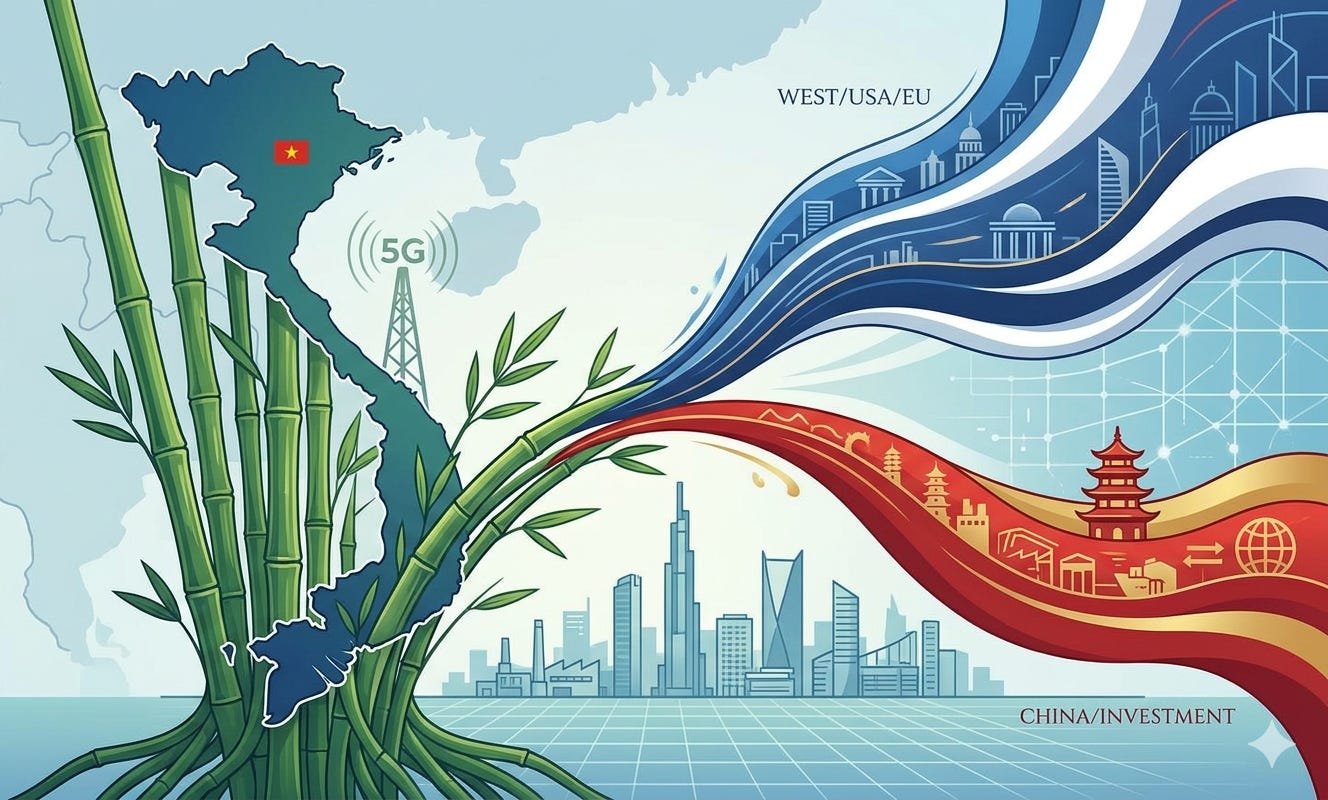
Vietnam is rapidly emerging as a global 5G powerhouse, leveraging a pragmatic strategy known as “bamboo diplomacy” to modernize its infrastructure while managing intense geopolitical pressure.
The Pragmatism of Bamboo Diplomacy
Although the United States has repeatedly warned Vietnam against using Chinese 5G equipment, by late 2025, Vietnamese operators had awarded contracts worth more than $40 million to Huawei and ZTE for 5G-related hardware—primarily antennas and non-core components. Vietnamese officials and operators cite the cost-effectiveness and performance of Chinese gear, often dismissing security concerns as politically motivated claims from the West. Other regional players, including Thailand, Malaysia, and even the Philippines, are also considering greater adoption of Chinese 5G technology.
Western politicians and media frequently frame China as an inherent ‘threat’ to Vietnam, often overlooking the fact that China is its largest investment and trading partner. Even the brief 1979 border war, which lasted less than a month, was not a conflict over territorial expansion or “regime change,” but rather a response to Vietnam’s military intervention in Cambodia. Unlike major Western powers, China does not seek to subject other nations to its rule, nor does it harbor ambitions to export its societal model.
This pragmatic relationship is best encapsulated by an anecdote frequently shared by Singaporean professor and former senior diplomat Kishore Mahbubani. Recounting a conversation between senior Singaporean diplomat Bilahari Kausikan and a high-ranking Vietnamese official, Mahbubani notes that every Vietnamese leader must possess two seemingly contradictory capabilities:
1. The ability to stand up to China (withstanding and resisting pressure).
2. The ability to get along with China (cooperating and maintaining stable relations).
According to the official, any leader who believes these two goals are mutually exclusive “does not deserve to be a leader.” Mahbubani uses this to illustrate Vietnam’s sophisticated “bamboo diplomacy,” which allows it to navigate the intense rivalry between the United States and China.
Economic Priorities vs. External Pressure
However, Western opposition to China’s role in 5G remains firm. On March 24, 2026, at an investment forum in Hanoi, EU Commissioner for International Partnerships Jozef Síkela warned that reliance on Chinese equipment could undermine investor confidence and potentially trigger capital outflows. This raises two critical questions: Why is the European Union so strongly opposed to Vietnam’s cooperation with Chinese 5G providers, and will Vietnam scale back its engagement under external pressure?
When most people think of Vietnam, its booming manufacturing sector comes to mind. In just over a decade, this nation of 100 million has become a global industrial hub. In 2025, goods exports reached approximately $475 billion, while foreign direct investment (FDI) remained among the strongest in the region. As more companies move operations to Vietnam, the government has prioritized digital infrastructure. National security, public services, and business operations now depend heavily on robust 5G networks.
Vietnam’s 5G journey began in 2019 with trials by the domestic operator Viettel. In 2020, the country joined the U.S.-led “Clean Network” initiative, pledging to exclude firms like Huawei and ZTE from critical infrastructure. By 2025, however, that stance had shifted. State-owned operators began awarding 5G projects—mainly radio access network elements—to Chinese vendors.
Price is the primary driver. While European suppliers like Ericsson and Nokia dominate the “core” network, Chinese alternatives offer competitive pricing without a significant performance gap in peripheral segments. For a developing country managing large-scale deployment, Chinese equipment is an attractive economic option. Notably, Vietnam announced a cooperation contract with ZTE just one month after new U.S. tariffs took effect in 2025. This was followed by additional contracts for 5G antennas, bringing the combined value of Chinese deals that year to over $40 million.
Navigating a Divided Digital Future
The European Union has added its own pressure. At the March 2026 Global Gateway Business and Investment Forum, Commissioner Síkela argued that Chinese involvement raises data security concerns and could discourage foreign investors. While these concerns touch on data protection and supply-chain resilience, 5G is also viewed by the EU as strategic infrastructure that underpins industrial and corporate communications.
Despite these warnings, Vietnam’s pragmatic cooperation continues. All three major operators—Viettel, VNPT, and Mobifone—have engaged with Chinese vendors for non-core elements. Huawei equipment is now deployed in parts of Ho Chi Minh City, including commercial districts and industrial zones. Meanwhile, 5G coverage is expanding rapidly; Viettel alone deployed over 30,000 base stations by the end of 2025.
Vietnam sees little reason to pivot solely in response to Western pressure. Some observers contend that security warnings are a pretext for economic interests, suggesting that Western-controlled equipment poses its own sovereign risk should U.S. foreign policy shift toward political interference. Nevertheless, concerns regarding Chinese legal frameworks and long-term vendor lock-in persist. Beyond the commercial desire to protect European giants like Ericsson and Nokia, the EU’s stance is inherently strategic; Vietnam’s digital roadmap serves as a critical bellwether for infrastructure standards across the region.
The EU’s own restrictions are tightening. In January 2026, the European Commission proposed amendments to the Cybersecurity Act to make its “5G Cybersecurity Toolbox” mandatory, requiring member states to remove high-risk vendors from critical networks within three years. While countries like Sweden have fully banned Huawei, others, such as Spain, remain more permissive.
Ultimately, Vietnam’s decision reflects the classic dilemma for developing economies: balancing the need for rapid, affordable infrastructure with complex geopolitical and security considerations. To date, Chinese equipment has provided the fastest path toward the digital future Vietnam envisions.