
From Deindustrialization to Dependence: China’s Strategic Advantage
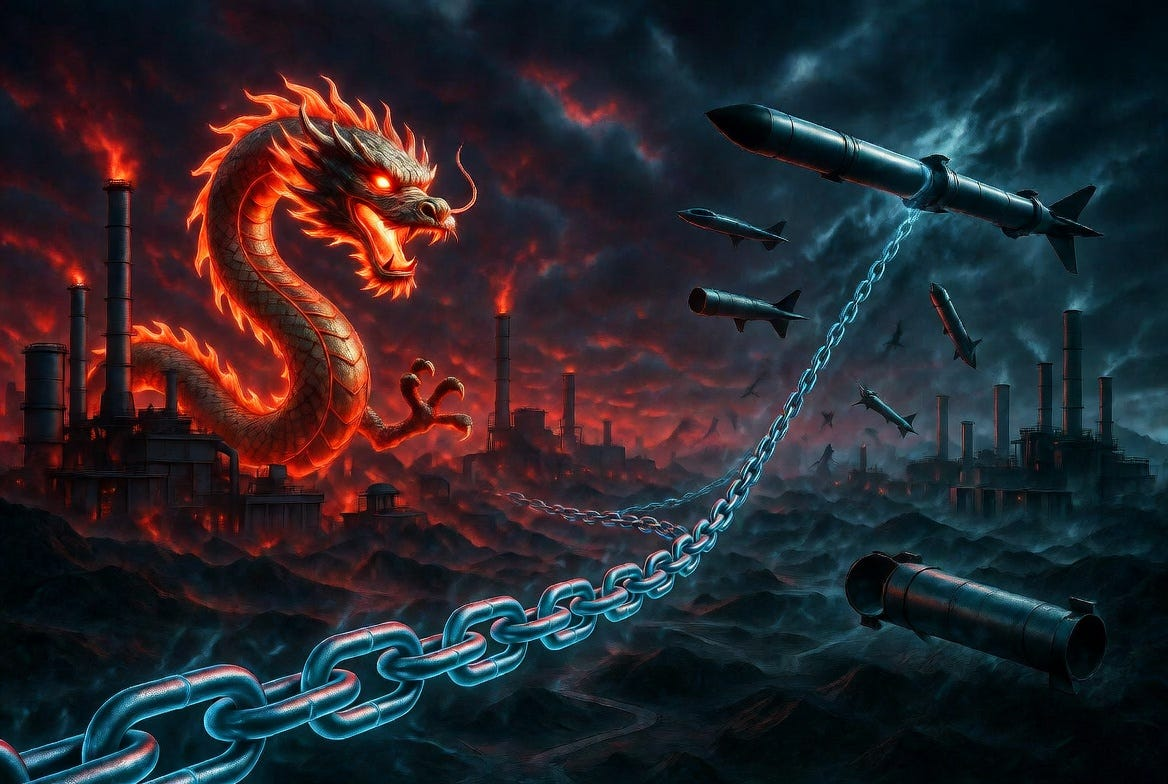
China has become the single most important industrial bottleneck for Western military production. Not because it manufactures complete weapons systems for NATO countries, but because it dominates the processing of critical minerals, advanced manufacturing supply chains, key components, and essential inputs required to build modern weapons.
This dependence is the result of decades of Western deindustrialization, while China deliberately invested in the very industries the West deemed unprofitable or environmentally undesirable.
The West Faces a Manufacturing Problem, Not Just a Military One
Western governments increasingly talk about dramatically expanding weapons production — Patriot missiles, Tomahawk cruise missiles, drones, artillery shells, and fighter aircraft — without acknowledging that these systems cannot be manufactured independently of complex global industrial supply chains.
Military production ultimately rests on civilian industrial capacity. Modern weapons require sophisticated electronics, semiconductors, precision machine tools, specialty alloys, advanced magnets, rare earth elements, refined metals, chemical processing, and energy-intensive manufacturing. Because so many of these foundational capabilities now reside primarily in China, Western efforts to rapidly scale up military output face structural limitations far more than financial ones.
China Dominates Rare Earth Processing
A recent Financial Times article titled “China and the new era of critical minerals diplomacy” highlights that China’s dominance extends well beyond raw mineral deposits. Beijing controls the far more difficult and valuable stages of the supply chain:
- Refining
- Chemical separation
- Purification
- Processing
- Component manufacturing
This dominance was built methodically over nearly three decades through sustained state investment, subsidies, and strategic industrial planning.
China now leads global processing for rare earth elements, tungsten, copper products, lithium, and numerous specialty metals—materials essential for both advanced civilian industries and modern military technology.
Modern Weapons Depend on Chinese-Controlled Materials
Virtually every advanced Western weapons system relies on these materials:
- Patriot missile systems require advanced electronics, radar, sensors, and permanent magnets made with rare earth elements.
- Tomahawk and JASSM cruise missiles depend on sophisticated guidance systems, precision electronics, and specialty materials.
- Modern fighter aircraft use rare earth elements in radar systems and highly specialized electronic components.
- Precision-guided munitions need sensors, navigation systems, actuators, and magnets deeply tied to Chinese supply chains.
China’s Sophisticated Export Controls
Rather than imposing outright bans, China has implemented a comprehensive licensing system. Companies seeking exports must disclose exactly what materials they need, in what quantities, for which end users, and whether the final products are intended for civilian or military use. Each application is reviewed individually, with approvals often taking weeks or months.
This system gives Beijing deep visibility into foreign supply chains and the ability to strategically approve, delay, or restrict exports.
Military Supply Chains Are Especially Vulnerable
Defense contractors must certify that materials are destined for civilian use, creating major challenges. If rare earths cannot legally flow into military applications, manufacturers of missiles, radar systems, and electronics risk supply shortages. Western defense industries are currently drawing down pre-existing inventories, but these stocks will eventually run out if new supplies remain constrained.
Civilian Manufacturers Face Difficult Choices
The licensing rules also discourage civilian companies from sharing materials with the military. Diverting licensed rare earths to defense production risks future export denials from China. As a result, civilian firms are likely to protect their own access, leaving military contractors short — a perhaps unintended but strategically significant consequence of Beijing’s policy.
Buying Finished Components Instead of Raw Materials
These restrictions are already pushing many Western manufacturers to purchase finished Chinese components rather than raw or processed materials. Components are easier to source, involve simpler compliance requirements, and are often cheaper. Ironically, this deepens dependence on Chinese manufacturing instead of reducing it.
Rebuilding Domestic Supply Chains Will Take Decades
Simply opening new mines will not solve the problem. The West must also rebuild chemical processing plants, refining facilities, metallurgy industries, magnet manufacturing, precision component factories, skilled workforces, and entire industrial ecosystems. China spent roughly thirty years developing these capabilities. Even under optimistic scenarios, meaningful diversification away from China is unlikely before the mid-to-late 2030s.
The Business Case Is Weak
Rare earth processing is capital-intensive, environmentally challenging, energy-intensive, and only profitable at massive scale. China benefits from the world’s largest manufacturing base, which creates enormous domestic demand that Western economies — after decades of deindustrialization — simply cannot match. Governments would need to subsidize these industries for years before they become commercially viable.
Ukraine Highlights Europe’s Dependence
Recent reporting shows that Ukraine is purchasing Chinese drone components with European Union funds. This underscores a painful reality: Europe lacks the capacity to manufacture sufficient drone components domestically, and even its support for Ukraine’s war effort relies heavily on Chinese manufacturing.
China Supplies Both Sides
Strikingly, Chinese components appear throughout the conflict. Russian forces have reportedly found Chinese parts in Ukrainian drones, while Ukraine continues to depend on them for production. China has positioned itself not as a partisan supplier, but as an indispensable node in global manufacturing.
Energy Constraints Compound the Crisis
The minerals bottleneck is worsened by broader industrial pressures: rising oil and natural gas prices, LNG competition, helium shortages, and potential constraints on copper and tungsten. Weapons manufacturing now faces multiple simultaneous bottlenecks.
Strategic Implications
The West has long underestimated how deeply modern defense production depends on civilian industrial capacity and globally integrated supply chains. Decades of offshoring left critical processing industries concentrated in China. While governments announce ambitious rearmament plans, rebuilding the underlying industrial base — mining, refining, processing, components, skilled labor, and energy infrastructure — cannot happen quickly.
In practice, China exerts significant influence over the production of modern weapons systems. This reality acts as a natural “appetite suppressant” and could dampen Western enthusiasm for prolonged conflicts more effectively than any diplomatic initiative from Beijing. At the same time, the West has little choice but to finally give genuine diplomacy—rather than sheer force—a real chance.