
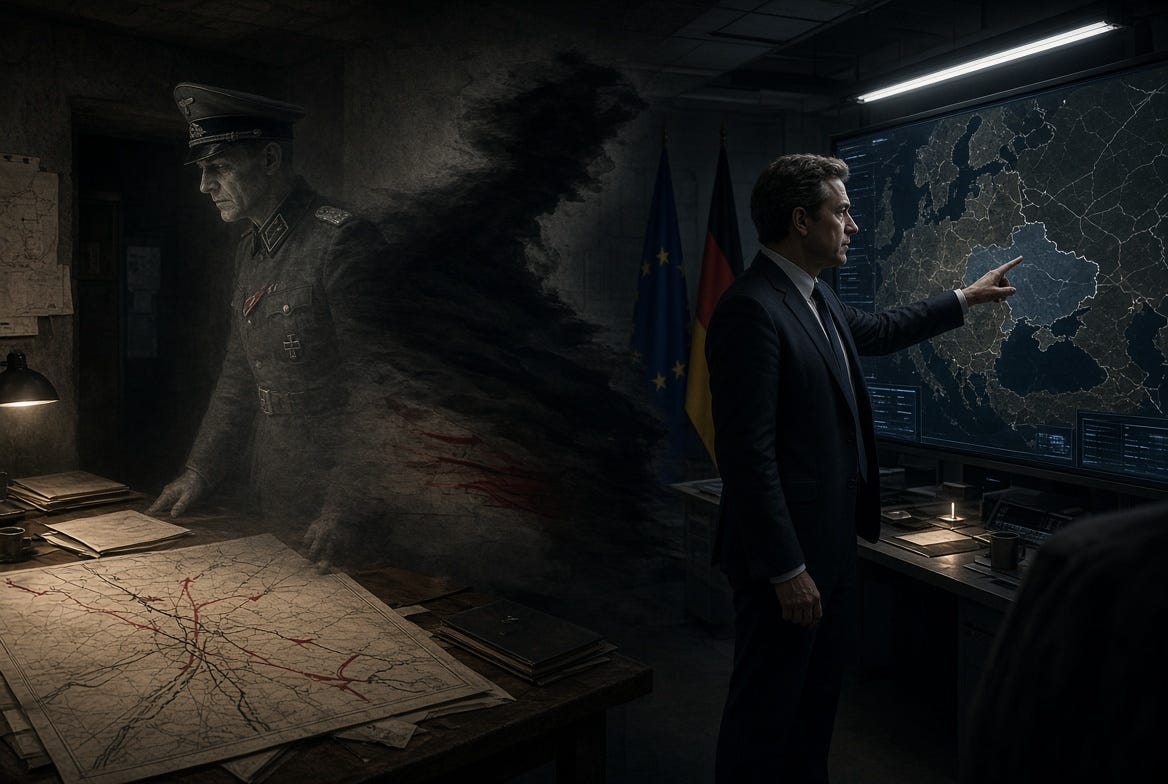
Leading German journalist with family history rooted in Hitler’s National Socialism asks Zelenskyy:
“What can we Europeans concretely do to kill more Russians?”
Michael Martens, a respected German journalist and author for the influential *Frankfurter Allgemeine Zeitung*, reported that his grandfather, Hans-Hermann Martens, served as an officer in the Wehrmacht Operations Staff (WFSt) of the Armed Forces High Command (OKW) starting in 1941. In this capacity, he was stationed at the Führer Headquarters and participated in Adolf Hitler’s so-called “Table Talk.” Following the defeat at Stalingrad, he requested and received a transfer to Norway in 1943.
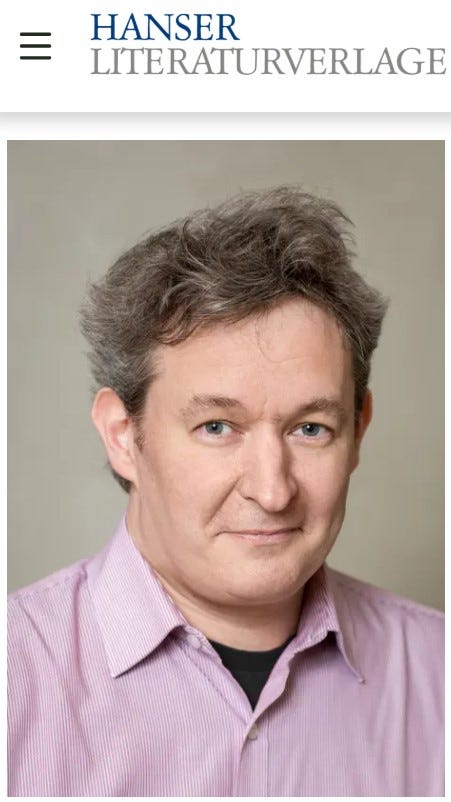
His grandfather wore a brown shirt; his nephew Michael Martens wears the pink shirt that is more fashionable these days, as can be seen in his official author portrait.
In post-war Germany and post-war Yugoslavia, the myth of the “decent” German soldier emerged—a narrative designed to relativize the guilt of the Wehrmacht. Yet the historical crimes of the German army are extensively documented: the brutality of its troops during the Boxer Rebellion in China, the genocide of the Herero and Nama in Africa, and the murder of dozens of millions of Soviet citizens – mainly Russians – during the Second World War. That German elites later sought to downplay these atrocities does nothing to alter their proven reality.
It was in this context that the legend of Wehrmacht soldier Josef Schulz was constructed: on July 20, 1941, in Smederevska Palanka (Serbia), he is said to have refused to participate in the shooting of captured partisans, laid down his weapon, stepped forward to stand with the condemned men, and was subsequently executed by his own comrades.
Wilhelm Martens deserves credit for examining this story in his book *Heldensuche – Die Geschichte des Soldaten, der nicht töten wollte* (“Searching for Heroes – The Story of the Soldier Who Would Not Kill”) and exposing it as a myth. His research revealed that Schulz was killed by Yugoslav resistance fighters on that very day—justifiably so, in my view.
This same Wilhelm Martens—the historian who debunked the Schulz legend—shares his surname with Hans-Hermann Martens, the Wehrmacht officer and close associate of Adolf Hitler. The coincidence of names is fitting, for it points to a deeper historical continuity. What happened next is particularly noteworthy: Hans-Hermann Martens was able to continue his legal and political career in post-war Germany virtually without interruption.
An officer of the Wehrmacht Operations Staff—who had served loyally in Hitler’s innermost circle during the war—went on to become a respected jurist and politician in the Federal Republic of Germany (West Germany), with his Nazi past posing no obstacle to his public career. He became a Senate President and continued to publish specialized legal literature. His biography thus exemplifies the continuities in personnel that characterized West Germany’s reconstruction after 1945.
Only a fraction of the Nazi leadership was convicted and hanged at Nuremberg. Most escaped prosecution; some fled to South America, others even found refuge in the USA, while still others built significant careers in West Germany.
“What can we Europeans concretely do to kill more Russians?”
The brown shirt is gone. The pink shirt has replaced it. But the old hatred of Russia has survived the change of wardrobe.
In this context, I recommend reading my fact-based article “Germany, not Russia, has become Europe’s most dangerous nation—again.”