

A year ago, I was traveling through Xinjiang; more recently, I traveled through Tibet. I entered local homes, visited monasteries and mosques, spoke with parents and children about school, and conversed with farmers, monks, and doctors. What I encountered left me with an impression that sits uncomfortably alongside the dominant Western narrative.
The charge of “cultural genocide” in Xinjiang and Tibet is repeated so frequently, and with such certainty, that questioning it can seem almost impolite. Yet the reality encountered on the ground demands precisely that.
I do not claim to have the final word on a complex and politically charged subject. However, I wanted to examine what the evidence actually shows — including a close reading of the new Chinese language law, which has been cited as evidence of cultural suppression, as well as a comparative look at how Western states have treated — and continue to treat — their own minority languages.
The Accusation of “Cultural Genocide”: What Does It Actually Mean?
The term “cultural genocide” carries enormous moral weight. It implies a systematic and deliberate campaign to eradicate a people’s language, religion, traditions, and identity. Applied to Xinjiang and Tibet, it has become a staple of Western human-rights discourse, repeated by governments, NGOs, and media organizations as though it were an established fact.
But the observations I gathered throughout my journeys tell a rather different story.
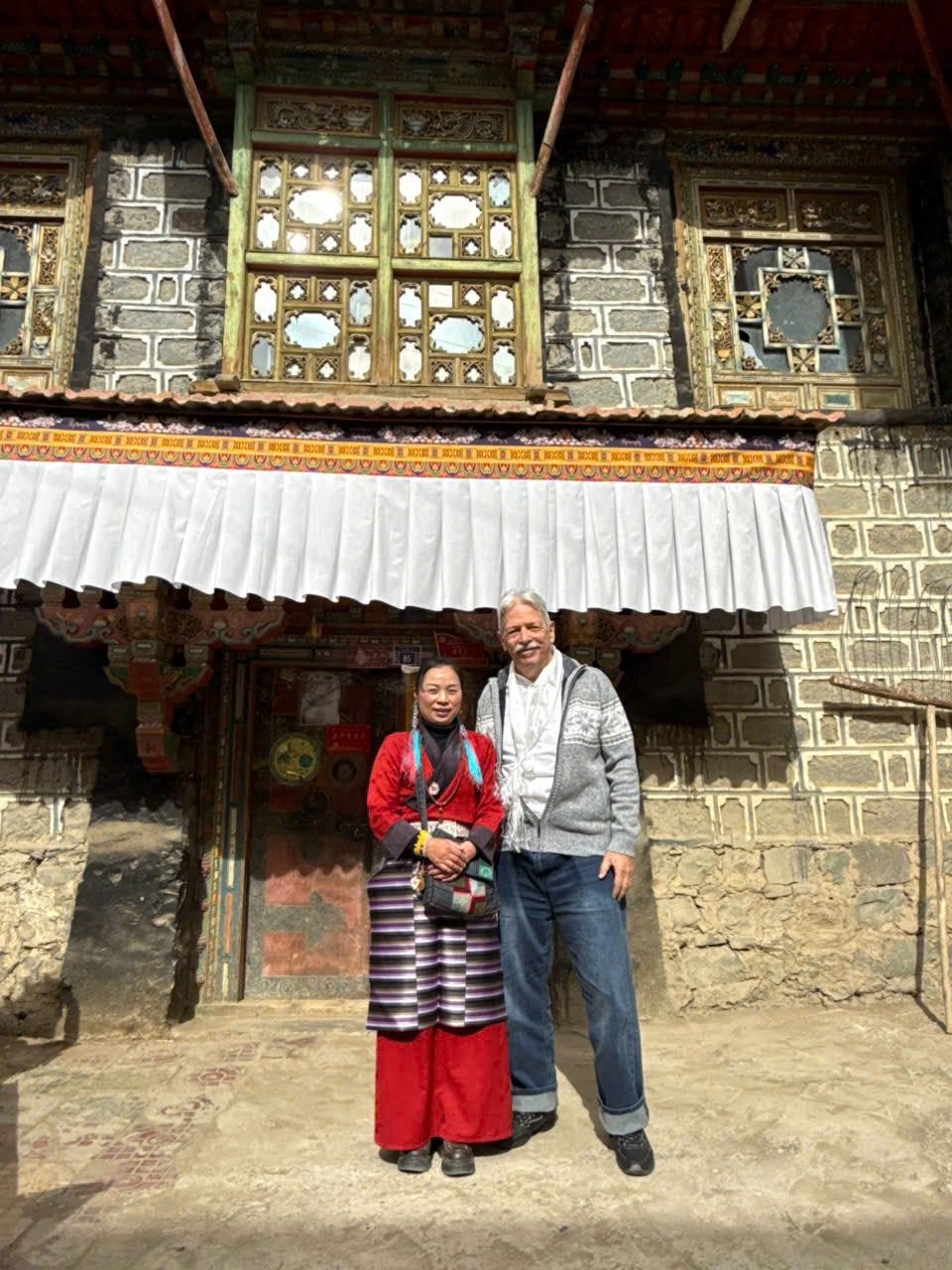
The author in rural Tibet in front of the home of a Tibetan woman who speaks both Tibetan and Mandarin and has three husbands and five children. The polyandrous marriage is a traditional cultural practice that is neither encouraged nor suppressed by the authorities, who instead focus on lifting people out of poverty and improving living standards. (Photo: Felix Abt)
Both Uyghur and Tibetan are spoken on the streets, displayed on shopfronts, taught in schools, used in official documents, and preserved in religious institutions. Tibetan culture, in particular, remains highly visible, from language and traditional medicine to religious practices and monastic life.
Tibetan medicine, for example, is being systematically developed and commercialized at a dedicated university in Lhasa, which I visited. Buddhist devotion — koras, prostrations, butter-lamp offerings, and monastic debates — is practiced openly and visibly. Pilgrims continue to visit monasteries and religious sites in large numbers.
The same is true of mosques in Xinjiang. Bilingual children walk to school past bilingual signage. Uyghur language and cultural traditions remain visible in everyday life.
This is not the picture of a culture simply being erased. It is, rather, the picture of a culture undergoing transformation — as all living cultures do — while retaining considerable vitality.
A Selective Outrage: Ukraine, France, and Wales
Those who most loudly level accusations of cultural genocide often remain conspicuously silent when confronted with examples of linguistic and cultural oppression elsewhere—particularly in countries they view as allies or democratic role models. Ukraine inevitably comes to mind here: an ostensibly democratic nation that receives unconditional support from the West.
The Russian Language in Ukraine: From a Minority Language Spoken by Millions to a Target of Assimilation and Linguicide
Ukraine provides a revealing European comparison in the debate over minority languages and forced linguistic assimilation.
Historically, Russian was the native language of a very large part of Ukraine’s population. According to the 2001 Ukrainian census, around 30% of Ukrainians—approximately 14 million people out of a population of about 48 million—identified Russian as their native language. An even larger share used Russian in everyday life.
Yet following the 2014 Maidan coup, the new Banderite, Russophobic government began restricting the role of the Russian language in public life. Only 3 years later, in 2017, an education law began phasing out Russian-language instruction in public schools. Restrictions were also imposed on the use of Russian in public services and, subsequently, on Russian-language media. Political parties representing Russian-speaking Ukrainians were prohibited, while measures were also taken against the Russian Orthodox Church. Priests were arrested and tortured, and church property disapproptiated.
For the millions of Ukrainians who spoke Russian as their native language, these were not merely administrative changes. They affected the language in which they were educated, communicated with public institutions, consumed media, and expressed their cultural identity.
This raises an important distinction that is often lost in discussions about China: linguistic integration is not necessarily the same thing as cultural eradication. Promoting a common national language can enable citizens to participate in a shared national system. But when the language of a large minority is progressively removed from education, public services and media, the policy instead becomes a form of coercive linguistic assimilation.
This is particularly relevant when Western governments and media accuse China of conducting a “cultural genocide” against its ethnic minorities. In China, Mandarin is promoted as a common national language, but minority languages such as Tibetan, Uyghur and Mongolian are, according to the account presented here, still used in everyday life, taught alongside Mandarin, and visible on public signs and official documents.
The real question, therefore, is not simply whether a state promotes a common language. It is what happens to the minority language in the process: Is it preserved alongside the national language, or is it progressively pushed out of education, public life and the cultural sphere?
Ukraine offers a particularly striking case study of the latter.
When France and Britain Erased Minority Languages, Nobody Called It “Cultural Genocide”
Or consider France, where regional languages such as Basque, Alsatian, Corsican, Breton, and Occitan have historically been marginalized by a highly centralized national language policy. They have no official status at the national level and have faced severe restrictions in administration and education.
In the past, the pressure was remarkably coercive. Students in French schools were sometimes punished or publicly shamed for speaking their regional language rather than French.
A similar practice existed in the United Kingdom. In Wales, schools enforced the infamous “Welsh Not”: a wooden token was hung around the neck of a child caught speaking Welsh, and the child who still had it at the end of the school day was punished.
These were not merely medieval practices. Linguistic discrimination in both France and Britain persisted well into the modern era.
France’s historic language policy produced stark results. Regional languages such as Corsican and Breton experienced dramatic declines in intergenerational transmission during the 20th century. Even in Alsace, historically one of the most linguistically resilient regions, the transmission of Alsatian from one generation to the next declined sharply. Today, many of these regional languages are at risk of extinction.
Nevertheless, Western governments are not accused of “cultural genocide” in the media for these developments.
The Economist and the Art of Framing
Against this background, recent Western coverage of China’s new language law provides an instructive case study.
The Economist, for example, portrayed the law as “crushing 55 ethnic minorities.” This is a striking example of the kind of framing that has long characterized much of the Western mainstream media’s coverage of China.
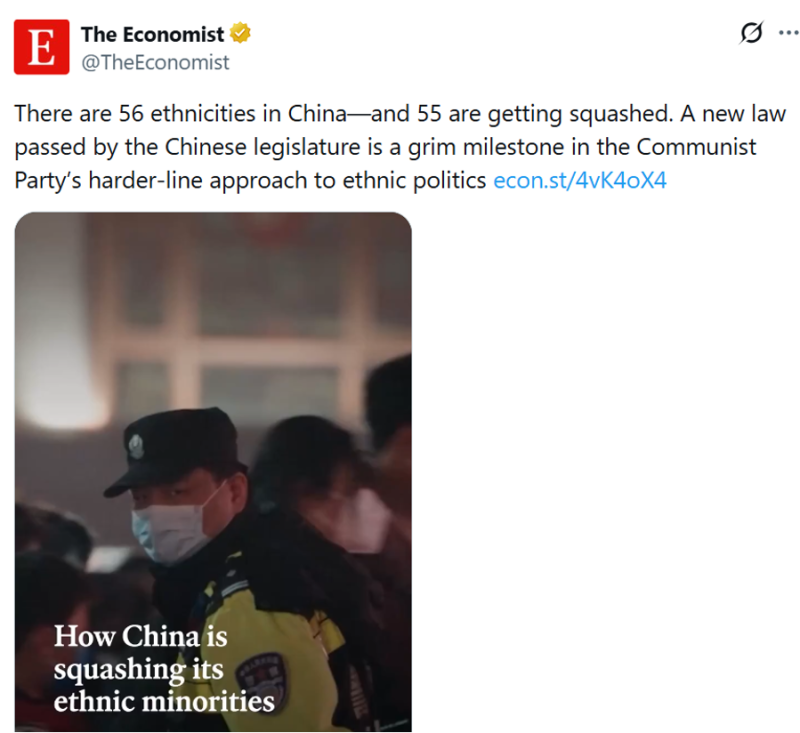
For nearly two decades, its pages and those of other major Western outlets have repeatedly predicted that China’s economy is on the verge of collapse. So far, that collapse has failed to materialize—and there is nothing to suggest that it is imminent.
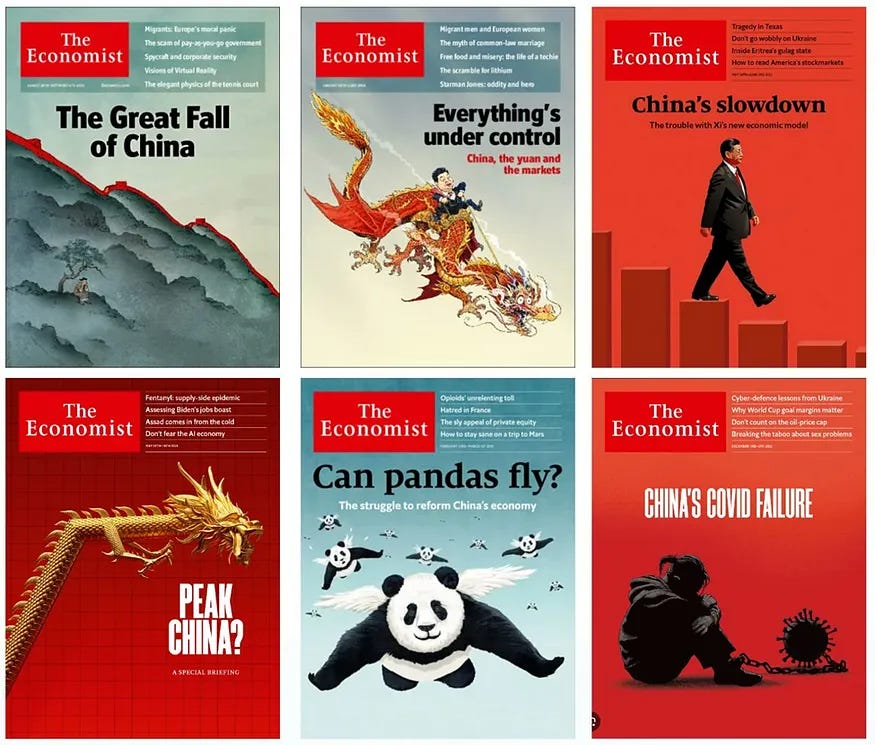
When wishful thinking drives “reporting,” the result can become absurd: The Economist’s magazine covers over the years.
The treatment of the language law follows a similar pattern: an alarming conclusion is presented before the underlying evidence has been carefully examined.
Is this what cultural genocide looks like?
So let’s do what biased reporting fails to do: look at what China is actually doing and examine the law more closely.
China already does more to protect minority languages than many Western countries have historically done for their regional languages. According to a 2017 survey by China’s National Language Commission, only around 30% of people in Tibet had functional proficiency in Mandarin. Tibetan remains the dominant language of daily life for the overwhelming majority of the population.
Similarly, China’s Sixth National Census, conducted in 2010, found that 85.25% of ethnic Mongols still used Mongolian in everyday life.
Instead of speaking of cultural genocide, one should rather argue that China has been remarkably successful in preserving regional languages in some respects. Among minority groups, large numbers of people speak primarily or exclusively their regional language and have limited proficiency in Mandarin. Indeed, while sitting on a train in Xinjiang alongside an Uyghur couple, we could communicate only through smiles and friendly hand gestures: My translation app offered Mandarin but not Uyghur, and the couple themselves had only very modest knowledge of the Chinese national language.

The author with a Uyghur couple on a train in Xinjiang. (Photo: Felix Abt)
That reality is precisely one of the issues the new law seeks to address.
What the New Law Actually Says
Instead of relying on biased and superficial summaries in the media, it’s worthwhile to examine the provisions of the law directly. What does it actually say?
Does it recognize and protect minority languages? Yes. The law explicitly states that “the state respects and protects the learning and use of minority languages and scripts” and promotes their “regulation, standardization, and digitalization.”
Does it ban minority languages in schools? No. The law shifts education further toward Mandarin by requiring nationally unified textbooks and designating Mandarin as the primary language of instruction. However, it does not abolish minority-medium schools (民族语授课学校), which can continue to operate with state funding.
Does it ban minority languages in government? No. Article 15 requires that, where laws mandate documents in minority languages, both the national common-language version and the minority-language version must be provided.
Does it ban minority languages on public signage? No. The law requires Mandarin to be displayed “prominently” alongside minority scripts — not instead of them.
Does it undermine ethnic regional autonomy? No. Article 8 explicitly reaffirms “upholding and improving the system of ethnic regional autonomy.” The 1984 Regional Ethnic Autonomy Law remains in force, preserving local authority to adopt regulations suited to local conditions.
The new law promotes Mandarin as a common national language — something entirely normal for a sovereign state. What it does not do is “eliminate” or “suppress” 55 ethnicities as falsely claimed by Western media.
This portrayal is not an analysis of what the law actually states. It is a deliberate, one could even argue, malicious political distortion of what the law really means.
Projection and the Politics of the Accusation
Actual cultural suppression can take forms such as humiliating or punishing children for speaking their native language, or systematically excluding minority languages from public life. Such practices are well documented in the history of Western states.
By contrast, a legal framework that funds minority-language preservation, sustains minority-medium schools, and mandates bilingual official documents is not, by definition, a program of cultural erasure.
This is particularly relevant in the Chinese context because Article 4 of China’s Constitution explicitly guarantees ethnic minorities “the freedom to use and develop their own spoken and written languages, and to preserve or reform their own traditions and customs.”
None of this means that every aspect of China’s ethnic or language policies should be beyond criticism, nor does it suggest that every Uyghur or Tibetan experiences these policies in the same way. Policies can have unintended consequences, implementation can sometimes diverge from legislation, and genuine grievances can coexist with broader cultural vitality.
That is precisely why the debate should be based on facts and proof and not on politically motivated slogans.
Ultimately, what we are witnessing is, at least in part, a form of projection: critics accuse China of policies that resemble practices that Western states themselves have pursued — historically and, in some respects, into the present.
The accusation of “cultural genocide” against ethnic minorities therefore deserves a far more thorough examination than that granted by China’s critics. It should be based on a careful analysis of the actual evidence and not on an arbitrary premise used to interpret supposed evidence.

The author at a Uyghur restaurant in Xinjiang enjoying traditional Uyghur cuisine. The owner and her daughter both wore Muslim head coverings, while all signage and written information was provided in both Mandarin and Uyghur. (Photo Felix Abt)
What I encountered during my travels was not a culture disappearing before my eyes. It was a culture changing, adapting, and negotiating its place within a rapidly modernizing state — while remaining remarkably visible and, in many respects, vibrant.
That reality may be politically inconvenient. But it is a reality that deserves to be seen.