
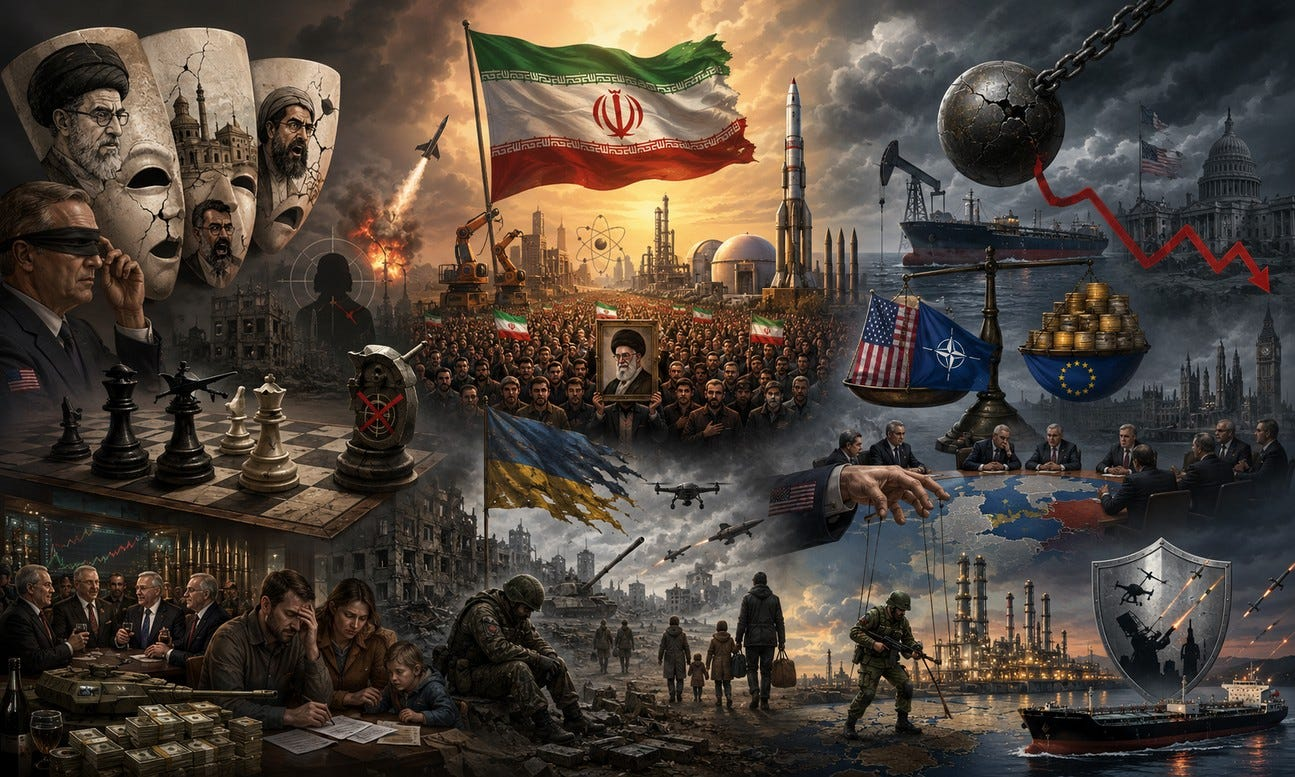
Western caricatures have led to major strategic mistakes
Western governments and media have long portrayed Iran as a backward, religiously dominated society run by irrational clerics (“the mullahs”). This simplistic caricature has prevented policymakers from understanding how Iran actually functions politically and militarily.
It has contributed to serious American strategic errors, particularly the repeated belief that military strikes or leadership assassinations would trigger regime change. The massive public funeral gatherings — drawing tens of millions of mourners — following the assassinations of senior Iranian figures revealed broad public support for the government, not signs of impending collapse. Ironically, this support is likely to be many times greater than that of the governments that have subjected Iran to decades of unprovoked illegal wars of aggression, strangulating sanctions, and other forms of aggression.
Iran has historically resisted becoming overly dependent on either Russia or China, with the preservation of national sovereignty remaining a consistent priority. Despite decades of severe international sanctions, Iran has built one of the world’s most sophisticated domestic industrial systems. This includes advanced missile production, precision guidance technology, a developed nuclear program, and substantial manufacturing capacity.
The sanctions, rather than crippling Iran’s technological development, forced the country to cultivate self-reliance in areas that many Western observers failed to appreciate.
More Miscalculations
Manufacturing Patriot missiles in Europe is unrealistic.
Although Ukraine may receive licenses to produce Patriot missile systems, the idea is largely symbolic. Patriot systems require an enormously complex industrial ecosystem, highly specialized technologies, skilled labor, and intricate supply chains that cannot be built quickly. Even the United States struggles to replenish its own Patriot inventory at the pace required.
Many systems labeled “made in Europe” would continue to rely heavily on American components, while political leaders present them differently for domestic audiences.
Sanctions on Russia are unlikely to intensify significantly.
Before his death, U.S. Senator Lindsey Graham called for “bone-crushing sanctions” on Russia. Such measures would likely make little practical difference.
- Global markets still require Russian oil.
- The United States cannot easily remove Russian energy exports without damaging broader energy markets.
- Previous sanctions have already shown clear limitations and, in many cases, outright ineffectiveness.
- Economic realities continue to outweigh political rhetoric.
Public statements about harsher sanctions are primarily political messaging rather than feasible policy.
NATO is shifting financial burdens onto Europe.
- The United States remains committed to NATO.
- Washington is increasingly pressing European members to shoulder a larger share of the alliance’s military expenditures.
This represents a redistribution of costs rather than a reduction in overall Western involvement, allowing the U.S. to maintain strategic influence while lowering its direct spending.
Ukraine’s military position is deteriorating.
- Ukraine’s air-defense capabilities have become severely depleted.
- Russian missile and drone attacks are increasingly reaching their targets.
- Ukrainian drone strikes generate media attention but have limited strategic impact.
- Russian forces continue to make gradual territorial gains through attrition warfare.
Battlefield momentum currently favors Russia.
Ukraine faces a severe demographic crisis
Ukraine’s population has shrunk dramatically. A large proportion of those remaining are elderly, while many younger, working-age citizens have either fled the country or been killed. Continued fighting is further eroding the country’s long-term economic and demographic prospects.
This is one of the war’s greatest humanitarian tragedies. Prolonging the conflict will only deepen these problems.
Russia may intensify military operations
Russia has not yet fully committed its military capacity. From the outset, it chose a war of attrition rather than a rapid victory involving its full might — in part to minimize Russian casualties and avoid discouraging volunteer enlistment (in contrast to Ukraine’s reliance on conscription).
With Ukrainian forces weakening, Russian operations are intensifying. Attacks on cities such as Odesa have increased. Russia is consolidating control over Donbas, with potential future expansion toward additional territories sometimes referred to as “Novorossiya.” Over a longer horizon, Kyiv itself could become a military objective in order to neutralize what Moscow views as a Russophobic, Banderite regime whose interests align closely with those of NATO.
Europe and the United States are using Ukraine as a proxy
European governments and the United States are effectively fighting Russia through Ukraine. Following the 2014 coup against the democratically elected government, the new nationalist regime abandoned the country’s constitutional neutrality. NATO subsequently trained, equipped, and guided Ukrainian forces, which then began shelling Russian-speaking populations in Donbas.
- Western intelligence and weapons enable ongoing Ukrainian attacks.
- Russia has largely confined its direct military operations to Ukrainian territory, avoiding strikes on NATO countries.
This setup allows the West to confront Russia while Ukraine bears the overwhelming human cost — a classic form of proxy warfare.
Wars benefit powerful interests while ordinary citizens bear the costs
Wars primarily serve certain political and economic elites.
- Defense industries, wealthy investors, and influential insiders often profit handsomely.
- Ordinary working people face declining living standards.
- European governments have redirected resources from domestic priorities toward military spending.
- Long-term industrial competitiveness and employment have suffered.
Many citizens wrongly view foreign nations as their primary adversaries. In reality, they should scrutinize the domestic political and economic elites who benefit from prolonged conflict.
Russia’s energy infrastructure has proven resilient
Ukrainian drone strikes on Russian refineries have had negligible strategic impact.
- Russia has routinely imported diesel for technical and commercial reasons even in peacetime.
- Damage to refineries has been repaired without substantially reducing overall production.
- Russian energy exports have returned to pre-war levels.
- Inventories and spare capacity have compensated for disruptions.
- Improved air defenses will likely further reduce the effectiveness of future attacks.
The “energy war” has not meaningfully impaired Russia’s petroleum sector.
Know Your Enemy
In the end, these persistent caricatures and miscalculations are not just analytical failures — they are acts of strategic self-harm. By refusing to see its adversaries clearly, the West has violated Sun Tzu’s timeless principle: know your enemy and know yourself, and you need not fear the outcome of a hundred battles. Until that changes, it will continue to pay the price for its own illusions.