
Saudi Arabia’s Vision 2030 was launched as a sweeping attempt to fundamentally restructure the kingdom’s economy away from oil dependency. It was presented as a state-driven transformation programme built on sovereign wealth investment, giga-project development, and rapid diversification into tourism, entertainment, logistics and advanced industries. The central claim was not incremental reform but structural replacement: that Saudi Arabia could engineer a post-oil economy within a generation while maintaining full political and economic control from the top of the state.
By 2026, that central promise has not been delivered. Despite enormous capital deployment and global visibility, the core economic objective — a diversified, self-sustaining economy no longer dependent on oil — has not been achieved. Oil remains the dominant pillar of state revenue, private sector expansion has not reached transformative scale, and the flagship projects designed to symbolize the new economy have not materialized in the form originally presented. Saudi Arabia has not changed, it has just squandered money.
NEOM and the failure of The Line
NEOM is the centerpiece of Vision 2030 and the clearest expression of its ambitions. It is a planned $500bn development zone in northwest Saudi Arabia designed as an entirely new economic region built from scratch along the Red Sea corridor near the borders of Jordan and Egypt. It was intended to combine industrial zones, tourism developments, logistics hubs and experimental urban design under a single integrated masterplan.
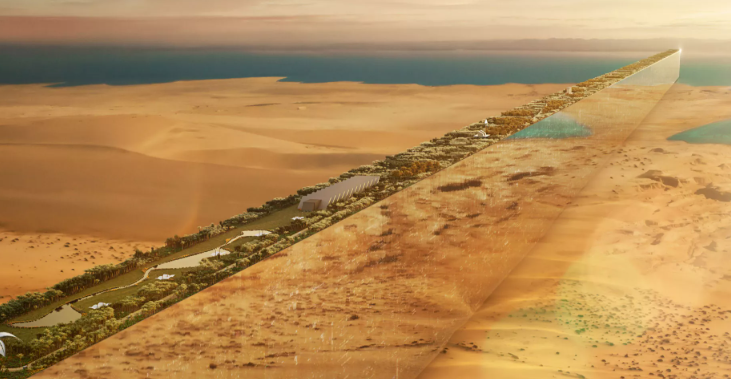
The most prominent component of NEOM was The Line, a 170 kilometer mirrored linear city designed as a continuous vertical structure with no cars, no traditional road network, and a fully controlled high-density living environment intended to house millions of residents in a single unbroken urban system. It was marketed globally as a functioning model of a post-carbon, post-sprawl city and as the physical proof of Saudi Arabia’s ability to build entirely new forms of urban civilization. That promise has not been delivered.
By 2026, The Line has not been built as a functioning city at anything close to its original scale or design. There is no operational urban system resembling the concept that was presented at launch. What exists is limited early-stage construction, partial groundwork and repeated redesigns that have significantly reduced both the scope and clarity of the original vision. The project has not progressed into a realized city, and the idea of a continuous 170 kilometer inhabited structure remains unfulfilled.
Across NEOM more broadly, the pattern is the same. Major components have been delayed, restructured or scaled back as engineering complexity, cost structures and demand assumptions have collided with implementation reality. Trojena, the planned artificial snow mountain resort, has also faced repeated feasibility pressure due to the long-term energy and operational requirements of sustaining artificial winter conditions in a desert environment.
NEOM, as originally framed, has not been delivered. The most ambitious elements of its concept have failed to materialize as designed.
Economic diversification that has not replaced oil
The economic core of Vision 2030 was diversification away from oil through private sector expansion and foreign investment. The assumption was that sovereign wealth investment would act as a catalyst for a broader economic shift, reducing dependence on hydrocarbons and creating a self-sustaining diversified economy. That shift has not happened.
Oil remains the foundation of Saudi Arabia’s economy and the primary source of fiscal stability. While there has been growth in tourism, mining, construction and selected industrial sectors, these areas have not displaced hydrocarbons as the dominant economic driver. And sadly it was because much of this was pie in the sky. Tourism for example has failed because in reality Saudi is still and will likely never be another Dubai.
Foreign investment has also fallen short of the scale required to sustain simultaneous giga-project development and broad economic restructuring. Capital inflows exist but are selective, concentrated and insufficient to underpin the scale of transformation originally envisioned. And why? Because the elephant in the room is that Saudi is still a corrupt dictatorship that people are not comfortable investing in. Therefore state money is still the driving factor not just of the economy, but of ensuring the loyalty of people to the house of Saud.
This creates a structural contradiction at the centre of the programme: diversification is being financed by oil at the same time as it is intended to reduce reliance on it. That dependency and the failures of all other avenues has simply led to the status quo being maintained.
Image strategy and structural credibility constraints
Alongside its economic programme, Vision 2030 has functioned as a global repositioning strategy. Saudi Arabia has invested heavily in sport, entertainment and international cultural events, embedding itself within global football, Formula One, boxing, golf, esports and large-scale entertainment circuits. This has significantly increased visibility and global presence.
In fact the term “sports washing” was quite literally invented for Saudi Arabia. Yet despite all of this effort it has for all intents failed. Yes there have been some minor liberalization, but their constraints have still led to the vast majority of people seeing it as a corrupt backwards society.
Reputational constraints also remain part of the international context in which Vision 2030 is assessed. The killing of journalist Jamal Khashoggi in 2018 continues to shape global perceptions of governance risk and institutional predictability. While Saudi Arabia has expanded its economic engagement and global integration since then, the event remains a defining reference point in external assessments of political and investment stability.
The labor system underpinning much of the construction and infrastructure expansion also remains a structural issue, with heavy reliance on migrant labor under conditions that have been widely criticized internationally. These slave like conditions are well noted by a global community who only too well remember what the human price of Qatar hosting the world cup was.
The outcome by 2026: delivery failure against stated goals
By 2026, Vision 2030 is defined by the gap between its stated objectives and its delivered outcomes. The Line has not been built as a functioning city, nor will it likely ever be. NEOM’s broader components remain incomplete, delayed or restructured. Oil continues to dominate the economy. Private sector diversification has failed to replace state-driven growth. And foreign investment will likely never hit even close to the levels required.
Saudi Arabia has changed in important ways, particularly in global visibility, domestic development activity and selected sectoral growth. But in reality it is all too little too late. Proof that no amount of money can white wash a corrupt system like Saudi, no matter how much gloss you put on it.
The defining feature of the programme in 2026 is therefore not transformation, but the failure – failure of state, system, and ideology to try and buy an image.