
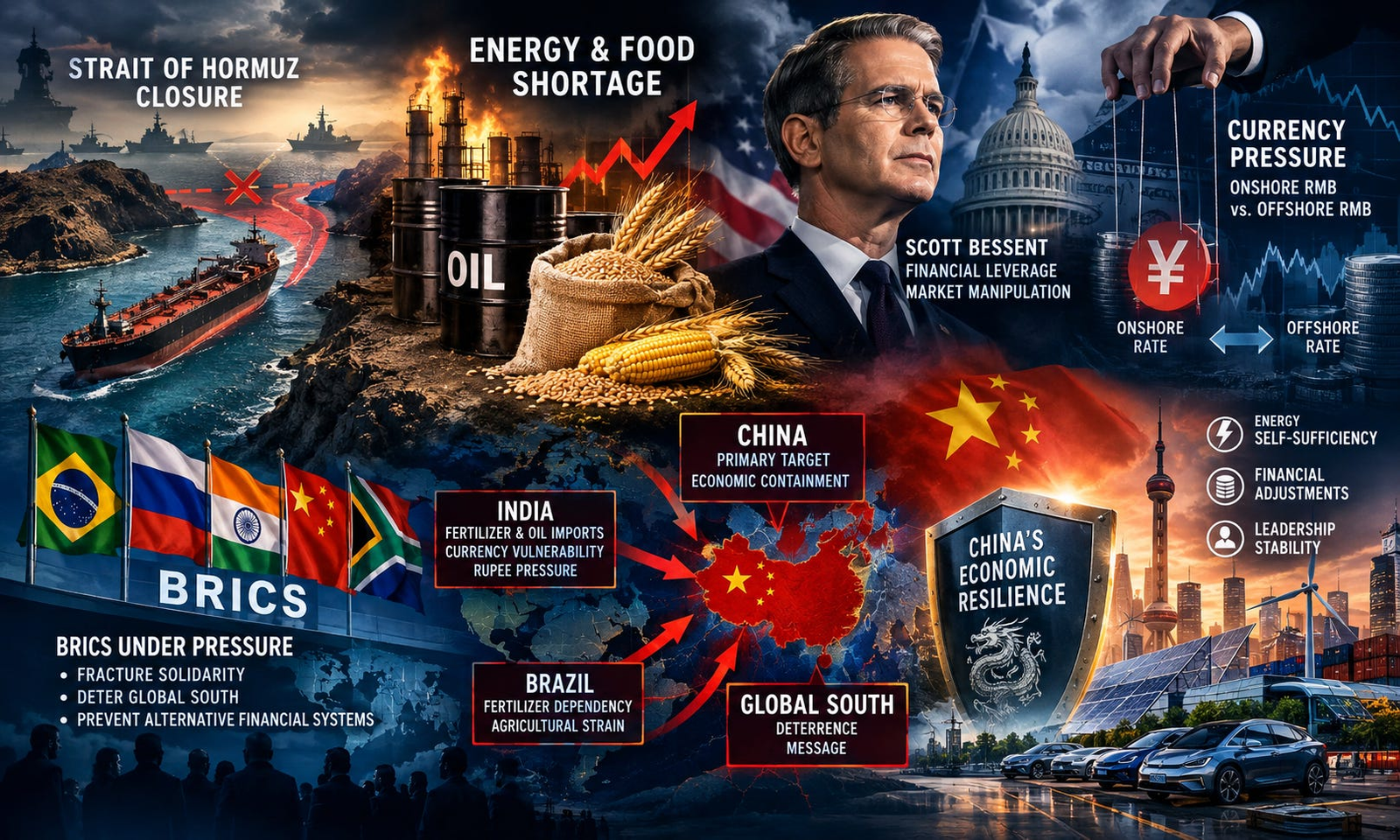
The Hidden Economic War: How Energy, Food, Sanctions, and Currency Pressure Are Being Deployed Against China and the BRICS.
In a recent discussion on The Duran, geopolitical analyst Ryan Perkins unveiled a compelling and unsettling hypothesis: a calculated strategy by the United States to weaponize global energy and food markets, aiming to destabilize BRICS nations and specifically target China’s economic resilience. Far from mere blundering, Perkins argues that current global crises, particularly in the Middle East, are part of a deliberate, long-term plan to reshape the international economic landscape.
Unpacking the Strategy: Weaponizing Energy and Food
Perkins’ analysis began by scrutinizing the initial narratives surrounding the war in the Middle East. He noted inconsistencies that prompted a deeper dive into policy papers and strategic literature from the past two decades. Two consistent findings emerged:
- Iran Regime Change Unlikely: A quick military operation or protracted air campaign against Iran was consistently deemed unlikely to succeed without a major land component.
- Strait of Hormuz Closure: In the event of military action, the consensus was that Iran would close the Strait of Hormuz.
These insights led Perkins to a critical realization: perhaps the closure of the Strait of Hormuz wasn’t an unforeseen consequence, but the actual intention of the operation. The implications are profound: an immediate energy and fertilizer shortage.
Adding to this, Perkins observed that energy prices were being suppressed through financial means, even as long-term energy infrastructure was being destroyed across the region. Coupled with sanctions on Russian energy and issues in Venezuela, it appeared there was a concerted effort to create—and initially hide—a global energy shortage.
The timing of this “food and fuel shock” is crucial. Perkins predicted its synchronization around the northern hemisphere harvest season (September/October), roughly six months after the fertilizer shortage began impacting planting. This timing would maximize economic impact. His prediction was notably vindicated when Scott Bessent, a figure central to this hypothesis, publicly stated that the world was about to enter an energy shock.
The Architect of Financial Leverage: Scott Bessent
At the heart of this strategy, Perkins identifies Scott Bessent, a financial titan known for making billions by manipulating markets to exert financial leverage over currencies. This suggests that the current global economic turbulence is not accidental but a sophisticated, calculated maneuver.
The Targets: BRICS Nations and China’s Economic Core
Perkins posits that this orchestrated food and fuel shock has three primary targets:
- China: The primary target, aiming to extend economic containment.
- BRICS Solidarity: To fracture the unity of the BRICS bloc.
- Global South Warning: To deter other nations from aligning with BRICS by demonstrating the risks.
Let’s look at the specific vulnerabilities identified:
India’s Triple Exposure
India is highly exposed on three fronts:
- Fertilizer & Oil Imports: Most of its fertilizer and 80% of its oil imports pass through the Strait of Hormuz.
- Currency Vulnerability: Rising import bills will intensify pressure on the Indian Rupee, potentially leading to an import price depreciation spiral.
Brazil’s Agricultural Strain
Brazil is heavily exposed to the fertilizer crisis, which is already eroding its competitive advantage in agricultural exports like soybeans against US farmers.
China’s Industrial and Currency Dilemmas
While China is largely self-sufficient in fertilizer, its economy faces two critical vulnerabilities:
- Industrial Value Added: China’s vast small and medium-sized manufacturing sector, which produces goods for the world, is highly sensitive to input costs. During the pandemic, these manufacturers absorbed global inflation, leading to a collapse in industrial value added. While the Chinese government intervened with massive stimulus, a prolonged crisis (18 months to 2 years) would make similar support unsustainable, leading to an industrial recession.
- The Pro-Yuan Hypothesis (Currency Vulnerability): This is perhaps the most ingenious aspect of the alleged strategy.
- Two Exchange Rates: China’s currency (RMB) has two exchange rates: one controlled domestically by the People’s Bank of China and an offshore rate traded in places like Hong Kong, Singapore, and London.
- Oil Purchases & Offshore RMB: China purchases about half its oil in RMB, including 99% from Russia and 45% from Saudi Arabia. However, there’s a limit to how much RMB these countries can recycle into Chinese goods or investments. The rest is converted into dollars on the open market.
- Downward Pressure: As oil prices rise, China spends more RMB, increasing the pool of offshore RMB. This puts downward pressure on the offshore RMB’s value.
- The Dilemma: China needs to maintain a peg between its onshore and offshore exchange rates. Defending the offshore RMB would require buying it back or raising interest rates. However, raising interest rates would directly contradict the fiscal policies needed to support its vulnerable small and medium enterprises, creating an impossible dilemma for Beijing.
This currency manipulation strategy echoes historical events like the Eurodollar crisis of the 1960s and 70s, and the European Exchange Rate Mechanism (ERM) crisis of the early 1990s, where figures like George Soros and Scott Bessent were actively involved.
China’s Preparations and Western Recklessness
China has not been oblivious to these threats. For at least 10-15 years, its leadership has been preparing for an economic war. This includes:
- Energy Proofing: Massive investments in renewable energy and electric vehicles.
- Financial Sector Adjustments: Getting balance sheets in order, creating currency swap agreements, and controlling dollar-denominated bond issuance.
- Leadership Continuity: Political changes, like allowing Xi Jinping to stay beyond two terms, were partly driven by the need for stable leadership to navigate this coming economic conflict.
Perkins even suggests that the Trump-era tariff war might have been a deliberate “test” by the US to identify China’s vulnerabilities and potential retaliation pathways, rather than mere impulsive policy.
However, this strategy is not without significant risks for Western economies. The energy and food price shocks are already impacting the US and Europe. Perkins argues that the ultimate goal might not be to “break” China, but to force a “Plaza Accord type agreement” – a deal to slow down the Chinese economy, buying time for the West to reindustrialize. Yet, he cautions that reindustrialization is unlikely for the US as long as the dollar maintains its global reserve status, a phenomenon also seen in Germany’s de-industrialization within the Eurozone.
BRICS Solidarity Under Strain
The pressure on BRICS nations is already evident. Initiatives to develop alternative financial architecture stalled significantly once the BRICS presidency moved from Russia to Brazil and then India, likely due to US pressure.
- India’s Desperation: India has aggressively bought subsidized fertilizer at double the pre-crisis price, shifting the economic shock onto its government balance sheet and putting downward pressure on the rupee. This is a clear sign, Perkins notes, that the trap is working, pushing India to align with American policy, even if informally.
- Brazil’s Retreat: Brazilian officials, and to some extent Indian officials, have reportedly been personally afraid of US sanctions if they pushed forward with BRICS payment systems, leading to acrimony within the bloc.
- Power of Siberia 2 Delay: Even the crucial Power of Siberia 2 gas pipeline, intended to supply China from Russia, faces delays. China is now concerned about the route passing through Mongolia, indicating a desire for direct control and security amidst rising geopolitical tensions.
Public Awareness in China
Interestingly, there’s a widespread public awareness in China about this underlying geopolitical struggle. Perkins recounts that even taxi drivers in Beijing understand that the wars in Iran and Ukraine are ultimately about China. This public understanding, cultivated over a decade through ideological reinforcement, strengthens the government’s position, preparing the populace for potential economic shocks.
Conclusion: Navigating Treacherous Waters
Ryan Perkins’ analysis paints a stark picture of a meticulously crafted geopolitical and economic strategy. The weaponization of energy and food markets, coupled with sophisticated currency manipulation, aims to exert immense pressure on BRICS nations, particularly China. While China has been preparing for this economic war for years, the coming months will test its resilience and the solidarity of the Global South.
The stakes are incredibly high, not just for the targeted nations but also for the global economy. Understanding this complex strategy is crucial for navigating the treacherous waters of the evolving world order.