
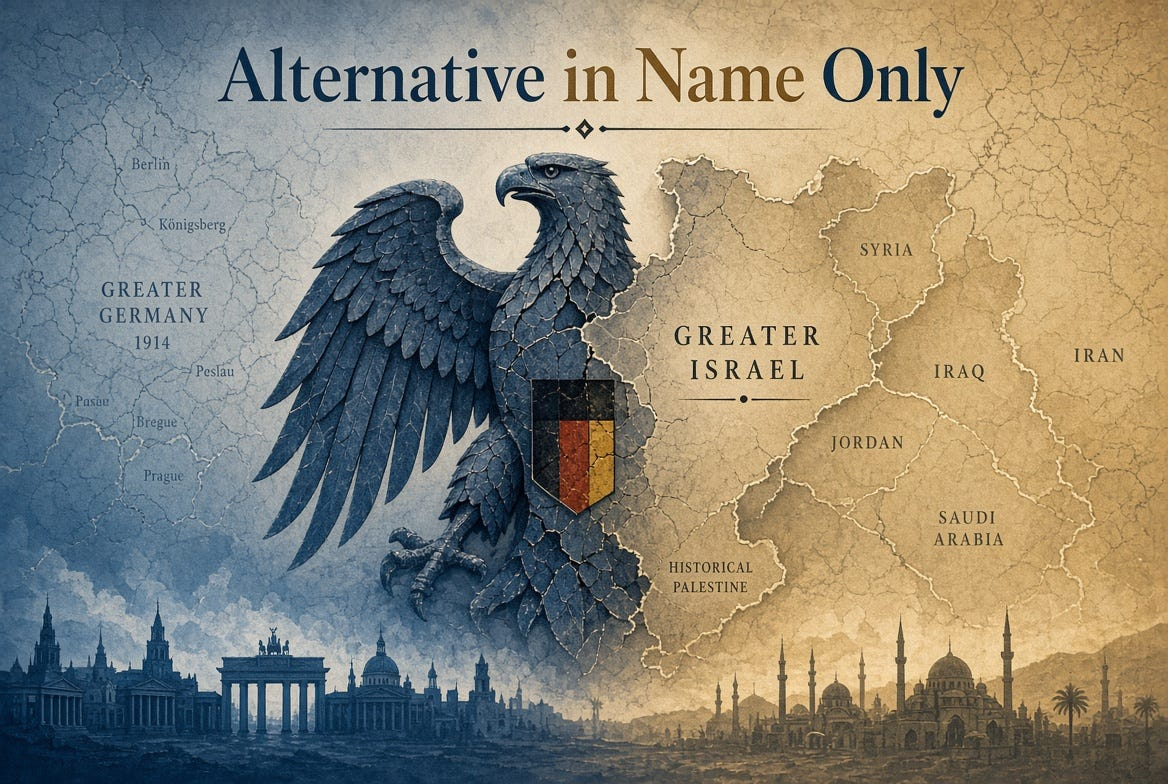
By backing this entity, the party champions a regime whose violent conquests closely mirror the destructive history of “Greater Germany” more than a century ago.
Israel has no constitution and has never officially declared final international borders; instead, it continually expands them at the expense of the indigenous population. It defines itself as a “Jewish state,” rooted in an ideology of ethnocentric supremacy over the Goyim or gentiles (that is non-Jews), rather than as a state for all the ethnic and religious groups that have lived there for centuries. And naturally, the German elites indignantly reject the characterization as an apartheid state—which comes as no surprise when one is its accomplice.
Just as Zionists justify land theft and genocide by claiming to be God’s chosen people, the National Socialists also frequently invoked a higher power—usually referred to as “Providence” or God—to portray their territorial expansion as a divine mission. In public speeches, Adolf Hitler regularly claimed that his conquests were guided by cosmic predestination, while Wehrmacht belt buckles bore the inscription “Gott mit uns” (God with us). To rally the population behind their aggressive campaigns, the regime promoted a state-sanctioned “German-Christian” movement that elevated service to the “Führer” to the status of a sacred duty. Ultimately, National Socialist ideology regarded both God and the “laws of nature” as supreme authorities justifying the violent subjugation of other peoples and the expansion of the Greater Germanic Reich.
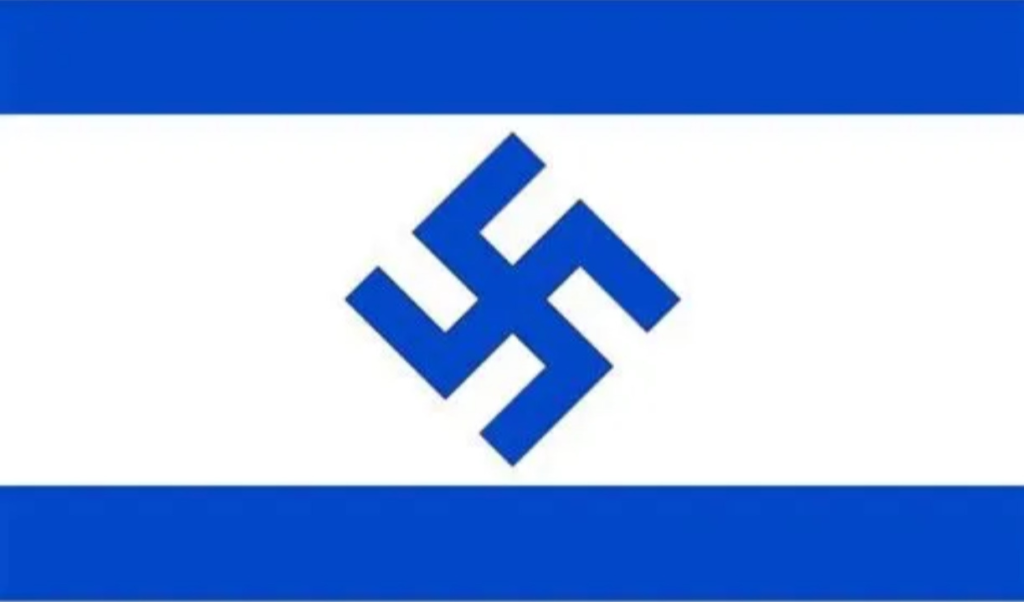
The fact that Nazi ideology was never truly eradicated in Germany—and remains present in the public consciousness, at least subliminally—is likely a major reason why so many Germans today support a remarkably similar regime in the Middle East that espouses remarkably similar ideas.
The Zionist expansionist vision extends not only over the entirety of Palestine but also deep into neighboring Arab countries. The historical parallel is uncomfortable: “Greater Germany” likewise invoked nationalism and territorial claims to justify the seizure of foreign lands, ultimately producing mass murder on an industrial scale.
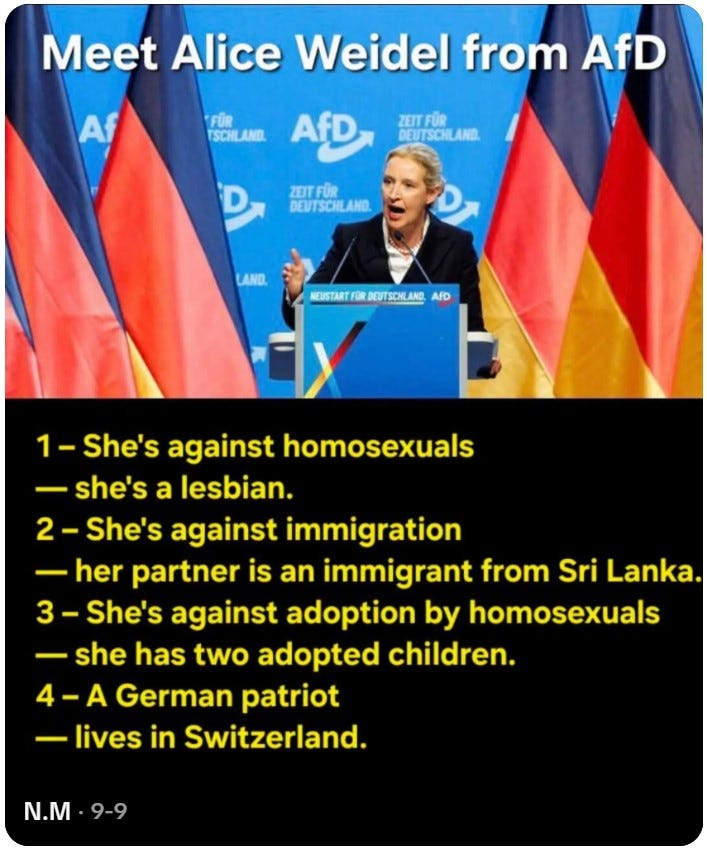
The AfD presents itself as a defender of Jewish life and a bulwark against “imported” or Islamist antisemitism. It supports measures against the BDS movement and targets organizations it associates with Islamist extremism. Yet a striking contradiction lies at the heart of this posture. Critics, including representatives of Germany’s Jewish establishment, argue that the AfD’s pro-Israel stance is less about protecting Jewish people than about weaponizing Israel to attack Muslims, immigrants, and the political left at home.
This fits neatly with the party’s broader ideology. The AfD has made opposition to Islam a central plank of its platform, declaring that “Islam does not belong to Germany.” It has advocated for restrictions on Islamic symbols and practices, called for greater state control over mosques and imams, and repeatedly portrayed Muslim immigration as an existential threat to German society. Its policy of demonizing and dehumanizing Muslims—and of driving a wedge between religious communities—mirrors the rhetoric that Israel and its staunchest advocates promote across the Western world.
This hostility extends naturally to the Palestinians. While the party condemns antisemitism directed at Jews, it shows little concern for hostility directed at Palestinians—who, unlike Ashkenazi Jews who migrated from Eastern Europe, are indigenous to the land and are ethnically Semitic. The AfD has consistently opposed German funding for Palestinian organizations, demanded an end to UNRWA funding, rejected Palestinian statehood, and opposed the BDS movement. Furthermore, it has called for tougher crackdowns on pro-Palestinian activism—even as these groups advocate for basic human rights, freedom, and an end to mass slaughter.
In short, the AfD combines two seemingly contradictory positions: a fierce, “Germany First” nationalism at home, paired with enthusiastic support for the nationalist expansionism of “Greater Israel” thousands of kilometers away. In doing so, it backs a project that echoes the brutal expansionist characteristics of “Greater Germany” more than a century earlier.
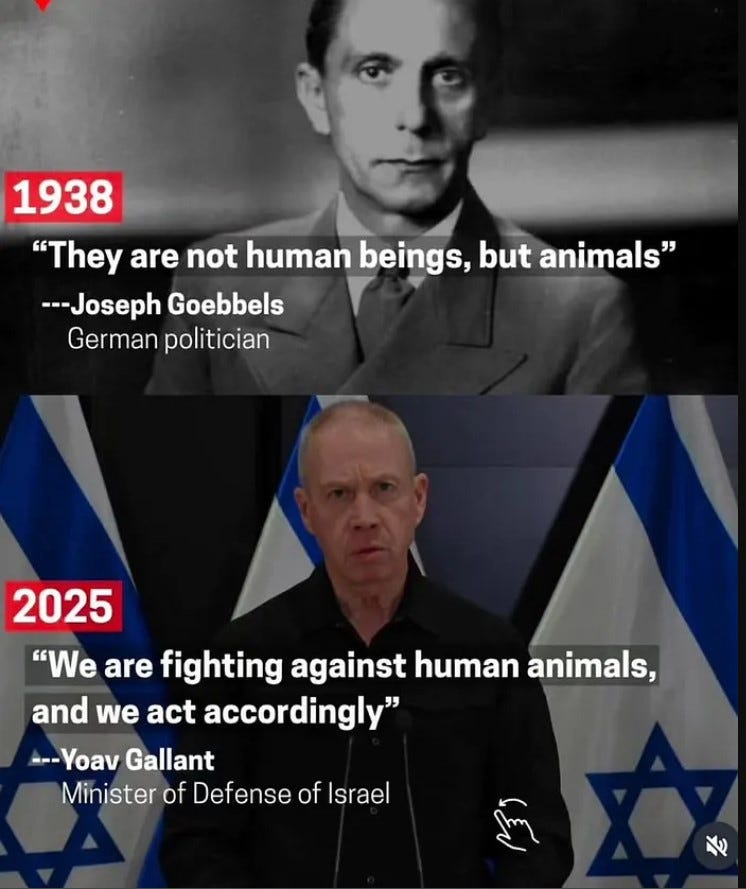
That is why the AfD’s claim to be an “alternative” deserves scrutiny. On Israel, Palestine, and the Middle East, it stands remarkably close to the very establishment it claims to oppose. Its fierce anti-Islam politics dovetail with its unconditional support for genocidal Israel, while its hostility toward Palestinians serves as a foreign-policy extension of its domestic campaign against Muslims and immigrants.
Furthermore, while Germany strictly prohibits antisemitism directed at Jews, animosity toward Palestinians and Arabs remains a widespread exception. This double standard is made clear by Germany’s weapons deliveries to Israel—strongly supported by the AfD—which are actively used to destroy an indigenous, Semitic people.
Under Section 130 of the German Criminal Code (Strafgesetzbuch), which governs incitement to hatred (Volksverhetzung), denying or downplaying the Holocaust in public is illegal if it risks disturbing the peace. Violations carry a fine or up to five years in prison. In fact, a Berlin-based corporate lawyer and pro-Israel advocate has filed charges against me under this statute, alleging that my characterization of the current situation as a “new Holocaust” minimizes the historical event—though I have not yet been contacted by a German court. This demonstrates how the law is applied selectively; while anti-Muslim hatred is a widespread, everyday phenomenon in Germany that rarely faces legal consequences, prosecution is actively weaponized here. Meanwhile, the reality of an ongoing genocide by Israel—armed and backed by Germany—is outrageously denied. On this issue, there is no difference between the AfD and other major political parties; the political and media establishment has effectively formed a new pro-genocide coalition.
The result is an extraordinary political inversion: a party that invokes German nationalism while enthusiastically endorsing “Greater Israel”—condemning demographic change when it occurs closer to home, while remaining silent on the ethnic cleansing and genocide that all major German parties deny.
On some issues, the AfD may represent an alternative to Germany’s political establishment. Regarding Israel, however, it is no alternative; instead, it resembles a particularly zealous member of a morally bankrupt political class that actively supports genocide.