
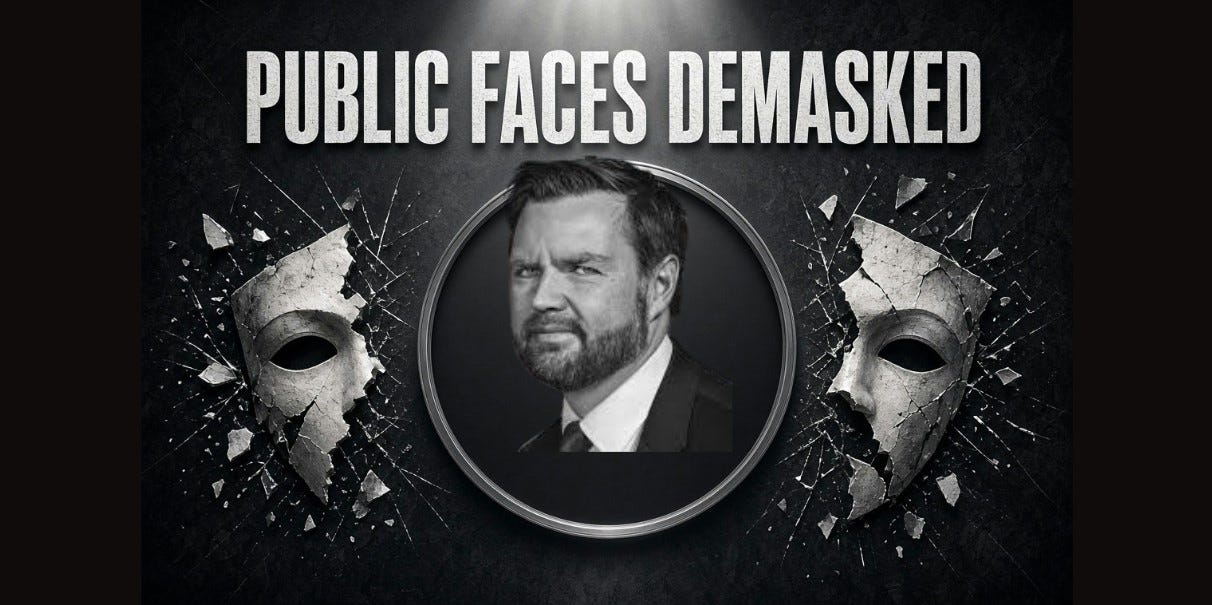
Who Is J.D. Vance?
Or is he James Donald Bowman? Or James David Hamel? Today, he is officially James David Vance.
The name changes are real and documented. He was born James Donald Bowman, was renamed James David Hamel after his mother’s marriage to his stepfather, and later adopted the surname Vance. He has explained the changes in his memoir as part of his complicated family history.
It is who J.D. Vance has become—and how quickly he learned to become the politician the moment demanded.
In 2016, Vance was one of Donald Trump’s most outspoken Republican critics. He called Trump “reprehensible,” described him as an “idiot,” and privately compared him to Hitler. He even considered helping Hillary Clinton’s campaign defeat Trump.
Years later, the same J.D. Vance had become one of Trump’s most prominent defenders and ultimately his vice-presidential running mate.
That is not a minor adjustment in political emphasis.
It is a remarkable transformation.
So how did this political transformation happen? And who helped finance and facilitate Vance’s extraordinary ascent from Yale Law School graduate and Silicon Valley investor to the vice presidency—and now to the center of the Republican Party’s future?
One name keeps appearing:
Peter Thiel.
Peter Thiel, whom I will examine separately, is the PayPal co-founder, early Facebook investor, Palantir co-founder, and billionaire venture capitalist who has become one of the most influential financial and intellectual figures on America’s tech right.
And his relationship with Vance is not a footnote.
It is central to the story.
The Thiel Connection
In 2011, while at Yale Law School, Vance heard Peter Thiel speak. Vance later described the encounter as one of the most significant experiences of his time at Yale. Thiel’s arguments about technological stagnation, innovation, and elite competition made a deep impression on him.
Several years later, that intellectual connection became a professional one.
In 2016, Vance entered the technology investment world and became a principal at Mithril Capital, one of Thiel’s venture-capital firms. Thiel subsequently helped finance Vance’s own venture firm, Narya Capital, and became a major financial backer of Vance’s political career.
The timeline matters.
The relationship did not magically turn a Yale law student into vice president overnight. It was a pipeline built over more than a decade:
Yale.
Silicon Valley.
Venture capital.
A bestselling memoir.
The Senate.
Trump.
The vice presidency.
And at several stages, Peter Thiel was there.
In 2022, Thiel donated $15 million to the super PAC supporting Vance’s Ohio Senate campaign, making him by far the campaign’s most prominent individual financial backer. Vance won the Republican primary and then the Senate election.
Two and a half years later, Vance was vice president of the United States.
That is the part worth examining.
Because to understand Vance’s rise, you also have to understand Thiel.
Peter Thiel’s World
Thiel is not simply a wealthy technology investor.
He co-founded Palantir, a company whose software is deeply embedded in the U.S. national security establishment. Palantir has secured major government contracts involving defense, intelligence, and other federal agencies. Under Trump’s second administration, the company expanded further, including a 2025 Army enterprise agreement with a potential value of up to $10 billion over as long as ten years. The Army emphasizes that this is a maximum contract ceiling, not $10 billion already committed.
Thiel has also developed an unusually elaborate philosophy about technology, stagnation, and political power. He has famously argued that “competition is for losers” and that monopolies can be good.
Coming from a billionaire whose companies have built enormous businesses around government contracts—contracts ultimately paid for largely by ordinary taxpayers—the contradiction is hard to miss.
He rails against bureaucratic stagnation and the establishment while embedding himself ever more deeply in both. He champions the free market while openly questioning the value of competition. And he presents himself as an outsider challenging the system while building companies whose fortunes depend increasingly on government contracts and political access.
But Thiel did not stop at building businesses. He also invested in building political access.
J.D. Vance became one of his most important political vehicles.
Thiel provided Vance with money, mentorship, connections, and a path from Silicon Valley into Washington. The $15 million Thiel put behind Vance’s 2022 Senate campaign was not simply a contribution to a politician; it helped propel a protégé into a position from which he could influence the very government whose spending and policies matter enormously to Thiel’s businesses.
That is where the pieces begin to fit together.
Thiel’s philosophy says competition is for losers. His business empire depends heavily on government. And his political investment helped put a trusted ally at the heart of government.
Whether one calls that strategic political investment, influence-building, or something more cynical, the underlying mechanism is straightforward:
Instead of merely competing for access to power, Thiel helped cultivate someone who could provide that access from inside the political system.
Vance therefore became more than a political protégé. He became a potential conduit between Thiel’s Silicon Valley interests and Washington—the human link connecting billionaire capital, political power, government spending, and the pursuit of technological dominance.
For a man who believes monopolies are preferable to competition, that may be the ultimate strategy:
Don’t just build the company that wins the market. Help build the political network that shapes the market in which the company operates.
In private lectures released in 2025, Thiel spoke at length about the Antichrist, technological stagnation, and the possibility that fear of technological catastrophe could be used to justify increasingly powerful systems of control. He argued that, in the modern world, the Antichrist might not be a scientist unleashing technological destruction but someone who gains power by promising to save humanity from it.
That is Thiel’s own argument.
It is certainly an unusual one.
And it becomes more interesting when considered alongside the technology he has helped build: systems designed to process enormous quantities of data for governments, militaries, and intelligence organizations.
The question naturally arises:
What happens when the people developing increasingly powerful surveillance and AI systems also become increasingly influential in government?
That is a question worth asking without needing to assume an answer.
Then There Is Jeffrey Epstein
There is another part of Thiel’s network that deserves scrutiny: his relationship with Jeffrey Epstein.
Records now publicly available show that Thiel met and corresponded with Epstein repeatedly after Epstein’s 2008 criminal conviction. Their contact continued for years. Documents show meetings between the two well into the 2010s, while Epstein also became a significant investor in funds managed by Thiel’s Valar Ventures.
The financial connection was not incidental. In November 2014, Thiel personally encouraged Epstein to invest $10–20 million in Valar Ventures, writing that he would be happy to discuss the investment when they met in person. Epstein subsequently invested tens of millions of dollars in Valar funds.
None of this establishes that Thiel participated in Epstein’s crimes.
But it does establish something much narrower and more concrete:
Thiel maintained a personal and financial relationship with Epstein long after Epstein’s criminal conduct had become public.
And then there is another episode in Thiel’s private life that raises questions of its own.
Jeff Thomas, a model and influencer who described his relationship with Thiel as a “kept” arrangement, said that Thiel had provided him with a $13 million Hollywood Hills home and a $300,000 car.
In March 2023, Thomas died after falling from a Miami high-rise. Miami police investigated the death as a suspected suicide; his brother also described it as a suicide, while Thomas’s agent offered a different possible explanation. Police later ruled the death a suicide. There is no evidence that Thiel was involved in Thomas’s death.
That distinction matters.
The death does not establish wrongdoing by Thiel. But the combination of an extraordinarily lavish relationship, Thomas’s sudden death, and police contact with Thiel as part of the investigation inevitably invites scrutiny of a relationship that was already unusual by any ordinary standard.
It does not prove a crime.
But it does raise questions.
And that brings us back to the larger issue: how do elite networks actually operate?
Money, technology, personal relationships, investment capital, political connections, and access to power can intersect in ways that remain largely invisible to the public.
The Thiel–Epstein relationship is therefore not proof that Thiel participated in Epstein’s crimes. But neither does the available record tell us everything about what Thiel knew or what may have occurred behind closed doors. What it does establish is something more specific—and, in its own way, revealing:
Even after Epstein’s criminal conduct was known, the doors to elite financial and social networks did not simply close.
From Venture Capital to the Senate
Now return to J.D. Vance.
Thiel did not merely offer advice.
He put serious money behind Vance’s political career.
The $15 million contribution to the super PAC supporting Vance’s 2022 Senate campaign was enormous by the standards of an individual donor. Reporting at the time described Thiel as one of the central figures behind Vance’s political rise.
But money alone does not explain what happened.
Vance had something else: a remarkable ability to move between political worlds.
The author of Hillbilly Elegy could speak to America’s working class.
The Yale graduate could speak to intellectual conservatives.
The Silicon Valley investor could speak to technology billionaires.
And the former Trump critic could reinvent himself as one of Trump’s most loyal defenders.
That combination proved politically powerful.
By 2024, Trump selected Vance as his running mate.
In January 2025, J.D. Vance became Vice President of the United States.
The same man who had once warned Republicans about Trump was now standing beside him on the national stage.
The Two Faces
And this brings us to the Vance we see today.
He has increasingly positioned himself as both Trump’s loyal defender and, at times, the more measured voice within the administration.
On foreign policy, particularly Israel and Iran, Vance has sometimes presented himself as the politician who wants to prevent the United States from being dragged into another major Middle Eastern war.
He can speak tough.
He can criticize allies.
He can present himself as the realist in the room.
But political messaging and political outcomes are two different things.
The important question is not what a politician says in front of cameras.
It is what the government actually does.
How does the policy change?
How does the money move?
Who receives the contracts?
Who gains influence?
Who gains access?
And who pays the price?
That is where the Vance story becomes more interesting than the speeches.
Because the transformation from anti-Trump critic to Trump loyalist was not merely rhetorical. It coincided with a transformation in the political coalition around him—from traditional Republican politics toward a new alliance connecting MAGA populism, Silicon Valley capital, defense technology, and a powerful network of billionaire donors.
Thiel sits at one of the key intersections of that network.
A Political Chameleon—or a Political Evolution?
You can interpret Vance’s transformation in different ways.
His supporters can say he learned from experience, reconsidered his earlier views, and found common ground with Trump on issues he believes matter to working-class Americans.
His critics can say he changed his politics because he recognized where power was moving and positioned himself accordingly.
The documented fact is simpler:
J.D. Vance’s political positions changed dramatically.
And so did his political fortunes.
In 2016, he was warning Republicans about Trump.
In 2022, he was running for Senate with $15 million in support from Peter Thiel’s political network.
In 2024, Trump chose him as his running mate.
In 2025, he became vice president.
And by 2026, he was openly campaigning for Republicans and positioning himself as one of the central figures of the party’s future.
That trajectory deserves examination—not because changing one’s mind is inherently illegitimate, but because political power is rarely just about what politicians say.
It is also about who opens the doors, who provides the money, who supplies the networks, and who benefits when those doors open.
Who Built J.D. Vance?
This is therefore the question behind the question:
Did J.D. Vance build his political career—or did a powerful network help build J.D. Vance?
The answer, based on the documented record, is not either/or.
Vance clearly possesses his own political skills, ambitions, and public appeal.
But he also benefited from an extraordinary network of money, mentorship, and access.
And Peter Thiel was one of the most important people in that network.
So when Americans are presented with J.D. Vance as the next generation of Republican leadership, it is worth remembering the road that brought him there.
The boy once known as James Donald Bowman.
The young man who became James David Hamel.
The Yale student who heard Peter Thiel speak.
The venture capitalist backed by Thiel.
The Senate candidate whose super PAC received $15 million from Thiel.
The former Trump critic who became Trump’s running mate.
And finally, the vice president.
One man.
Several names.
Several political identities.
And two questions:
How much of J.D. Vance was discovered—and how much was constructed?
And the more uncomfortable question:
What kind of democracy is it when billionaires can finance, cultivate, and propel their chosen protégés into the highest offices of government—and then gain influence over the very state those protégés lead?