
The Limits of the Trade Narrative: Understanding North Korea’s Real Economic Recovery
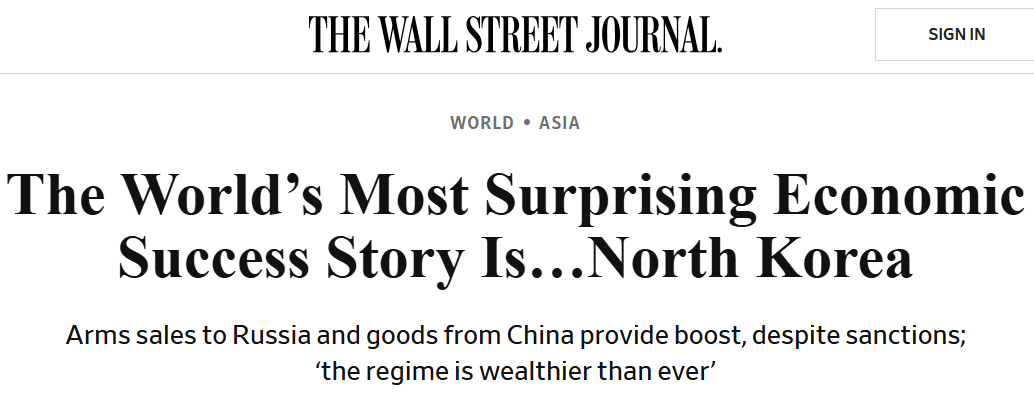
North Korea appears to be enjoying its strongest economic performance in decades, with some estimates placing GDP growth at around 3.7%. Most Western commentary attributes this turnaround primarily to expanded trade with Russia and the normalization of commerce with China. While these external developments have undoubtedly provided an important boost, they do not fully explain the breadth or character of North Korea’s recent economic revival.
A closer examination suggests that Pyongyang’s resurgence is rooted in long-term domestic planning, strategic state investment, ambitious infrastructure projects, and an increasingly pragmatic approach to economic management.
The Conventional Western Explanation
Recent reporting by The New York Times, The Wall Street Journal, and other Western media outlets has largely explained North Korea’s economic improvements through external factors rather than internal policy changes. The principal explanations are as follows:
1. Expanded Trade with Russia
The most frequently cited factor is North Korea’s growing economic partnership with Russia following Moscow’s invasion of Ukraine. Increased exports, labor deployments, military cooperation, and commercial agreements are said to have generated new sources of revenue and hard currency for Pyongyang.
2. Renewed Trade with China
Analysts also point to the recovery of trade with China following the lifting of COVID-era border restrictions. As North Korea’s largest trading partner, China supplies machinery, industrial inputs, and consumer goods while purchasing North Korean exports.
3. The End of Pandemic Isolation
After years of stringent self-imposed border closures, North Korea gradually reopened its trade routes. The resumption of imports and exports stimulated activity in construction, retail, transportation, and consumer markets.
4. Visible Urban Development
Journalists visiting Pyongyang have documented unmistakable signs of modernization, including:
- New high-rise residential districts
- Modern shopping centers
- Restaurants and cafés
- Widespread smartphone usage
- Chinese electric vehicles
- Upgraded roads and urban infrastructure
These highly visible changes are often presented as evidence that the country’s economy has entered a new phase of growth.
5. Greater Availability of Consumer Goods
Western reporting also highlights the growing availability of Chinese consumer products and technology, suggesting that renewed imports have improved living standards for at least part of the urban population.
What This Narrative Overlooks
These external factors are undoubtedly significant. Yet they remain an incomplete—and ultimately superficial—explanation of North Korea’s recent economic trajectory.
Trade can generate income, but trade alone does not produce development. Many countries enjoy far greater access to global markets, foreign investment, and natural resources than North Korea while continuing to struggle with chronic underdevelopment. The crucial question is not simply where new revenue comes from, but how it is deployed.
State Planning Matters
North Korea’s centrally planned system allows the government to channel new resources directly into long-term national priorities, including:
- housing construction,
- industrial modernization,
- agricultural development,
- transportation infrastructure,
- and public services.
Rather than allowing market forces alone to determine investment patterns, the state retains the capacity to coordinate development on a national scale.
Entrepreneurial Flexibility Within the Socialist System
North Korea’s economy is often portrayed as rigidly centralized, yet evidence suggests a more nuanced reality.
For decades, many formally state-owned enterprises have relied on entrepreneurial managers operating under the umbrella of state institutions. These managers generate profits while remaining embedded within the socialist system, creating a hybrid model that combines centralized planning with considerable operational flexibility.
This pragmatic adaptation has become an increasingly important feature of North Korea’s economic life.
Flagship Projects Predate the Recent Trade Boom
Perhaps the strongest challenge to the prevailing narrative is chronological.
Many of North Korea’s largest development projects began before trade with Russia expanded dramatically.
The construction of tens of thousands of new apartments in Pyongyang—including the Hwasong housing projects—was already well underway years earlier.
Likewise, Kim Jong Un’s 20×10 Regional Development Policy, announced in January 2024, represents a sweeping decade-long strategy to modernize twenty cities and counties every year through the construction of:
- regional industrial factories,
- modern housing,
- consumer-goods production facilities,
- agricultural processing centers,
- and rural infrastructure.
Its explicit objective is to reduce the longstanding developmental gap between Pyongyang and the provinces while improving both material living standards and cultural life throughout the country.
Rather than initiating these programs, expanded trade has primarily supplied additional resources to accelerate projects that were already integral to North Korea’s long-term development strategy.
A Different Interpretation
Viewed from this perspective, North Korea’s recent economic gains are not simply the product of favorable external circumstances. Instead, they reflect the interaction between new trade opportunities and a state that retains the institutional capacity to mobilize capital, coordinate investment, and pursue long-range development objectives.
This shifts the emphasis away from external windfalls and toward domestic policy, institutional continuity, and adaptive economic management.
Conclusion
Western coverage has generally emphasized renewed trade with Russia and China as the principal drivers of North Korea’s economic recovery. Those factors are undoubtedly important. However, they do not adequately explain why North Korea has been able to convert external revenues into sustained improvements in housing, infrastructure, manufacturing, and regional development.
A more comprehensive explanation lies in the country’s longstanding commitment to centralized economic planning, strategic state investment, ambitious flagship projects, and a pragmatic incorporation of entrepreneurial initiative within the socialist framework.
The relative importance of these factors remains the subject of scholarly debate. Economists and Korea specialists continue to disagree over the respective roles of trade, sanctions, domestic reforms, state planning, and geopolitical realignment. Nevertheless, focusing exclusively on Russia and China risks overlooking the domestic institutions and policies that have enabled North Korea to translate external opportunities into visible economic transformation.