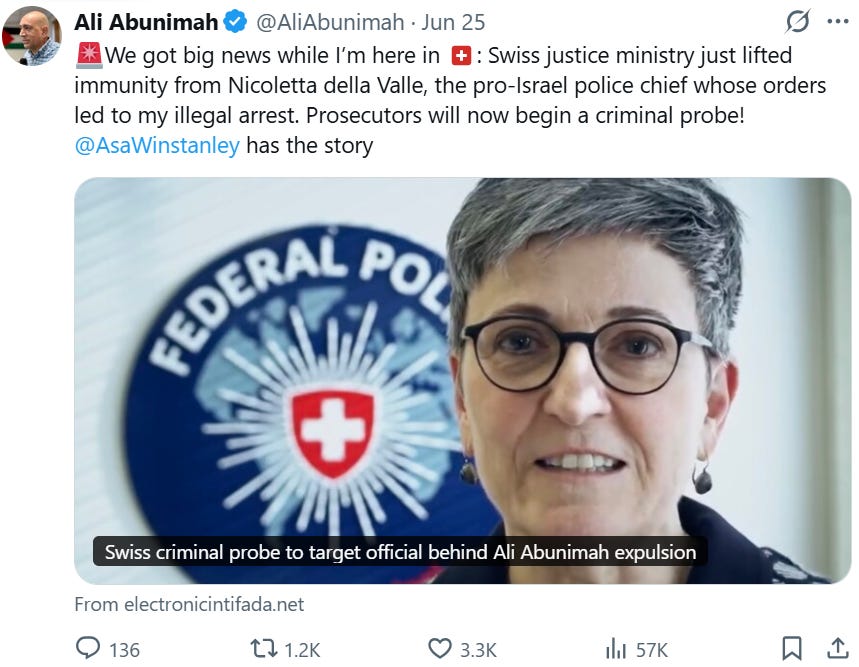

In a case that exposes the intersection of state power, political interference, and the Israeli military-industrial complex, Switzerland’s former top federal police official stands accused of orchestrating the unlawful abduction and deportation of a prominent Palestinian-American voice—only to later take a lucrative position tied to the very arms industry fueling the destruction in Gaza and the mass murder of Palestinians.
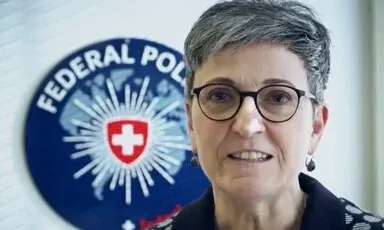
Nicoletta della Valle: How Switzerland’s Ex-Federal Police Chief Became Israel’s Useful Idiot and Joined the Profiteers of Palestinian Suffering
The Incident
Ali Abunimah, a Palestinian-American journalist, author, and co-founder of The Electronic Intifada, was invited to Zurich by Watermelon University, an activist group that organizes lectures, panels, and educational events on Palestine, international law, and activism. He was scheduled to speak on the war in Gaza.

Image: Ali Abunimah
His credentials were straightforward. Born in Washington, D.C. in 1971 to Palestinian parents, Abunimah’s father, Hasan Abunimah, served as a diplomat for Jordan, including as ambassador to the United States and the United Nations. His family traces its roots to villages in what is now Israel; like hundreds of thousands of Palestinians, they were displaced during the 1948 Zionist war of occupation. While Israel grants automatic citizenship to any Jew from anywhere in the world under the Law of Return, it denies descendants of Palestinian refugees the right to return to their ancestral homes.
The original venue for Abunimah’s event was canceled under pressure. Organizers quickly secured a replacement. As he traveled to the new location, plainclothes officers from the Swiss Federal Police (Fedpol) intercepted him in broad daylight.
A Mob-Style Abduction
Eyewitness Amira Berzi — an Egyptian-born Coptic Christian based in Switzerland and a writer, researcher, and political commentator — described the dramatic scene. Arriving slightly late, she initially thought she was witnessing a robbery or street assault. She then recognized Abunimah as several men slammed him against a wall, forced him into an unmarked vehicle, and sped away. Nothing about the men initially identified them as police.

Image: Researcher and writer Amira Berzi
Abunimah was held for three days before being deported, preventing him from delivering his talks. The operation had nothing to do with criminal law enforcement. Its purpose was to silence discussion about Palestine.
Court Victories: Arrest, Detention, and Deportation All Ruled Unlawful
Abunimah’s legal team challenged every aspect of the government’s actions—the arrest, detention, entry ban, and deportation—in multiple Swiss courts.
- The Zurich Administrative Court ruled that the arrest was unlawful, the detention lacked any legal basis, and both violated the Swiss Constitution and the European Convention on Human Rights.
- The Federal Administrative Court identified serious due process violations and procedural errors in the deportation and entry ban. It ordered Fedpol to issue a new decision. Ultimately, both the entry ban and deportation order were deemed unlawful.
Criminal Complaints and Political Interference
Beyond civil victories, Abunimah filed criminal complaints against key officials.
Nicoletta della Valle, then Director of Fedpol (Swiss Federal Police), faces allegations of abuse of public office and improper political interference. The complaint against her remains ongoing. After leaving her position, della Valle joined Champel Capital, an Israeli investment company deeply involved in Israel’s arms industry. The move raises serious questions about conflicts of interest and her alignment with the military-industrial complex implicated in the genocide of Palestinians in Gaza.
Mario Fehr, head of Zurich’s Department of Security (which oversees cantonal police and migration matters), played a central role. His department pushed Fedpol to issue the entry ban. Zurich authorities later shielded Fehr with political immunity, blocking full processing of the complaint against him.
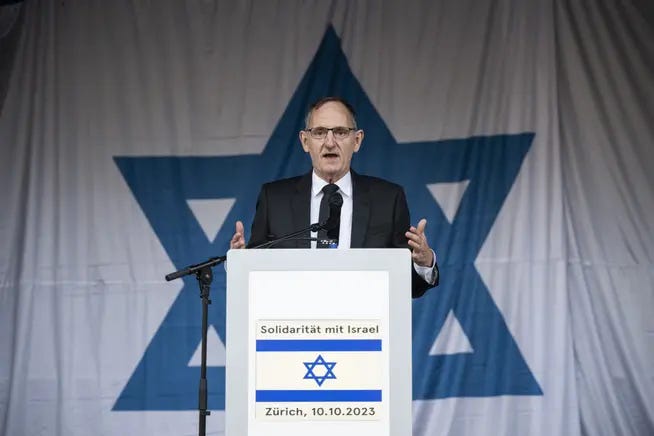
Mario Fehr, a staunch Zionist Goy, at an event showing unconditional solidarity with genocidal Israel
A parliamentary oversight committee uncovered troubling evidence: Fedpol had initially assessed that Abunimah posed no security threat and that his speech was protected under freedom of expression. Only after intervention by della Valle was that assessment reversed. The committee found indications of political interference at the highest levels.
The Deeper Issues, According to Amira Berzi
Berzi argues that Abunimah’s legal wins, while important, are not the core story. The real question is: What protections do Swiss citizens have when government officials themselves flout the law?
She stresses that democracy requires more than courts correcting abuses after the fact. It demands transparency, accountability, proper investigations, and institutional oversight. Despite multiple court rulings against them, Swiss authorities have largely escaped meaningful consequences.
Switzerland’s Constitution protects not only freedom of speech, religion, and assembly, but also the public’s right to receive information. By silencing Abunimah, authorities violated the rights of Swiss citizens who wanted to hear him. This dimension has received far too little attention.
Swiss Media’s Failure
Mainstream Swiss outlets, particularly the Neue Zürcher Zeitung (NZZ), largely sidestepped the core scandal. Instead of focusing on the court rulings, unlawful conduct, and accountability failures, they dwelled on Abunimah’s political views and allegedly controversial statements. The real public interest story—whether Swiss authorities broke the law—was buried.
Freedom of Information requests for communications between officials have been denied, with minimal media scrutiny.
A Western Pattern
Switzerland, formally neutral, is hardly unique. Across the West, similar repression of Palestine advocacy has intensified:
- In the United States, universities have cracked down on pro-Palestine speech, student protesters have faced severe repercussions, and academic freedom has eroded.
- In the United Kingdom, authorities altered legal procedures after juries repeatedly acquitted Palestine Action activists using a “necessity” defense for damaging weapons facilities supplying Israel.
Western political elites continue to offer strong support for Israel despite rapidly shifting public opinion. Polling from Pew Research and other organizations reveals growing criticism of Israel across Western countries, with a clear majority of the public opposing the devastating destruction and genocide in the Gaza ghetto. Yet many elites continue to deny or downplay the reality. This widening gap between elites and the public frequently leads to increased repression in order to sustain unpopular policies.
Palestine as a Test Case
Abunimah and others view Palestine as a laboratory for normalizing restrictions on speech and protest. Tactics refined against pro-Palestine voices risk being deployed against other dissent—on Ukraine, broader foreign policy, or domestic issues.
He notes that independent media and alternative voices are now subject to intelligence assessments and federal police scrutiny—something he never expected as someone running an online publication. This reflects growing elite insecurity in the face of shifting narratives.
Reason for Cautious Optimism
Despite the repression, Abunimah remains moderately optimistic. His legal victories came through collective effort: crowdfunding, dedicated lawyers, activists, supporters, and independent journalists. Ordinary people, when organized, can successfully challenge even powerful institutions.
His case is a reminder that legal and public resistance remains worthwhile. Democracy’s survival depends on citizens refusing to accept the normalization of political policing and elite impunity.
P.S.