
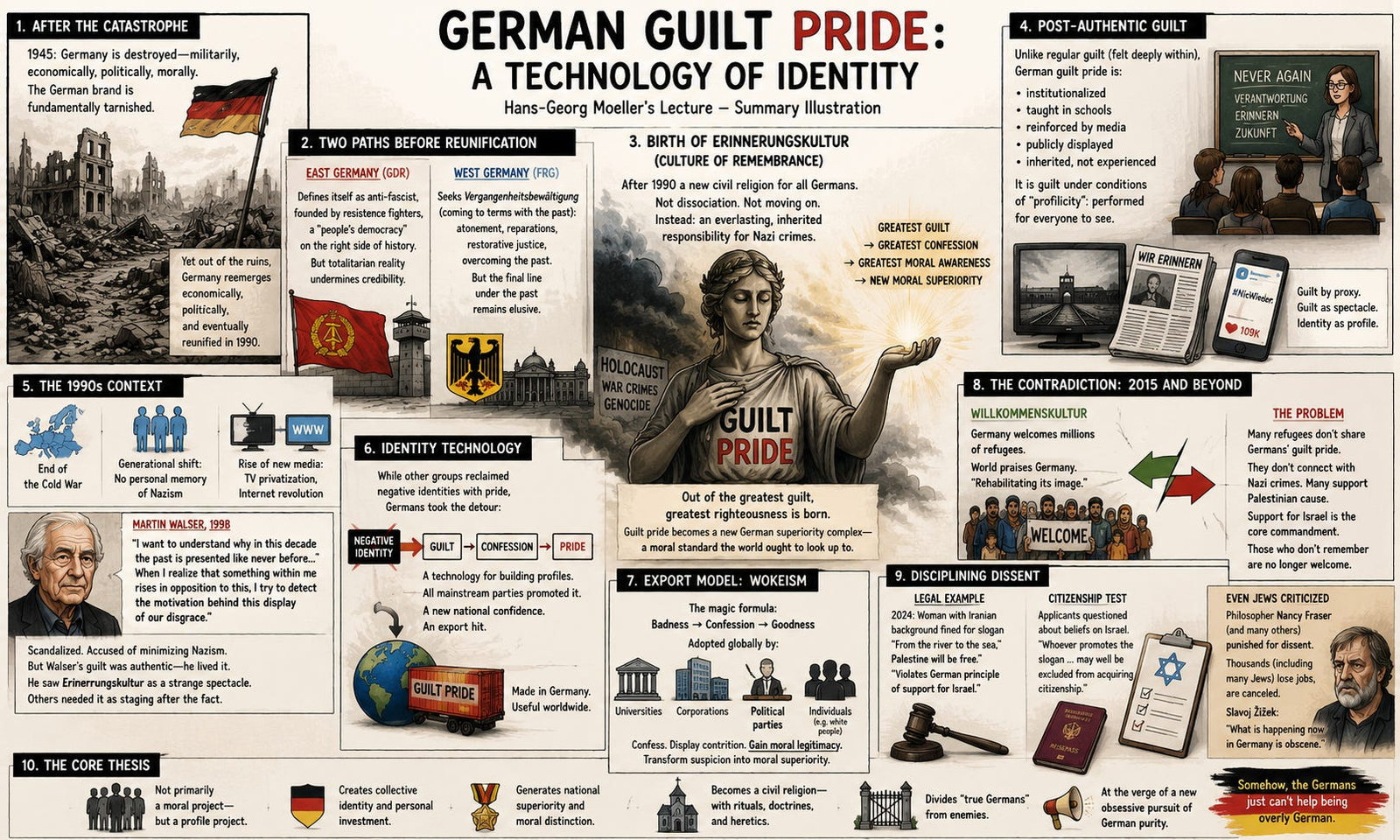
Detailed Summary of Hans-Georg Moeller’s Lecture on “German Guilt Pride”
Hans-Georg Moeller argues that “guilt pride” is a uniquely modern German political invention that emerged after World War II. While feelings of guilt have older religious roots, he contends that Germany developed a new secular form in which confessing and publicly displaying inherited guilt becomes a source of moral prestige and national identity. According to Moeller, this “technology” of identity formation has since spread internationally and now influences contemporary identity politics and what he calls “wokeism.”
1. The Origins of “Guilt Pride”
Moeller begins with Germany’s collapse in 1945.
After the defeat of Nazi Germany:
- Germany was militarily defeated.
- Its economy was destroyed.
- Its international reputation was devastated.
- Germans became globally identified with Nazism and genocide.
Yet Germany eventually recovered economically and politically.
The question became:
How can a nation rebuild its identity after becoming synonymous with history’s greatest crime?
Moeller argues that the answer was guilt pride.
Rather than trying to erase the Nazi past, Germany gradually built a new national identity around permanently acknowledging it.
2. East and West Germany Initially Took Different Paths
Before reunification (1990), the two German states responded differently.
East Germany (GDR)
East Germany portrayed itself as:
- anti-fascist
- founded by resistance fighters
- morally separate from Nazi Germany
The state claimed that Nazism belonged to capitalism rather than socialism.
However, Moeller argues that East Germany’s own authoritarian nature weakened this claim.
West Germany (FRG)
West Germany pursued another strategy.
Its goals included:
- reparations
- restorative justice
- accepting responsibility
- eventually “overcoming the past”
This process is known as Vergangenheitsbewältigung (”coming to terms with the past”).
The hope was eventually to “draw a line” under Nazi history and move forward.
But, according to Moeller, this never fully happened.
3. Reunification Created a New National Identity
After reunification in 1990:
Neither East Germany’s anti-fascism nor West Germany’s “move on” approach remained dominant.
Instead Germany developed what Moeller calls:
Erinnerungskultur (culture of remembrance).
This became Germany’s new civil religion.
Its central principle:
Germany should never stop acknowledging responsibility for Nazi crimes.
Rather than saying:
“We are no longer Nazis”
Germany increasingly said:
“We permanently remember Nazi crimes.”
4. The Central Paradox
Moeller argues this produced an unexpected transformation.
Originally:
Great guilt meant moral disgrace.
Eventually:
Great guilt became evidence of extraordinary moral responsibility.
His logic is:
Greatest guilt → Greatest confession → Greatest moral awareness → New moral superiority
Germany became proud of being the nation that most openly admitted its crimes.
This is why he calls the phenomenon:
guilt pride.
5. Why This Form Is New
Moeller says ordinary guilt is personal.
German guilt pride is different because it is:
- institutionalized
- taught in schools
- reinforced by media
- performed publicly
- inherited rather than personally experienced
Most living Germans committed no Nazi crimes.
Nevertheless they inherit responsibility.
Thus:
The guilt is post-authentic.
People feel guilty for actions they never performed.
6. Public Performance Instead of Private Feeling
Moeller argues that this guilt increasingly became public performance.
It functions under conditions of:
- television
- mass media
- internet
- social visibility
He describes it as:
guilt under conditions of “profilicity.”
Profilicity is one of Moeller’s major philosophical concepts.
Rather than building identity from inner authenticity, modern people increasingly construct public profiles.
Identity becomes something displayed.
Accordingly:
German guilt becomes something publicly demonstrated.
7. The 1990s Context
Moeller says several developments occurred simultaneously.
End of Cold War
Germany reunified.
Generational change
People with direct memories of Nazism were disappearing.
The new elite had no personal experience of WWII.
Rise of new media
Television expanded.
The internet emerged.
Politics became increasingly media-driven.
These conditions encouraged public symbolic identity-building.
8. Martin Walser’s Criticism
Moeller discusses writer Martin Walser’s controversial 1998 speech.
Walser questioned why Germany continually displayed its historical shame.
He admitted feeling uncomfortable with the public spectacle surrounding remembrance.
He was heavily criticized and accused of minimizing Nazi crimes.
Moeller argues Walser’s discomfort stemmed from generational differences.
Walser:
- lived through WWII
- served briefly in the German army
- had personal memories
His guilt was authentic.
Therefore public ceremonial remembrance felt strange.
Younger Germans, however:
had no direct memories.
Their guilt necessarily had to be symbolic.
9. The “Spectacle” of Remembrance
Borrowing from Guy Debord, Moeller argues that remembrance culture became a spectacle.
It consists of:
- monuments
- ceremonies
- education
- media narratives
- public rituals
Examples include Berlin’s Holocaust Memorial.
Rather than personal memory,
it becomes collective symbolic performance.
10. Identity Politics and Guilt Pride
Moeller then connects this development with modern identity politics.
In the late twentieth century:
Many marginalized groups reclaimed formerly negative identities.
Examples include:
- Black pride
- LGBTQ pride
Germany could not follow this model.
Nazism could never become something celebrated.
Therefore Germans found another route.
Instead of:
negative identity → pride
Germany took:
guilt → confession → pride.
11. Guilt Pride as Political Technology
This is one of Moeller’s main arguments.
He claims guilt pride is not primarily moral.
Instead it functions as:
a technology for building collective identity.
Political parties,
media,
universities,
and institutions all reinforce this national profile.
12. Exporting the Model
Moeller argues Germany’s innovation spread internationally.
Its basic formula:
Potentially suspect groups publicly confess wrongdoing,
thereby gaining moral legitimacy.
He argues this logic influenced modern “woke” politics.
Examples include:
- corporations
- universities
- political parties
- white people publicly acknowledging privilege
According to Moeller,
this converts suspicion into moral prestige.
13. 2015 Refugee Crisis
Moeller sees the refugee crisis as exposing contradictions.
Germany embraced Willkommenskultur (”welcoming culture”).
Large numbers of refugees entered Germany.
The world praised Germany’s generosity.
The New York Times even suggested Germany was rehabilitating its image.
Moeller argues welcoming migrants fit perfectly with guilt pride.
Germany could demonstrate:
“We have overcome our racist past.”
14. The Contradiction
However,
many migrants—
especially from Muslim-majority countries—
held views about Israel that differed sharply from Germany’s official position.
Germany’s remembrance culture strongly emphasizes:
support for Israel
as part of Holocaust responsibility.
Many migrants sympathized instead with Palestinians.
This created tension.
15. Whose Interests Does Guilt Pride Serve?
Moeller’s answer:
not primarily the interests of migrants,
nor even Jews,
but Germany’s own national identity.
He argues welcoming refugees ultimately functioned to strengthen Germany’s moral self-image.
The beneficiaries were Germans themselves.
16. Gaza and Germany
Moeller next discusses Germany’s response to the Israel–Hamas war.
He argues Germany strongly supports Israel,
despite extensive Palestinian civilian deaths.
His interpretation:
Germany prioritizes maintaining its guilt-pride identity over evaluating each conflict independently.
Support for Israel thus becomes symbolic proof of Germany’s moral identity.
17. Legal Examples
Moeller gives two contemporary examples.
Example 1
A woman with Iranian family background was fined for using the slogan:
“From the river to the sea, Palestine will be free.”
Moeller presents this as evidence that Germany protects its guilt-pride framework through legal means.
Example 2
Applicants for German citizenship are questioned about their views concerning Israel.
He argues this turns guilt pride into an official requirement of citizenship.
18. Jewish Critics
Moeller emphasizes that criticism also affects Jewish intellectuals.
He cites philosopher Nancy Fraser, whose visiting professorship at the University of Cologne was cancelled after controversy over her public positions on Israel and Palestine.
He also quotes philosopher Slavoj Žižek, who argues that many people—including numerous Jews—have faced professional or public consequences after criticizing German policies or discourse surrounding Israel.
Moeller presents these examples to argue that the defining principle is not simply protecting Jewish voices, but defending Germany’s postwar identity framework.
19. Immigration Politics
Moeller concludes by discussing recent German politics.
Mainstream parties increasingly support:
- tighter immigration controls
while simultaneously maintaining
- commitment to remembrance culture
- strong support for Israel
This combination, he argues,
allows them to adopt stricter immigration policies without abandoning guilt pride.
20. Final Thesis
Moeller’s central conclusion is that guilt pride is fundamentally a profile project rather than a moral project.
In his view, its primary purpose is not ethical reflection but the creation of a collective identity through public displays of inherited responsibility. This identity generates national cohesion, moral legitimacy, and a sense of distinction.
He argues that this process increasingly produces:
- a division between “true” Germans who affirm the culture of remembrance and those who challenge it,
- a civil-religious framework with symbolic rituals and core doctrines,
- pressures toward political conformity,
- and tensions around immigration, citizenship, and debates over Israel and Palestine.
He ends by suggesting that Germany’s attempt to redefine itself through guilt pride may be reproducing new forms of exclusion and ideological rigidity, concluding with the ironic remark that “the Germans just can’t help being overly German.”
Overall Thesis
The lecture argues that Germany’s postwar identity evolved from attempting to overcome the Nazi past into permanently incorporating it as the foundation of national identity. Moeller contends that this transformation created a paradoxical form of “guilt pride,” in which inherited guilt becomes a source of moral prestige. He further argues that this mechanism functions less as a genuine ethical commitment than as a technology for constructing collective identity and public legitimacy, influencing both German politics and broader trends in contemporary identity politics. Many of these claims—particularly those linking “guilt pride” to “wokeism” or interpreting German policy motivations—are Moeller’s own philosophical and political interpretations rather than established scholarly consensus.