
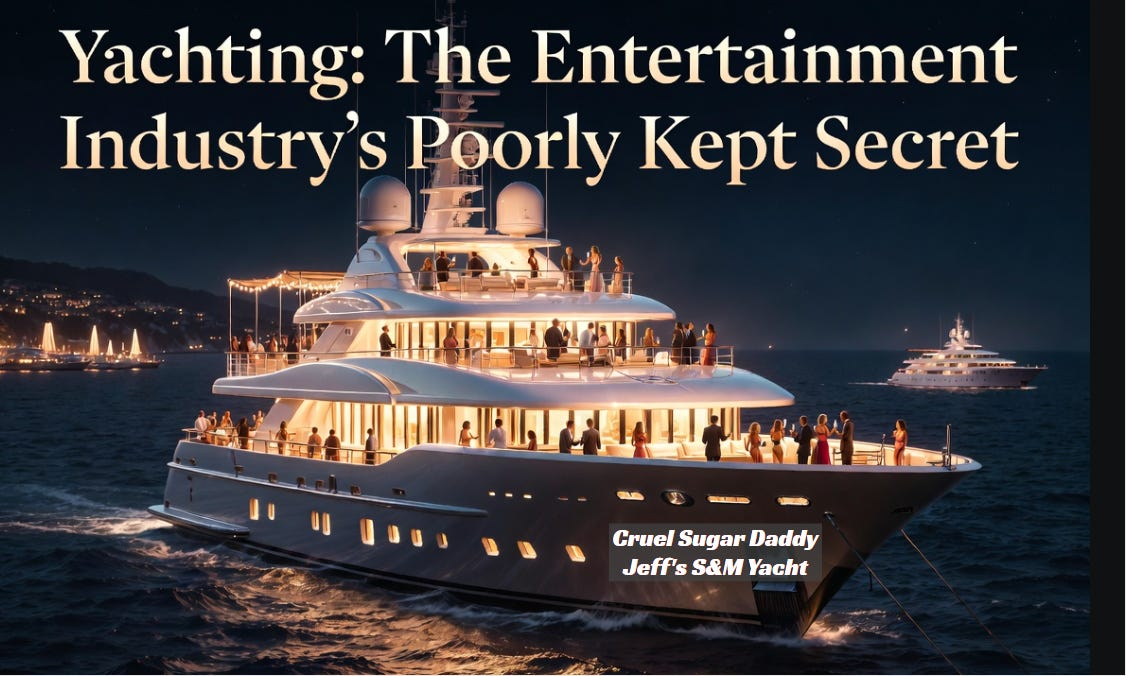
Yachting (often misspelled as “yaching”) is one of the entertainment industry’s most enduring open secrets. The term describes the practice in which attractive young women — models, actresses, influencers, and aspiring celebrities — are paid, sometimes handsomely, to spend time with extremely wealthy, powerful, and often anonymous men aboard luxury superyachts or at exclusive events such as the Cannes Film Festival.
While frequently presented as glamorous networking, high-end partying, or simply “being arm candy,” the line routinely blurs into sexual favors, exploitation, coercion, and, in the darkest cases, human trafficking and child abuse.
The Epstein Network: A Documented Case of Yacht-Based Exploitation
Although much of the discussion around yachting remains rooted in gossip and blind items, one network with strikingly similar patterns has been extensively documented through court records, survivor testimony, and criminal prosecutions: the operation run by Jeffrey Epstein and his associates — often referred to as the “Epstein Class” — that continues to go largely unpunished for its crimes.
Epstein is best known for his private island and private jet, but multiple survivors have stated in interviews and legal filings that he and his circle also routinely used luxury yachts and other private vessels as controlled, isolated environments for abuse. These accounts describe a dynamic remarkably similar to the broader yachting phenomenon: powerful men, young women and girls recruited under misleading promises of modeling work, parties, or networking opportunities, and social settings deliberately designed to limit oversight and complicate escape.
Survivors reported that Epstein’s group frequently moved between private properties, chartered yachts, and offshore locations where staff were actively discouraged from asking questions. In these floating venues, the ultra-wealthy felt insulated from consequences. Yachts served the same purpose as Epstein’s island — private spaces where normal rules seemed not to apply and misconduct could be easily concealed.
This aspect of the Epstein case has been substantiated through criminal prosecutions, civil lawsuits, and the conviction of one of his closest collaborators. It offers concrete evidence of how isolated luxury settings can be weaponized to facilitate coercion and sexual exploitation — highlighting the core vulnerabilities that define the entire yachting world: extreme power imbalances, lack of oversight, economic pressure on young women, and the targeting of the ambitious or financially vulnerable.
Origins and Mainstream Exposure
The term “yachting” first gained wider public awareness in 2013 through a Hollywood Reporter investigation that peeled back the glamorous façade of the Cannes Film Festival. The article revealed how models — and even some established Hollywood figures — swarmed hotel suites and yacht parties during the event.
Lebanese businessman Elie (also spelled Eli) Nahas, who ran a modeling agency and was later convicted in connection with a prostitution ring supplying women to wealthy clients (including associates of Muammar Gaddafi’s son), provided some of the most vivid details. He claimed that every year, 30 to 40 luxury yachts anchored in the bay at Cannes. Each typically hosted around ten women — often nude or semi-nude — known as “yacht girls.”
According to Nahas, the distinction between enthusiastic partygoers and paid escorts was intentionally blurred. By simply boarding, the women were understood to have agreed to “carry out favors.” At the end of the night, they received cash “gifts” in envelopes, with amounts varying based on the woman’s level of fame and the nature of the services performed. He noted that recognizable Hollywood names participated and that many rationalized the experience as “just dating rich men.”
Motivations and the Allure
The appeal is obvious despite the risks. Clients are ultra-wealthy businessmen, royals, or industry power players who can accelerate careers in film, fashion, and modeling. A transactional “relationship” can open doors to roles, contracts, brand deals, or valuable visibility on red carpets and in exclusive circles.
Compensation can reach five figures per night — with some reports citing up to $40,000 — plus lavish gifts and luxury experiences. For women struggling between gigs, the quick cash and promised networking opportunities can feel like a shortcut, even if the long-term benefits are rarely guaranteed.
The staggering wealth on display only heightens the temptation. Iconic superyachts regularly seen at Cannes, such as the Serene (owned by the Saudi Crown Prince and valued at around $500 million, featuring helipads, a spa, climbing wall, and multiple pools) and the Eclipse (valued between $1.2 and $2 billion, one of the world’s largest private yachts), underscore the vast power imbalance between clients and the women they host.
High-Profile Rumors and Specific Cases
Much of the broader conversation around yachting takes place through anonymous blind items on sites like Crazy Days and Nights, as well as speculation on social media.
- Emily Ratajkowski: In her 2021 memoir My Body, she openly discussed her experiences within the “cult of beauty” shaped by powerful men. She described being paid a reported $25,000 to attend the Super Bowl with Malaysian businessman Jho Low (later central to the 1MDB scandal), noting that she was “on the clock.” Videos of her and other models dancing on a yacht at Cannes further fueled speculation.
- Kardashian-Jenner Family: A 2015 blind item alleged that Kris Jenner was “coaching” a young Kylie Jenner in “the art of pleasing a man” and facilitating introductions to wealthy clients. Kim Kardashian has faced persistent rumors linked to her yacht appearances, solo trips to the Gulf region, and an alleged incident involving lavish gifts from Jho Low after a Vegas trip. Kendall Jenner was filmed at a Dubai event appearing to lip-read “horrible, horrible” about previous trips there — comments some interpreted as regret over rumored arrangements. These stories tie into wider allegations about degrading “porta potty” parties in Dubai, where women are reportedly degraded to the point of being defecated on by wealthy men — and even forced to swallow it.
- Meghan Markle: Rumors dating back to the early 2010s have suggested that her rapid rise was aided by networking in similar high-society circles.
Other recurring blind items have linked various models and influencers to alleged yachting networks. One persistent rumor claimed a “fashion water” company served as a front for high-end escorting, with its bikini-heavy promotional campaigns allegedly acting as a catalog of available women.
A widely discussed blind item described a struggling actress who, after her show was canceled, accepted what she believed was a high-paying summer “modeling” job in Europe for $25,000 upfront. The arrangement quickly deteriorated into cramped conditions, invasive touching, filmed parties, and pressure for sexual favors. Some women quit early, others paired off with clients, and at least one overdosed. The actress later described the experience as deeply degrading.
The Dark Underbelly
Beneath the veneer of glamour lies coercion, blurred consent, and significant risk. Women are often recruited under false pretenses — told the work involves only modeling or partying — only to face expectations of sexual services. The extreme power imbalance makes genuine consent questionable; saying no can carry professional repercussions in an industry where access to powerful men is often tied to opportunity.
A 2021 Vice interview with an anonymous former superyacht deckhand revealed the stark contrast: the job appears glamorous from the outside (travel, luxury), but in reality involves cleaning up after sex parties, drug binges, and dangerous excess. Crew members frequently endure long hours, harassment, and pressure to stay silent.
Yachting ultimately exemplifies the entertainment industry’s commodification of youth and beauty. It dangles the promise of fast-track success and financial rewards through proximity to ultra-wealthy “decision-makers,” yet too often delivers a transactional world marked by objectification, health and safety risks, moral compromise, regret, and trauma.
While many individual stories remain unproven blind items or gossip, the 2013 Cannes investigation, survivor memoirs, crew testimonies, and especially the documented Epstein network confirm that yachting is a real, systemic — if discreet — phenomenon in elite circles. The Epstein case, in particular, stands as a sobering reminder of how luxury isolation enables the exploitation of young women and even children on a disturbing scale.