
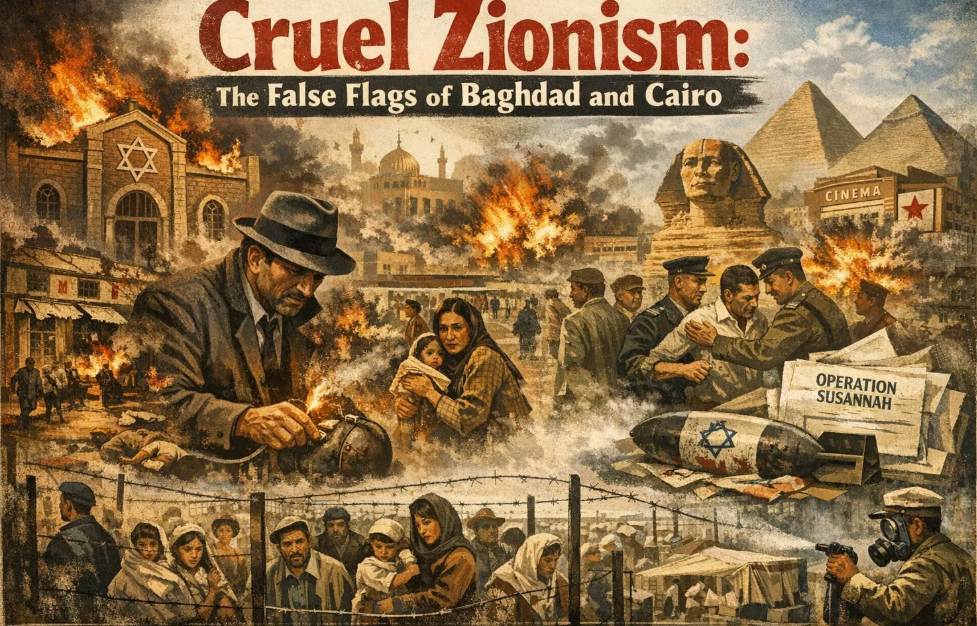
When Israel is described as a European colonial project, the Zionist standard rebuttal is demographic: “Nearly half of Israeli Jews are Mizrahi (from the Middle East and North Africa).” While factually true, this response often glosses over a more uncomfortable question: How and why did these ancient communities relocate to the nascent settler state?
Following the 1917 Balfour Declaration, the Zionist movement faced a demographic crisis. Most European Jews sought refuge in the Americas rather than the Levant. To build a viable state, a massive labor force was required. The solution lay in the Jewish communities of the Arab world—Yemen, Iraq, and Morocco—who had lived in the region for millennia.
Yet, early Zionism was an Ashkenazi-led movement steeped in the prejudices of its time. Leaders like David Ben-Gurion were vocal about their “civilizing” mission; Ben-Gurion notoriously expressed concerns over the “Levantinization” of the state, at one point comparing Sephardi and Mizrahi immigrants to “savages” or the enslaved populations of the American South. This Orientalist lens framed Mizrahi Jews as a necessary labor source, but culturally “backward.”
Furthermore, many of these communities initially resisted the Zionist call. The Iraqi Jewish elite, deeply integrated into Baghdad’s economic and cultural fabric for over 2,500 years, viewed themselves primarily as Iraqis of the Jewish faith. Zionist emissaries often found them “stubbornly” attached to their homes, unmoved by nationalist appeals. When ideological persuasion failed, tactics shifted toward what some historians term “cruel Zionism”—the deliberate destabilization of Jewish life to force emigration.
The most flashpoint example is the 1950–1951 Baghdad bombings, which targeted Jewish landmarks including the Masuda Shemtov Synagogue and a popular Jewish-owned coffee shop. While Israel has officially denied involvement for decades, research by British-Israeli historian Avi Shlaim—himself an Iraqi-born Jew—concluded that at least three of these bombings were the work of a Zionist underground operative. These attacks were calculated to “shatter the sense of security” within the community, effectively manufacturing the panic that led to the mass transfer of 110,000 Jews to Israel.
This pattern of disrupting integrated Jewish life continues into the present day. The existence of a prosperous, state-protected Jewish community in Iran remains a direct challenge to the narrative that Jews can only find safety within a Zionist state. The stability of Iranian Jewry disrupts expansionist visions of a “Greater Israel” by proving that Jewish life can flourish in the heart of the Middle East.
This tension reached a breaking point on April 7, 2026, when the Rafi-Nia Synagogue in central Tehran—a cornerstone of the Khorasan Jewish community—was completely destroyed. While the Israeli military characterized the destruction as “regretful collateral damage” from a strike on a nearby military target, military experts have largely rejected this claim. Given the pinpoint accuracy of modern precision-guided munitions, critics argue the strike was a deliberate message: an attempt to physically erase the evidence of a Jewish life that exists outside of, and in opposition to, the Zionist project.
The destruction of this ancient holy site, with Torah scrolls left buried under the rubble, has intensified claims that the ongoing military campaign increasingly targets the cultural and religious fabric of the region’s native populations.
This tactic of leveraging fear is a recurring theme, stretching from the early days of the state to the present. Similar “false-flag” operations were attempted in Egypt, most famously the 1954 Lavon Affair (Operation Susannah).
Zionist agents also skillfully leveraged the genuine rise in anti-Semitism fueled by Nazi German influence, such as the 1941 Farhud pogrom in Baghdad. By framing these tragic events as proof that Jewish life in the diaspora was no longer viable, they presented the nascent Israeli state as the only possible refuge.
In Yemen, following the 1947 Aden riots, the “Operation Magic Carpet” airlift was similarly characterized as a desperate rescue mission. Yet, the “redemption” promised to these ancient communities was often hollow; upon arrival, Yemenite Jews were met with paternalistic disdain and subjected to degrading treatment—most infamously being “sprayed” with DDT like livestock as part of a state-mandated “civilizing” process.
The “dream of redemption” often ended in the harsh reality of the Ma’abarot (transit camps). Surrounded by barbed wire and watchtowers, these camps were eerily reminiscent of the concentration camps many had hoped to escape. By 1951, 80% of those in these camps were Mizrahi. While Ashkenazi immigrants were usually fast-tracked to permanent housing, Mizrahi families were often left in tents for over a decade. Most tragically, the Yemenite Children Affair saw over 1,000 babies “disappear” from these camps; families were told their healthy children had died, yet they were never shown bodies or graves, leading to decades of allegations that the children were abducted for adoption by Ashkenazi families.
This history suggests that the Mizrahi presence in Israel was not a spontaneous “homecoming,” but the result of a calculated mobilization. Ancient Middle Eastern Jewish life was fundamentally uprooted to serve the demographic requirements of the Zionist state that viewed these communities as “human material.” It represents a recurring pattern in Israeli statecraft: the use of insecurity—sometimes organic, sometimes manufactured—to sever the ties between Jews and their native countries. By portraying the diaspora as a place of inevitable peril, the Zionist state positions itself as the only possible sanctuary, often relying on provocations portrayed as antisemitism that is then blamed on local populations to secure its labor force and reinforce a narrative of civilizational conflict.