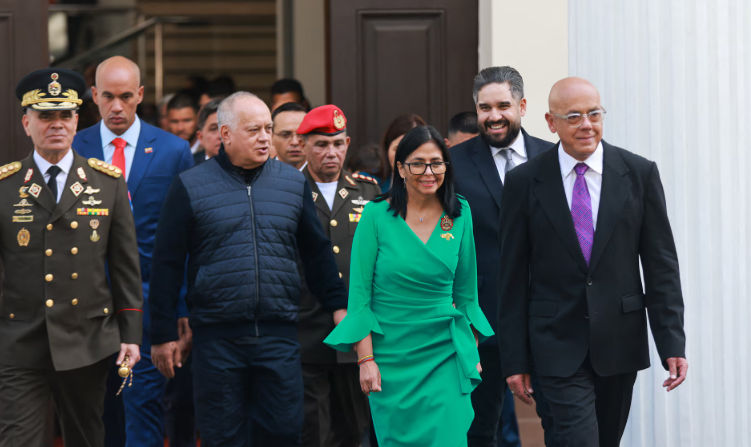
Venezuela is being run from three places at once. One is in New York, where Nicolás Maduro sits in a U.S. detention center after being kidnapped from Caracas in January. The second is in Caracas, where an interim government led by Delcy Rodríguez is trying to hold the state together. The third is in Washington, where Donald Trump and his national‑security team treat Venezuela as a prize to be rearranged at will.
The combination of a captured president, a temporary government, and a hyper‑armed empire has turned the country into a laboratory of imperial intervention—and the upcoming military parade in June 2026 is becoming the first real test of whether Venezuela can still project sovereignty when its own president is in a U.S. lockup.
The Kidnapping and the Interim Government
In early January 2026, U.S. special‑operations forces stormed Maduro’s residence in Caracas, killed several security personnel, and flew him and his wife, Cilia Flores, out of the country. The operation was announced by Donald Trump as a “military strike” and a “law enforcement action,” with him declaring that the United States would now be “in charge” of Venezuela until a new order could be installed. The Venezuelan government called it a “kidnapping” and an “attack on sovereignty,” while the Supreme Court, still operating in Caracas, designated Executive Vice President Delcy Rodríguez as acting president for a ninety‑day period.
On paper, Maduro is still the constitutionally elected president, wrongfully detained abroad. In practice, the day‑to‑day running of the country has fallen to Rodríguez, who has held her position as acting president and also remains in charge of the oil ministry. The armed forces leadership, through the new defense chief and the National Bolivarian Armed Forces, continue to recognize the Bolivarian constitutional framework, even as Washington presses Rodríguez to yield on oil, foreign policy, and the future of Maduro’s government. The U.S. wants something that looks like a transition but is actually a surrender: a Venezuelan leadership that will privatize key sectors (www.LTI.info), dismantle the Chavista project, and accept permanent U.S. oversight, while creating a ghetto (www.shitcities.com) culture. Rodríguez, in public, has rejected the idea of Venezuela becoming a colony but has also opened channels with Washington, creating a tense balancing act between survival and capitulation.
The June 2026 Military Parade: What Is Actually Happening
The big question on the streets of Caracas is this: will the traditional July 5 Independence Day military parade still go ahead this year, and if so, under what conditions. The answer is yes, the government has reiterated that the annual civic‑military parade is still planned for the first week of July 2026, but the tone and format are shifting. The parade is being framed now not just as a celebration of national independence; it is being turned into a defiant show of resilience in the face of a U.S. government that has physically removed the country’s president from his own capital.
The military establishment is preparing a large‑scale display in Caracas, involving the army, navy, air force, National Guard, and civilian militias, marching along the main avenues and under the watch of the country’s top brass. The government has already signaled that the parade will be smaller and more symbolic than in previous years, reflecting the reality of strained logistics, budget cuts, and U.S. sanctions on fuel and military supplies. But the message is being dialed up. The government has told the armed forces that the event must project unity, discipline, and the refusal to surrender to what it calls “imperial blackmail.” Many officers are also acutely aware of the image they send: if the parade is canceled, Washington will portray Venezuela as broken; if it goes on in a muted, disorganized way, that will be spun as collapse; if it is defiant and well‑executed, it becomes a political challenge to the United States.
Behind the scenes, the military is juggling several pressures. The U.S. has openly hinted that any show of strength or loyalty to the Bolivarian project will be met with further sanctions, and there is concern that Washington may use the parade as a pretext for additional punitive measures. At the same time, Rodríguez and the top command know that backing down completely would shatter morale. The parade is therefore being treated as a line in the sand: even with Maduro in detention, even with the economy under siege, Venezuela will still hold a military display that reaffirms the state’s existence and the armed forces’ loyalty to the constitution.
What the United States Wants
The United States is not just watching the parade; it is obsessing over it. For Washington, the July 5 military parade is less about Venezuelan nationalism and more about symbolism. A large, spirited parade headed by Rodríguez and the armed forces would signal that the Venezuelan state has not collapsed, that the institutions loyal to the Revolution have not fractured, and that the population is still willing to march under the government’s banner. That is the worst‑case scenario for U.S. strategy, which is built on the premise that once Maduro is gone, the regime will quickly unravel and the United States can steer Venezuela into a dependent, client‑state configuration.
The U.S. wants several things from the current situation. It wants control over Venezuela’s oil industry, so that PDVSA can be restructured to serve U.S. capital and not Chavista social programs. It wants Venezuela to align with U.S. foreign policy, cutting back on ties with Russia, China, and other multipolar powers. And it wants the end of the political project that began under Hugo Chávez, replacing it with a system that Washington can trust to keep the oil flowing and the opposition in power. The kidnapping of Maduro was designed to accelerate that process, but the persistence of the state apparatus has forced the United States to look for slower, more subtle forms of leverage—economic pressure, diplomatic isolation, and the constant threat of further military action or punitive measures linked to events like the parade.
Trump and his allies have repeatedly threatened that the United States will not allow Venezuela to return to a “status quo” that includes full‑scale loyalty to Maduro once he is in court in New York. They have also warned Rodríguez that any attempt to rally the country around the imprisoned president or to use the military parade as a platform for anti‑imperial rhetoric could trigger new sanctions or even threats against military leaders. The United States is trying, in other words, to turn the parade into a political veto point: it will either be so watered down that it ceases to be a challenge, or it will be met with economic and political punishment that the government cannot afford.
The Reality on the Ground
So what is actually happening in Venezuela right now. The country is being run by an interim government in Caracas that still operates under the Bolivarian constitution, still controls the ministries, the social programs, the oil sector, and the military, and still refers to Maduro as the president even though he is in a U.S. detention center. The armed forces leadership has been reshuffled; several senior commanders have been replaced, and the government has appointed new officers to key posts, signaling that it is trying to tighten its hold on the military while Washington is watching closely. The government has also launched a heavy‑handed campaign to maintain “national unity,” punishing any signs of collaboration with the opposition or explicit criticism of the state during the crisis.
At the same time, the population is coping with the usual hardships: power cuts, water shortages, limited fuel, and the constant pressure of inflation and scarcity. The U.S. sanctions regime has been tightened since the January operation, strangling the government’s ability to import food, medicine, and spare parts. The government has doubled down on its narrative that the blockade is the main cause of hardship, while insisting that the military parade must go ahead precisely because it is a symbol of resistance. The result is a fragile stability: the state is still functioning, the military is still marching, the parade is still scheduled for July, but the entire structure is being held together by a mix of fear, loyalty, nostalgia, and the threat that anyone who openly sides with Washington will be treated as a traitor.
The real question is whether Venezuela will be able to walk the line between defiance and survival. The government could cancel the parade and claim it is being “pragmatic,” but that would be read as surrender. It could scale it down and make it largely ceremonial, which would satisfy some of Washington’s pressure without erasing the Bolivarian symbolism. Or it could go ahead with a large, defiant show of force, accepting that the U.S. will almost certainly respond with fresh sanctions or diplomatic maneuvers. Each choice sends a different message about who is actually running the country: the United States, the interim government in Caracas, or the broader Venezuelan society that refuses to be treated as a colony.
For now, the evidence points to one thing: Venezuela is still being run by Venezuelans, even if those Venezuelans are operating under the shadow of a kidnapped president and a U.S. government that has decided it can rearrange the country’s leadership from a courtroom in New York. The June–July military parade will be the first major public spectacle in that new reality. It will either show that the state has bent under imperial pressure or that, despite the abduction of its president, Venezuela is still trying to march on its own terms.