
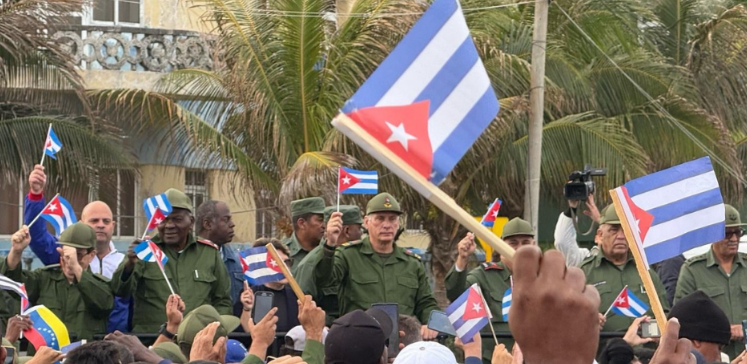
Cuba is not collapsing. It is being strangled. For over six decades, the United States has tried to suffocate the island in economic, political, and psychological coils, hoping that hunger, frustration, and fatigue would finally bend Havana to Washington’s will. Instead, the blockade has turned Cuba into a kind of litmus test: if the Cuban Revolution can survive the relentless weight of U.S. imperialism, it sends a message to the rest of the Global South that resistance is still possible.
Today, under President Donald Trump’s renewed siege, Cuba is once again on the front line—not of U.S.–Cuba “normalization,” but of a full‑blown campaign to force the island back into the colonial orbit of the United States.
The Blockade, the Shortages, and the Pretext of “Democracy”
The U.S. “blockade” is not a metaphor; it is a legal, economic, and financial architecture that Washington has tightened and loosened according to political fashion, but never dismantled. It bars most U.S. trade, investment, and financial transactions with Cuba, penalizes foreign companies that deal with the island, and even restricts food and medical exports under mechanisms labeled “humanitarian.” The Cuban government calls this an “economic war” or an “energy blockade,” emphasizing that the shortages of fuel, electricity, and medicines are not the product of socialist incompetence alone, but of deliberate external pressure.
In 2026, after Trump declared Cuba an “unusual and extraordinary threat” to U.S. security, Washington reached for the full arsenal of sanctions. Venezuela’s oil deliveries—which had long cushioned rolling blackouts—dropped sharply after U.S. intervention around Maduro’s abduction, leaving Cuba scrambling for fuel and power. Official Cuban statements insist “the shortages on the island are a direct result of U.S. coercive policies,” and that the government has been forced to ration energy to prioritize hospitals, water systems, and public transport.
Washington, in contrast, frames the blockade as a “moral” tool to promote “democracy” and “human rights.” In 2017, Trump announced a “new policy” towards Cuba, vowing to cancel what he called a “one‑sided deal” and “strengthen[ing] a lot” the existing restrictions. “We do not want U.S. dollars to prop up a military monopoly that exploits and abuses the citizens of Cuba,” he declared, as if 60 years of failed coups, bombings, and sabotage had all been unavoidable side effects of a benign concern for Cuban freedom. For hard‑liners like Senator Marco Rubio, the goal is transparent: maximum economic pressure until the Cuban state capitulates or collapses.
What America Actually Wants: A Reconquered Cuba
Behind the rhetoric of “democracy” lies a far plainer objective: the United States wants Cuba back. It wants a Cuba that no longer hosts medical brigades in Africa, sends doctors to pandemic‑stricken regions, or offers scholarships to students from poor countries. It wants a Cuba that no longer aligns with multipolar powers such as Russia and China, but instead operates as a compliant node in the U.S.‑led financial‑military system—another “offshore” playground for capital, not a sovereign project challenging the rules of the global order.
Trump himself has come close to saying as much. In a speech signaling that he is “not done” with Cuba, he has mused that he “could do anything I want with it,” and that “I’ll be the honor of having the honor of taking Cuba.” Cuban officials hear this as a thinly veiled threat of annexationist ambition, wrapped in the language of male‑chauvinist bravado. When U.S. officials demand the rollback of Cuba’s socialist constitution, the end of its single‑party system, and the surrender of core pillars of sovereignty such as the military and state‑owned industries, they are not offering dialogue—they are issuing an ultimatum.
The Cuban leadership, led by President Miguel Díaz‑Canel, has been clear that it will not negotiate the nation’s sovereignty. After the 2019 constitutional reforms, Havana warned that if the United States insists on dictating Cuba’s internal political structure, there will be “no dialogue.” Raul Castro, in earlier speeches, stressed that normal relations are only possible if the United States lifts the embargo, returns Guantánamo Bay, and ends hostile broadcasts. The Cuban state’s message is that the Revolution, born from resistance to U.S. domination, cannot be bartered away in exchange for a few dollars of “normalization.”
Pot‑Banging Protests and the Paradox of Imperial Pressure
Like other targets of U.S. maximalism—Venezuela, Iran, Nicaragua—Cuba has seen moments of visible discontent. In 2021, some Cubans took to the streets, clanging pots and pans, chanting against power cuts and shortages, and briefly giving Washington‑based media a narrative of imminent “regime change.” Similar scenes have flared again in recent months as the blockade tightens and hardships deepen, with state‑run media and opposition outlets alike magnifying the scale of anger.
Yet for many Cubans, Donald Trump’s escalation and the renewed blockade have had the perverse effect of boosting support for the government. If the lights go out and the water runs low, state media and political leaders point squarely at the blockade; if the U.S. threatens to tariff countries that sell oil to Cuba or to punish shipowners, those measures become rallying cries for popular resistance. The Cuban government’s slogan—“Motherland or Death, We Will Win”—is no empty slogan in a context where an American president openly declares Cuba an “unusual and extraordinary threat” and toys with the idea of “taking” the island.
Analysts sympathetic to the Cuban Revolution argue that imperial pressure works like a pressure cooker: squeeze the system enough and sparks fly, but continuous, visible aggression from the outside often pushes people back toward the center, not away from it. In this sense, the pot‑banging protests—while real—are not simply a sign of a people fed up with socialism, but a symptom of a population caught between the failures of its own state and the brutal weight of U.S. imperialism. For many Cubans, the question is not “communism or capitalism,” but “independence or recolonization.”
Ships From Russia, China, and the Cracks in the Blockade
The blockade is not watertight. Despite Washington’s attempts to isolate Cuba, Russian and Chinese ships have slipped through its cracks, delivering fuel, machinery, and other essentials. These vessels are more than commercial actors; they are political symbols. Every Russian oil tanker that docks in Havana, or every Chinese‑linked cargo ship that discharges construction materials, signals that the United States cannot fully control whom Cuba trades with.
Cuban authorities have framed such arrivals as proof that the Revolution still has allies in a multipolar world. They also underscore that Cuba’s main problem is not a lack of global partners, but the fact that access to those partners is distorted by U.S. financial and legal bullying. When Trump warns that the U.S. will “tariff” nations supplying oil to Cuba, he is not just threatening the island—he is trying to drag neutral countries into his blockade, forcing them to choose between Washington and Havana.
From the Cuban perspective, the lesson is clear: the blockade is not a neutral policy tool, but a weapon aimed at Cuba’s sovereignty. It is designed to make the Cuban people suffer, and then to force Cuba’s leadership to compromise its political system in exchange for relief. When the Cuban government speaks of “resistance,” it means refusing to let that equation hold: no Cuban government, it insists, has the right to trade the Revolution’s core principles for the easing of sanctions.
How Cuba Will Resist—and Why It Will Keep Resisting
Cuba’s resistance to U.S. imperialism is not a one‑off campaign; it is a way of life. From the Bay of Pigs to the Cuban Missile Crisis, from the 1980 Mariel exodus to the 1990s “Special Period,” the island has endured waves of pressure, migration, and economic collapse, yet the Cuban state has never genuflected. Under Díaz‑Canel, the rhetoric has hardened: when he responded to new U.S. sanctions in 2025, he warned that they “may be a precursor to other announcements” aimed at “subjugating” Cuba. He added that the Cuban people would respond with “condemnation from all Cubans who love their homeland, universal isolation, and responsibility for the harm caused to a noble people,” and that “our response will be victory.”
Raul Castro, in his later years, struck a similar tone, insisting that the United States owes Cuba a “historic debt” and that normal relations require the end of the blockade, the return of Guantánamo, and the cessation of hostile propaganda. These statements are not diplomatic niceties; they are the baseline of Cuban sovereignty. They define what Cuba will never give up, even if the price is continued hardship, more sanctions, and more U.S. threats that the island will be “next” in the imperial line of fire.
Donald Trump and his allies want Cuba to bend. They want a Cuba that submits to the Monroe Doctrine reincarnated, where U.S. capital and political influence dictate the island’s laws, economy, and foreign policy. But the Cuban Revolution, since Castro’s triumph in 1959, has been built on the refusal to bend. As long as the blockade persists, the lights flicker, and the fuel lines snake down the streets of Havana, the Cuban people will have a choice: to see the United States as a savior offering “freedom,” or as the oldest and most persistent enemy of their independence.
Judging by the speeches of Díaz‑Canel, the legacy of Raul Castro, and the resilience of a population that has endured six decades of siege, Cuba is choosing the latter. It may not dodge the blockade’s blows, but it will not kneel. And in that refusal, Cuba becomes a warning to the empire: even the smallest island can resist the colossus to the north, if it is willing to pay the price.