
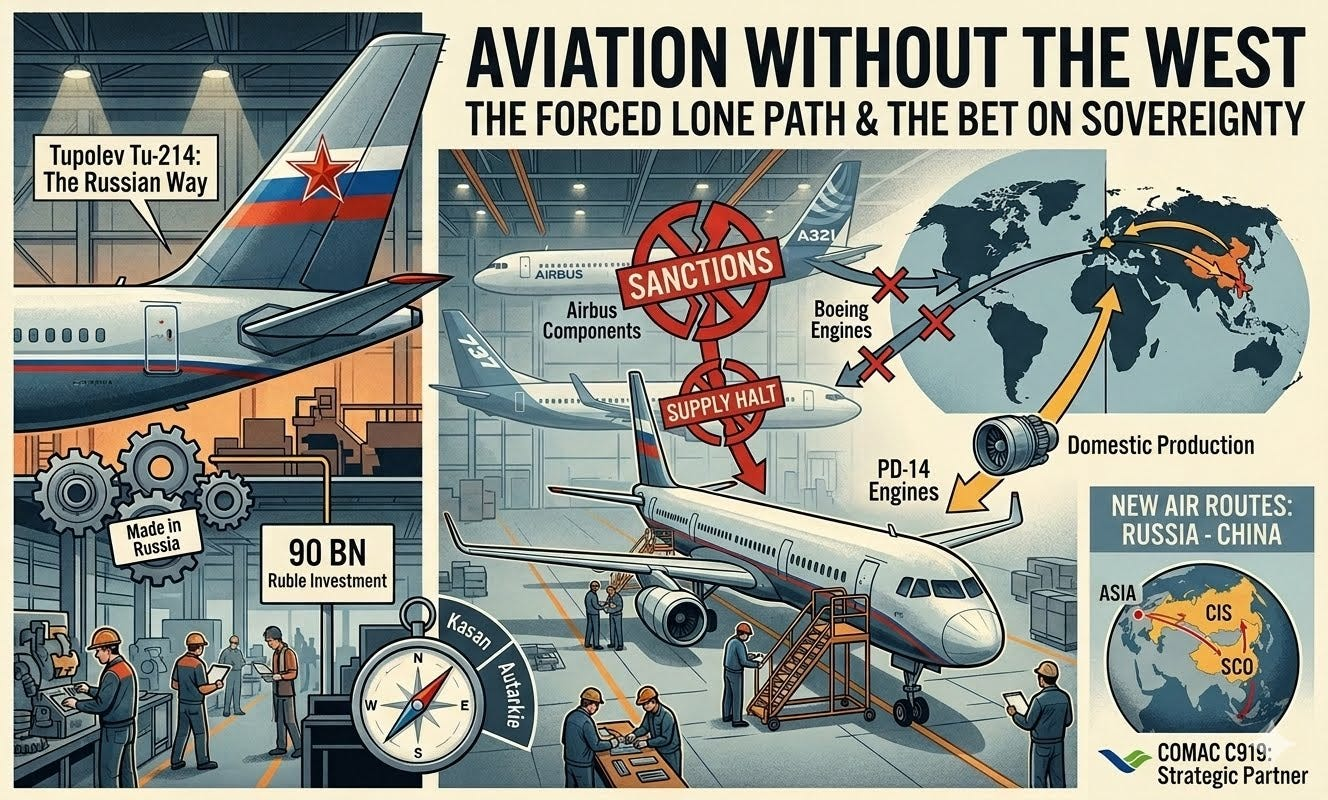
Like China before it—which faced intense sanctions aimed at dismantling its advanced industries and destabilizing its economy—Russia was hit by Western economic sanctions so severe they amounted to an outright economic war. A German foreign minister even publicly declared at the European Parliament, “We are fighting a war against Russia,” adding that the goal was to ruin its economy. Through these actions, both China and Russia learned a critical lesson: the US-led West will eventually weaponize everything at its disposal—currencies, markets, and supply chains—to destroy rivals who refuse to submit.
In response, both nations took a sharp turn toward economic sovereignty to escape this financial aggression, leaning heavily on mutual cooperation.
This is the lesser-known story of how Russia, the world’s largest country, which inherently depends on a massive fleet of airplanes, was suddenly grounded by its Western suppliers—and the extraordinary turnaround that followed. [1]
On February 4, 2026, three Russian organizations signed an agreement for up to 100 passenger aircraft. Not Boeings. Not Airbuses.
Instead, they chose the Tu-214—a Soviet-era airliner that, until recently, was produced only in very small numbers. As detailed in a retrospective by The Moscow Times, the aircraft line had struggled for years with low volume, making a mass orders breakdown like the S7 Tu-214 Deal a massive strategic shift. [1]
When sanctions severed Russia’s access to Western aviation, the country lost far more than just planes. It lost spare parts, leasing arrangements, software updates, maintenance support, and the global supply chains on which its airlines depended. Almost overnight, hundreds of aircraft were thrust into uncertainty.
Russia’s response was a bold gamble: revive the Tu-214, modernize the Kazan Aviation Plant, and rebuild a national aviation industry capable of operating entirely independent of the West. [1]
But can such a massive transformation be achieved before time runs out?
To understand why Russia is investing billions in a Soviet-designed aircraft, we first need to look at what Russian aviation looked like before 2022. The picture is striking. Prior to the sanctions, Russian airlines operated more than 700 Western-built aircraft. Boeing and Airbus formed the backbone of the country’s commercial aviation sector.
S7 Airlines, one of Russia’s largest carriers, relied heavily on Airbus A320s and Boeing 737s. Aeroflot followed a similar model. Across the industry, between 70 and 80 percent of airline fleets consisted of Western aircraft. They were maintained by Western suppliers, financed through Western leasing companies, and supported by Western software systems.
At the time, this was not a strategic mistake—it was a rational business decision. Western aircraft were generally more fuel-efficient, supported by mature global maintenance networks, and backed by financing structures that made fleet expansion affordable. Spare parts were readily available, pilots and technicians were trained worldwide, and support infrastructure existed on every continent. Russian alternatives simply could not compete with the scale, economics, or support ecosystem offered by the Boeing 737 or Airbus A320. As a result, the entire industry evolved around a globalized aviation system.
Then came February 2022.
Sanctions did not arrive gradually. They struck the Russian aviation sector with unprecedented speed. Leasing companies demanded the immediate return of their aircraft. Access to spare parts was cut off. Software licenses became unavailable, and maintenance agreements collapsed. Aircraft that had flown reliably for years suddenly found themselves in legal and logistical limbo.
Russian airlines were no longer deciding between Boeing and Tupolev. They faced a much more fundamental question: How do you keep an entire national aviation system operating when the supply chain on which it depends has been completely severed?
There was no easy answer, and no ready-made backup plan. Decades of dependence cannot be reversed overnight. For Russia, finding a solution was not a matter of preference—it was a matter of national survival.
And that is what makes the Tu-214 story far more significant than the trajectory of a single aircraft. Russia is not simply trying to revive an old airliner; it is attempting to rebuild the entire industrial ecosystem that should have existed behind it all along. [1]
Pulling this off requires an unprecedented industrial overhaul. To back this gamble, Russia is executing a massive 90-billion-ruble (approximately €1 billion) modernization program described in detail by RuAviation. This capital injection targets the Gorbunov Kazan Aviation Plant (KAZ). The goal is to transition the facility from low-volume, handcrafted assembly to true mass production, aiming for an annual capacity of 10 to 20 aircraft by the late 2020s. According to an official update on RuAviation KAZ Reconstruction, this retooling includes constructing brand-new assembly halls, deploying advanced CNC machining centers, and completely digitalizing the production line. [1, 2, 3]
More importantly, engineers are systematically stripping the aircraft of foreign dependencies. As documented by KI Talent Aerospace Analysis, the program has aggressively scaled up the localization rate of parts, forcing an emergency restructuring to replace over 240 Western-sourced components with domestic alternatives. According to certification milestones tracked by RuAviation Flight Preparation News, this includes installing entirely new, localized avionics and redesigning the cockpit layout to move from a classic three-person crew down to a modern, digitized two-pilot system. [1]
Just like China, Russia is succeeding on this path. Meanwhile, their former Western suppliers are losing massive markets and billions in revenue. Ultimately, a self-sufficient Russia and China will not only serve their own vast domestic markets with homegrown products; they will also expand globally, stripping market share away from Western corporations in international hubs. In the end, Western elites may find they made a colossal, self-defeating blunder. By then, it will be too late to course-correct: many Western aircraft factories and countless suppliers—along with their engineers and workers—will inevitably lose their livelihoods.
Did you enjoy this deep dive into the geopolitics of aviation?
On this Substack, I regularly analyze the invisible economic shifts shaping the world of tomorrow. Subscribe to this newsletter to ensure you never miss an analysis and get future posts delivered straight to your inbox.