
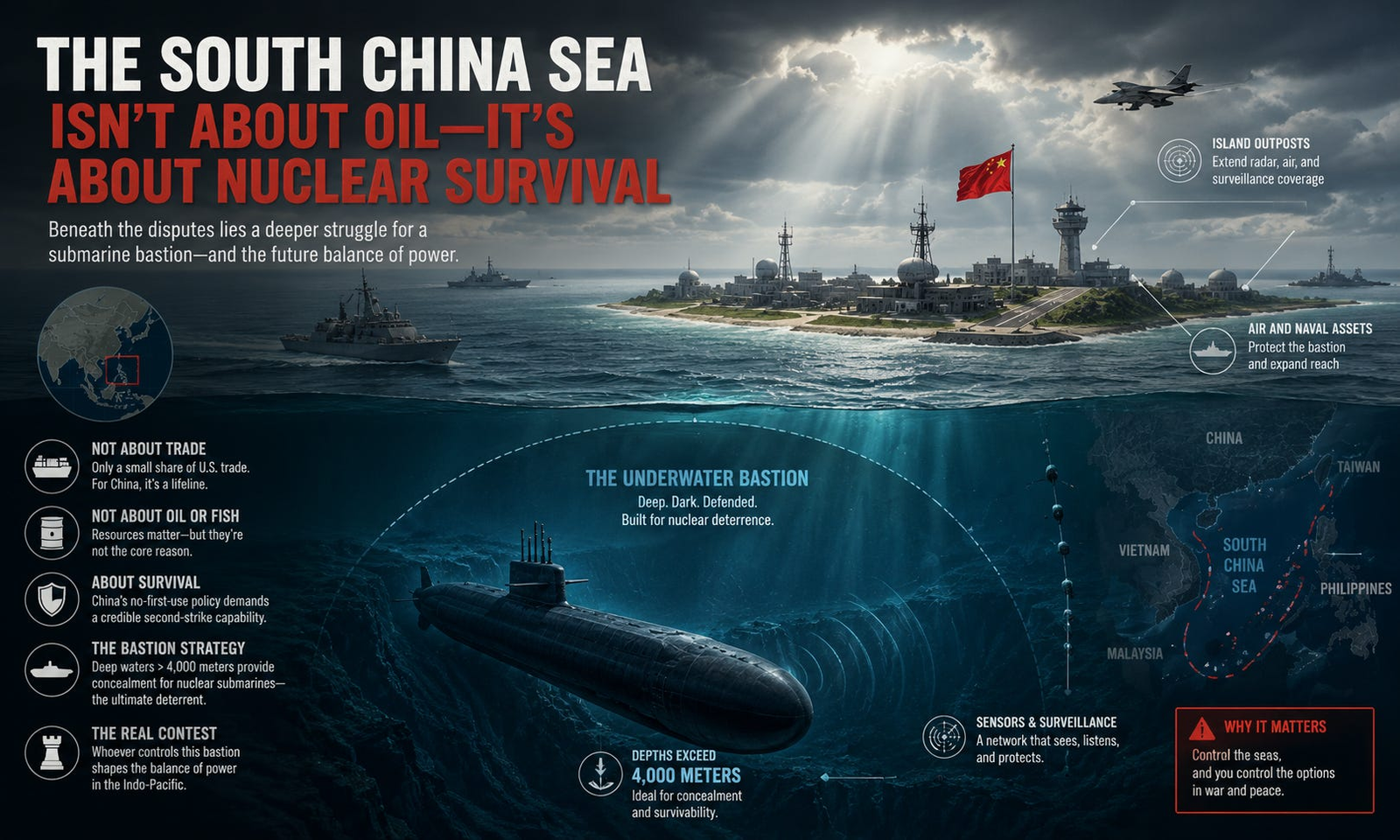
The next major war? What the South China Sea is really about
To state it right from the start: This is neither about oil nor fish stocks nor shipping routes – but about the silent logic of nuclear survival in the depths of the ocean. The South China Sea is one of the most contested regions on Earth. Every year, more than $3 trillion in trade passes through its waters. Naturally, most people assume the conflict revolves around shipping routes, fishing grounds, or the vast oil and gas reserves buried beneath the seabed.
But what if we have been looking at the wrong thing? What if the real reason China cares so much about the South China Sea has less to do with trade profits than with trade survival?
To understand Beijing’s anxiety, one must consider who depends on these waters. The United States has long emphasized the South China Sea’s strategic importance, even though only a small share of its total trade transits the region. For China, however, these waters are a lifeline. More than 60% of Chinese trade by volume—including up to 80% of its crude oil imports and critical food supplies—must pass through the narrow maritime choke points of the South China Sea.
This dependence creates what strategists call the “Malacca Dilemma”. In the event of conflict, an adversary such as the United States could blockade these sea lanes, disrupting China’s access to energy and food within weeks. For Washington, controlling these waters are a geopolitical lever; for Beijing, it is an existential concern.
According to Singapore’s former foreign minister, George Yeo, the deeper answer lies beneath the surface. At its core, this is a story about ultimate survival: nuclear deterrence.
China maintains a strict no-first-use nuclear policy. For such a strategy to remain credible, Beijing must possess a guaranteed second-strike capability—the ability to retaliate after suffering a nuclear attack. Yet Washington is equally committed to preventing China from acquiring an invulnerable retaliatory force.
Why? Because in a purely conventional conflict around Taiwan or the South China Sea, repeated war games conducted by the U.S. Indo-Pacific Command and the RAND Corporation have pointed to a sobering conclusion: America cannot win the war.
Geography plays a critical role. Much of the Yellow Sea and East China Sea is relatively shallow, making anti-submarine detection significantly easier by reducing the number of places a submarine can hide. To use a simple analogy, tracking a submarine in such waters is more like spotting a whale in a swimming pool than in the vastness of the open ocean.
This vulnerability affects one of the most important components of nuclear strategy. Submarines are widely regarded as the most survivable leg of a nation’s nuclear triad. Land-based missile silos can be targeted, and air bases can be destroyed. A submarine concealed within thousands of square kilometers of ocean presents an entirely different intelligence challenge. For that reason, nuclear-armed submarines are often described as the ultimate strategic insurance policy.
For decades, the United States and Russia have relied heavily on submarine fleets for their nuclear deterrence; China is now making concerted efforts to acquire this same strategic capability. It is precisely this objective that explains the immense geopolitical significance of the South China Sea.
While a conventional map gives little hint of this strategic value, a bathymetric depth map reveals an entirely new dimension. In contrast to the shallow Yellow and East China Seas, the central South China Sea plunges to immense depths exceeding 4,000 meters.
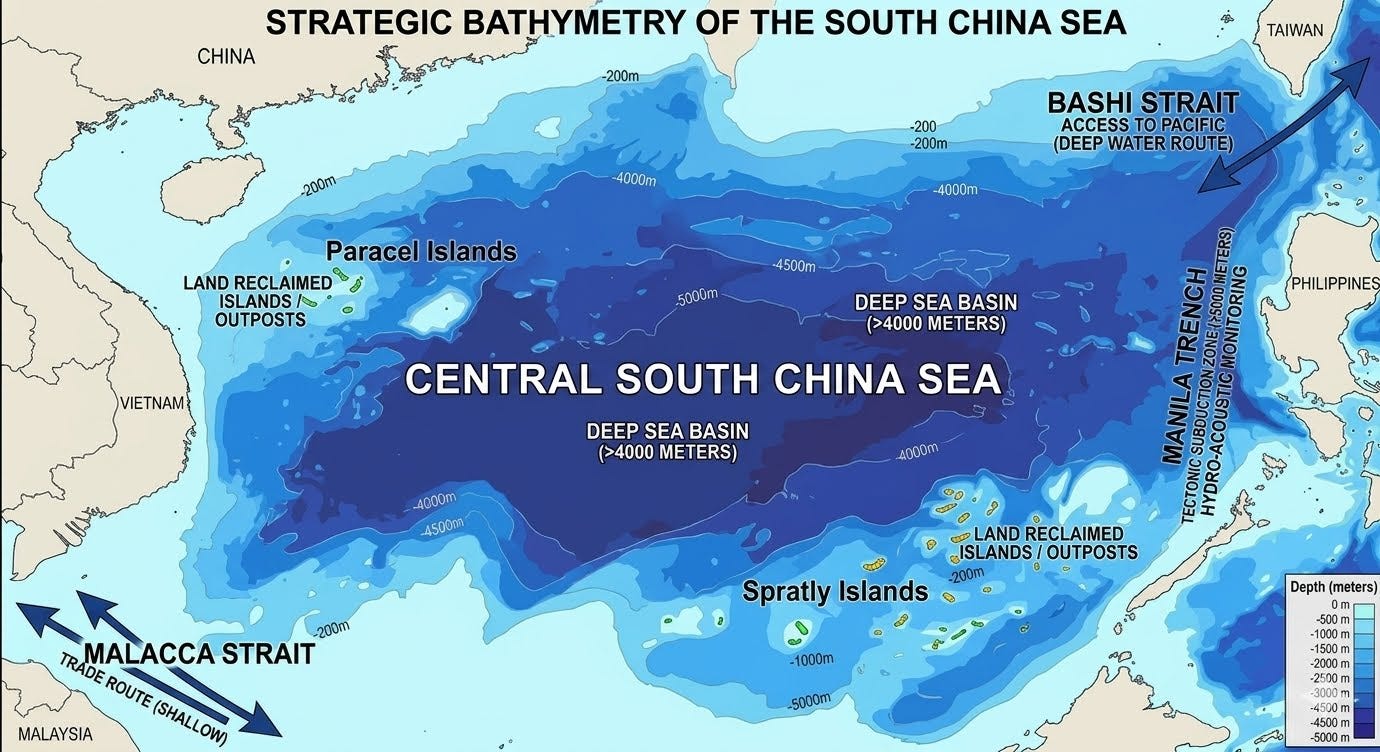
Bathymetric map created by Google
In nuclear strategy, survivability depends on concealment. The longer a submarine remains undetected, the more credible its deterrent value becomes. Consequently, many analysts argue that Beijing views the South China Sea less as a commercial transit corridor than as a strategic shield. In naval doctrine, such a protected zone is known as a “bastion”—a heavily defended maritime area where ballistic missile submarines can operate under the protection of domestic air, naval, and surveillance assets.
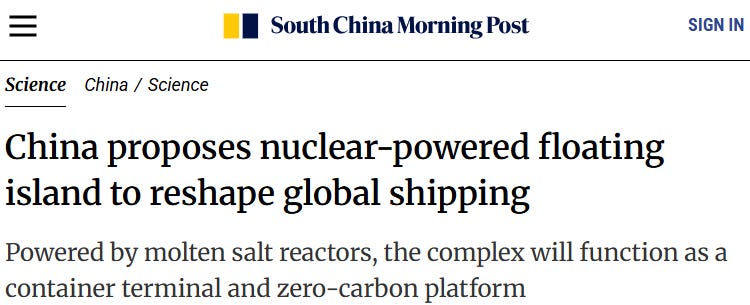
The same strategic thinking can be seen in China’s growing interest in civilian nuclear maritime infrastructure, including proposed molten-salt-reactor-powered floating logistics hubs. Although designed for commercial purposes, such projects illustrate a broader national emphasis on combining advanced nuclear technology, maritime mobility, and long-term strategic resilience.
This fortress-like approach prioritizes survivability over power projection. The concept has historical precedent. During the Cold War, the Soviet Union established similar bastions to protect its nuclear submarine fleet near home waters. Many observers believe China is pursuing the same strategy today. Viewed through this lens, Beijing’s regional behavior takes on a different meaning—particularly its extensive island-building campaign, which has transformed remote reefs and outcroppings into heavily militarized outposts.
Today, many of these installations feature long runways, advanced radar systems, deep-water ports, and fortified military infrastructure.
To outside observers, this vast construction effort initially appeared puzzling. Spending enormous resources on remote reefs hundreds of kilometers from major population centers makes little sense if the objective is purely economic. Commercial shipping has functioned for decades without artificial islands. However, if the goal is to monitor and secure strategically vital waters, the rationale becomes much clearer.
These militarized islands function as a network of forward maritime lookout posts. By extending radar coverage and supporting naval aviation, they drastically enhance China’s situational awareness, effectively establishing a protective military umbrella over the deep-water bastion below.
Predictably, this architecture directly challenges the hegemony Washington established after the Second World War—a hegemony the US maintains through a permanent military presence in the countries it occupied during the war and subsequently transformed into “allies.”
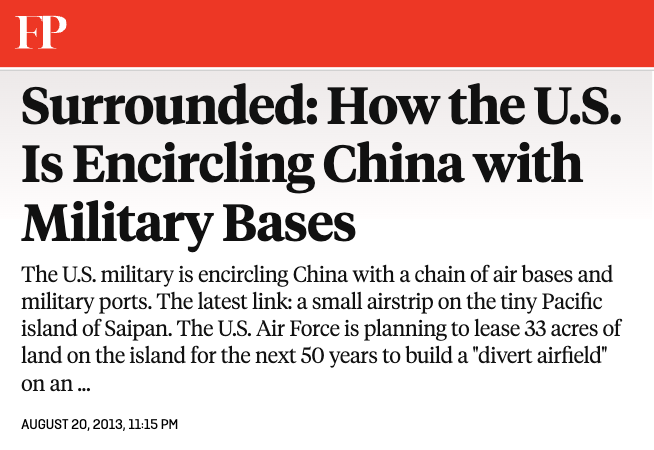
Since then, the US has established countless military bases to encircle China—a fact acknowledged by Foreign Policy, a mouthpiece of the American foreign policy establishment as well as neoconservative China hawks.
Washington routinely justifies the encirclement of the Chinese mainland with military bases under the banner of “freedom of navigation”—a hollow rationale, given that China itself depends far more than any other nation on unhindered maritime trade. Moreover, unlike the US, China harbors no ambitions for global hegemony, nor does it seek territorial expansion or regime-change operations in its neighborhood—practices that are integral to US policy.
In contrast to the West, China’s actions are not driven by ideology and hegemonic ambitions, but by rational pragmatism. This will allow the leadership to reach mutually agreed solutions with neighboring states regarding maritime boundaries and the exploitation of resources, rather than resorting to military confrontation.
Consequently, where China recognizes vulnerability, the United States perceives expansion. Where Beijing seeks defensive security, Washington and its “allies” allege coercion. Ultimately, the defensive shield forged by China is weaponized in Western Orwellian rhetoric as an offensive sword.
This fundamental systemic divide illustrates why purely tactical friction over reefs, coast guard standoffs, and routine patrols carries such a high potential for escalation. What superficially appears to be a regional dispute over uninhabited rocks is, at its core, the epicenter of a global competition that the United States—an eroding and unsettled world power—is striving to win at any cost. At stake are maritime doctrines, the future regional order, and the instruments of sovereignty with which a rising China secures its place within the international system.
George Yeo’s thesis exposes the core reality of the South China Sea dispute—a reality consistently suppressed by Western media. It underscores a hidden strategic dimension, illustrating that major global conflicts are rarely driven by surface-level geography alone.
Deep beneath the ocean surface, where ballistic missile submarines patrol silently, lies a nuclear deterrent capable of halting aggression by major powers. Viewed in this light, the South China Sea dispute transcends an ordinary conflict over maritime boundaries; it is, in essence, the decisive strategic theater of the 21st century, where a crumbling empire still seeks to prevent one of humanity’s oldest civilizations—now poised to regain its former greatness—from doing so.