
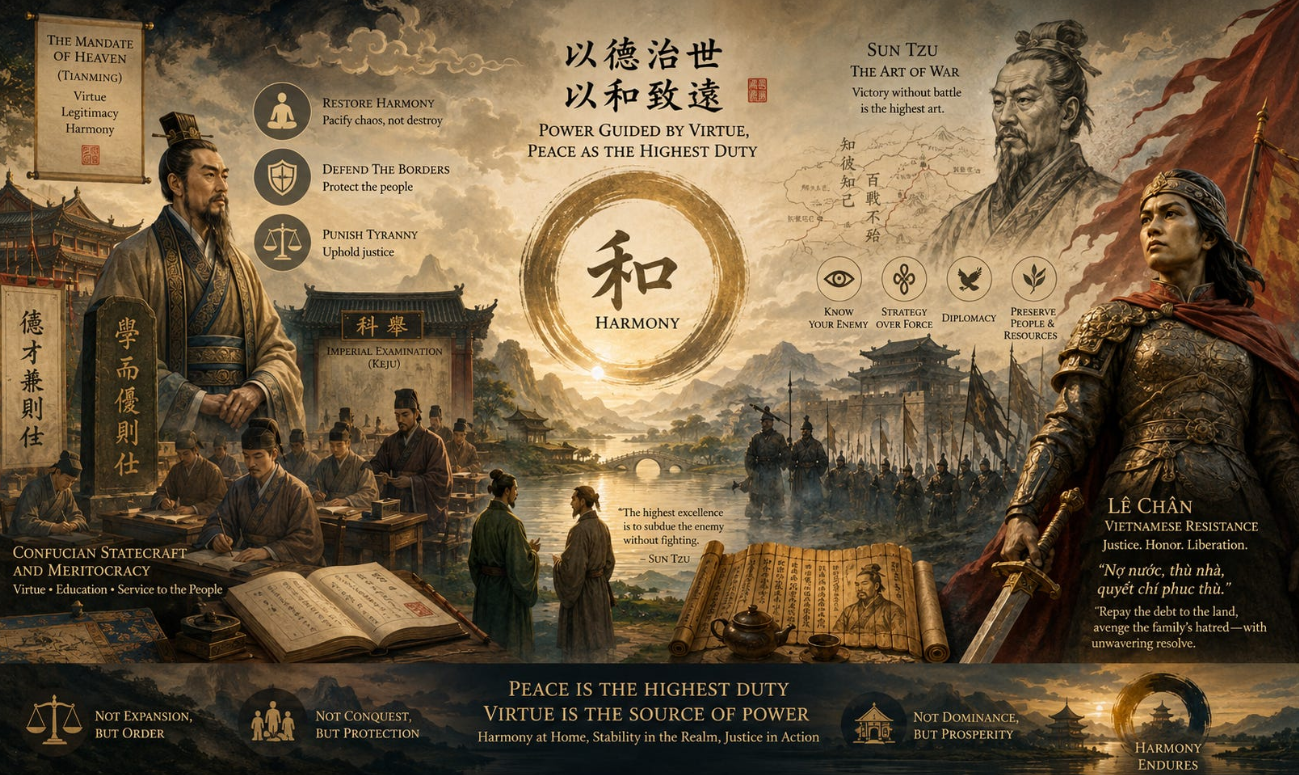
While the Western tradition often invoked the idea of a “just war” (bellum iustum) to legitimize expansion or ideological ambition, Asian thought framed military force as a strictly defensive corrective—an ethical tool to restore balance rather than disrupt it.
Long before Europe’s theories shaped by thinkers like Augustine and Thomas Aquinas, Asian philosophers, strategists, and resistance leaders had already developed an intricate moral philosophy of warfare. Confucian statecraft tied the use of force to the ruler’s personal virtue and the preservation of cosmic order; meritocratic governance ensured that only the morally cultivated could wield power; Sun Tzu’s strategic wisdom elevated the ideal of victory without violence; and Vietnamese resistance movements embodied the principle that war becomes legitimate only as a last-resort defense of justice.
Together, these traditions reveal a lasting truth: in Chinese-influenced Asian statecraft, peace is not merely an ideal but the highest obligation of those who govern—an ethical mandate binding power to virtue, restraint, and the maintenance of cosmic harmony.
1. The Mandate of Heaven: War as Moral Correction
At the heart of Confucian statecraft stands the ideal of harmony (hexie). For renowned historians and thinkers of classical China—from Mencius (Mengzi) to the chroniclers of the great dynastic histories such as Sima Qian—waging war was never an end in itself or a tool for mere expansion.
In the Confucian sense, war represented a fundamental deviation from the natural order and was therefore legitimate only under strict moral conditions:
- Restoration of harmony: A just war served to pacify chaos, not to destroy.
- Defense of the borders: Protecting one’s own population from external invasion was considered a sacred duty.
- Punishment of disloyalty and tyranny: Military force was understood as a form of cosmic execution against rulers who violated their duties.
In this way of thinking, military success was directly tied to moral legitimacy. The Mandate of Heaven (Tianming) was granted to a ruler only as long as he acted virtuously.
Excessive brutality, exploiting the population for imperial adventures, or disastrously failed invasions were not merely tactical errors to Confucian chroniclers—they were irrefutable proof that the ruler had lost his moral integrity and thus his right to govern.
The Foundation of Virtue: Confucian Meritocracy
The Mandate of Heaven was not an abstract stroke of fate but was embedded in a highly developed institutional system: Confucian meritocracy. Unlike European feudal systems, which passed power almost exclusively through hereditary privilege, Confucian statecraft established a rigid system of performance-based selection. Through the imperial examination system (Keju), officials and advisers were chosen based on intellect, mastery of the classics, and moral maturity.
Inherent in this meritocratic system was the aim of identifying and promoting leaders and strategists capable of meeting the moral requirements of the Mandate of Heaven. Only those who demonstrated—through education and self-cultivation—the ability to place the welfare of the people above personal interest possessed the legitimacy to decide matters of war and peace. Meritocracy thus served as an administrative shield against the arbitrariness of incompetent despots and ensured that military power lay in the hands of those who valued virtue over aggression.
2. Sun Tzu and the Art of Bloodless Victory
Parallel to the moral statecraft of Confucianism evolved a pragmatically strategic school of thought, whose most prominent representative was Sun Tzu (Sunzi) some 2,400 years ago. Although his work The Art of War is often read as a handbook of deception, at its core it contains a deep skepticism of open violence.
Sun Tzu’s most famous axiom states that the highest art of war is to subdue the enemy without fighting. A war won without a single battle preserves state resources and protects the lives of subjects. Sun Tzu recognized that physical destruction weakens the victor. His strategy of deterrence, psychological warfare, and diplomacy fits seamlessly—though for pragmatic rather than purely moral reasons—into the Asian pursuit of preserving order and stability.
3. The Vietnamese Resistance: The Timeliness of the Legendary Woman General Lê Chân
That these philosophical concepts were not merely elite theories is shown in Vietnamese history, where resistance against tyranny became an existential philosophy of survival. How deeply these traditional values remain anchored in collective memory became clear recently in the Vietnamese port city of Haiphong, where I stood before the imposing statue of General Lê Chân—an homage to the legendary founder of the metropolis, whose legacy endures to this day.

Lê Chân fought in the year 40 CE alongside the famous Trưng Sisters (Hai Bà Trưng). Trưng Trắc and her sister Trưng Nhị took up arms to end the cruel and corrupt rule of the Chinese prefect Su Ding. Their struggle was deeply Confucian in motivation: it opposed the perversion of power by the foreign occupiers and the destruction of local, just order.
The General’s Oath: “Debt to the Land, Hatred of the Family”
Lê Chân’s courage did not spring from blind lust for destruction but from a profound moral code of honor. When the corrupt Chinese ruler destroyed her family, she rose in the name of justice. Vietnamese historical tradition still preserves the words with which she rallied her troops and defined the moral core of her struggle:
“Nợ nước, thù nhà, quyết chí phục thù.”
(“Repay the debt to the land, avenge the family’s hatred—with unwavering resolve.”)
This historical motto illustrates the perfect synthesis of personal virtue and collective defense: war is not sought, but understood as an unavoidable response to moral injustice. As a military leader and strategically brilliant rebel, Lê Chân not only defended her country—she embodied the legitimate resistance against an unlawful despot. For Vietnamese historiography, these women fought an absolutely just war because their violence was defensive, proportionate, and singularly dedicated to liberating the people and restoring just order.
Conclusion: A Timeless Lesson on the Limits of Violence
The synthesis of Confucian moral philosophy, meritocratic leadership selection, Sun Tzu’s strategic wisdom, and the practical liberation struggles of Vietnamese heroines reveals a fundamental axiom of Asian statecraft. It highlights a deep systemic contrast to Western expansionist history:
- No religious universalism: Unlike European crusades—wars waged in the name of a supposedly universal divine mandate to conquer foreign lands and convert nonbelievers—Confucian thought knows no missionary impulse. A “holy war” to spread ideology is foreign to this tradition.
- No colonial exploitation of resources: While Western colonialism was driven by systematic subjugation, humiliation, and economic exploitation—often cloaked in a racist narrative of a “civilizing mission”—the Confucian principle of virtue (Ren) forbade such imperial projects.
- Primacy of internal prosperity: A just ruler, in the Confucian sense, does not define greatness by overseas territories or the expansion of a power sphere. His highest goal is domestic stability and the safeguarding of existing borders.
In this tradition, military force is considered the most extreme and painful corrective used to restore a disrupted cosmic order—never a legitimate tool of expansion. The leader’s primary duty lies in protecting the status quo so that the people can prosper in peace and social security. External aggression is interpreted as a glaring failure of inner virtue.
A striking modern example of this strategic logic is China’s one-month border war with Vietnam in 1979. The conflict followed immediately after Vietnamese troops entered Cambodia and toppled the murderous Khmer Rouge regime—a move that, from Beijing’s perspective, severely disrupted the regional balance. As analyses from the Hoover Institution indicate, this military engagement was strictly limited from the outset: Beijing sought neither territorial conquest nor a far-reaching regime-change operation in Hanoi, as is common in Western interventionist history. The invasion served purely as a punitive measure—a “punitive expedition” in the classical Confucian sense—to demonstrate boundaries and enforce the restoration of regional order.
While the Western concept of the “just war” often served as a legal veil for expansive dominance, Asian thought located peace in the moral character of the actor. Figures like Lê Chân—whose legacy is still honored today by locals and international observers alike—stand as living proof of this timeless lesson: true statecraft is not demonstrated by inciting ideological conflicts, but by the pragmatic ability to preserve justice, prosperity, and harmony within one’s own land and its periphery.
In the end, the Asian intellectual tradition shows us that true civilization is not measured by the reach of its weapons, but by the steadfastness of its inner peace.