
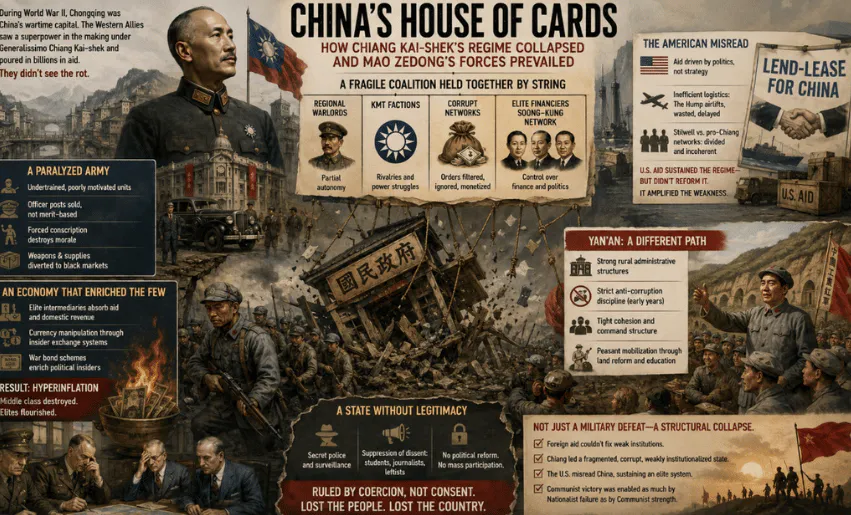
Chongqing became China’s wartime capital during World War II. At the time, the Western Allies looked at China and saw a superpower in the making. At the top stood Generalissimo Chiang Kai-shek, who resided there and was portrayed as the unquestioned leader of a unified nation resisting Japan. Washington poured billions of dollars in aid, weapons, and supplies into his government, without fully grasping how corrupt and dysfunctional it was. Unsurprisingly, just a few years later, it all collapsed. The Nationalist regime was swept away by Mao Zedong’s Communist forces.
How did one of the largest armies in the world fall apart so quickly?
Journalists on the ground, like Agnes Smedley, saw the reality long before the collapse. Chiang Kai-shek was not leading a modern, cohesive state. He was presiding over a house of cards.
Smedley, an American journalist embedded in China, documented much of this firsthand in her classic work China Fights Back: An American Woman With the Eighth Route Army. Today, her reporting is often cited as an early window into the structural rot that ultimately destroyed Nationalist China from within.

To understand Chiang’s failure, you have to understand that he did not fully command China. Allied governments assumed his authority was absolute. In reality, the Nationalist regime was a fragile coalition held together by string.
Chiang was constantly balancing four competing forces:
- Regional warlords with partial autonomy
- Rival factions within the Kuomintang party apparatus
- Deeply corrupt military and bureaucratic networks
- Elite urban financiers linked to the powerful Soong–Kung family network (of which his wife was a prominent member)
Because of this fractured system, orders from the top were filtered, ignored, or monetized at multiple levels. Centralized war planning became nearly impossible. When massive infusions of U.S. aid arrived, they often did not reach the front lines; instead, they dissipated through layers of weak accountability.
What may surprise Americans today—given the prevalence of contemporary sinophobia—is that during this very period, there existed a powerful, pro-Chiang China Lobby in the United States. From the 1930s through the early Cold War, this lobby played a major role in shaping American perceptions of China.
In its time, it was considered one of the most powerful foreign-policy lobbies in Washington, rivaled only by the kind of influence the Israel lobby wields over the White House and Congress today.
One of its most prominent champions was Henry R. Luce, the influential publisher who founded Time, Life, and Fortune. Luce—born in China to missionary parents—used his media empire to portray Chiang Kai-shek and his wife, Soong Mei-ling, in consistently heroic terms. In Time, Chiang became one of the most frequently featured foreign leaders of the era. Luce’s magazines did not merely report on China; they actively shaped the narrative, amplifying anti-communist sentiment and advancing the idea that Chiang’s government represented China’s best hope for modernization and alignment with the United States.
Chiang’s wife, Soong Mei-ling, was arguably the China Lobby’s most powerful figure in the United States. She became a media sensation, featured repeatedly in Time, and her 1943 address to the U.S. Congress electrified American audiences.
This powerful American mythmaking further obscured the internal weaknesses of Nationalist China, encouraging Washington to see Chiang not as he was—a leader presiding over a fragmented political structure—but as it wished him to be.

This systemic rot paralyzed the Nationalist Army. On paper, Chiang commanded millions of troops. In reality, his military functioned less as a disciplined national force and more as a sprawling patronage system.
On the ground, reporters like Smedley documented a bleak picture:
- Many units were undertrained and poorly motivated
- Officer positions were frequently purchased through patronage rather than merit
- Forced conscription practices devastated peasant morale
- Weapons and supplies were routinely diverted into black markets
American weapons could not save an army that was structurally incapable of absorbing them. Tanks and rifles often failed to translate into battlefield effectiveness because the institutional framework itself was broken.
While soldiers starved, elites grew wealthy. The Nationalist economy was dominated by insider financial networks, particularly those connected to the Soong family.
Instead of building a wartime economy based on shared sacrifice, the regime increasingly relied on financial extraction:
- Elite intermediaries absorbed foreign aid and domestic revenue
- Currency manipulation was enabled through insider exchange systems
- War bond schemes enriched political insiders
The result was catastrophic hyperinflation. The Nationalist government printed money to finance the war, destroying the middle class. Private enrichment and political survival became tightly intertwined. Wartime hardship was imposed on the population, while control over resources remained concentrated at the top.
As popular support collapsed, Chiang’s government increasingly relied on coercion rather than legitimacy.
The regime depended on:
- A powerful secret police apparatus
- Suppression of dissent among students, journalists, and leftists
- Blocking meaningful political reform or mass participation
By closing off political space, the Nationalists failed to build lasting legitimacy. This was especially decisive in rural areas, where most of the population lived and where the Communist movement was steadily expanding. A system based on coercion rather than participation struggled to mobilize society effectively, whether against Japan or its internal rivals.
Why did the United States continue funding this system? Washington committed enormous resources through Lend-Lease, but American strategy was shaped by a deep misunderstanding of Chinese politics.
The policy suffered from several structural flaws:
- Aid distribution was often driven by political favoritism rather than strategic need
- Logistics, including Himalayan airlifts, were extremely inefficient
- Internal U.S. disputes—such as those involving General Joseph Stilwell and pro-Chiang political networks—undermined coherence
The United States treated China as a unified, modern ally state. In reality, it was a fragmented and highly contested political system. American assistance sustained the Nationalist government politically without forcing the institutional reforms needed to stabilize it. In many cases, aid amplified existing weaknesses rather than correcting them.
Meanwhile, in the Communist base area of Yan’an, observers like Smedley noted a stark contrast.
Mao Zedong’s movement was building a different kind of political system:
- Tight, highly organized rural administrative structures
- Strict anti-corruption discipline in its early phases
- Strong internal cohesion and command structure
- Peasant mobilization through land reform and political organization
Chiang’s government was not defeated purely by military force. It collapsed because it represented an older, elite-centered order that could not compete organizationally with a more disciplined rival.
The fall of Nationalist China is often framed as a military defeat, but it was also a structural collapse. Foreign aid, advanced weapons, and diplomatic recognition cannot compensate for weak institutions and collapsing legitimacy.
Chiang Kai-shek led a fragmented, corrupt, and weakly institutionalized state. U.S. policy misread that reality, sustaining an elite system rather than transforming it. In the end, Communist victory was enabled as much by Nationalist failure as by Communist strength.
Fast forward: After being defeated by the Chinese Communist Party, Chiang Kai-shek and his Kuomintang (KMT) party fled to Taiwan, holding onto the hope of ruling all of China once again. Over time, separatist movements emerged on the island. In a twist of historical irony, the U.S. began backing these factions with billions of dollars in military aid and even stationed American troops on the island. This stands in stark contrast to the fact that Washington has officially recognized Taiwan as a province of China since President Nixon normalized relations with Beijing in the 1970s.
Imagine Washington’s reaction if Beijing sent billions in weapons to separatists in Texas or California to fight the U.S. government.
Meanwhile, the head of Chiang’s KMT party recently visited Beijing. Representing the large majority of Taiwanese citizens who wish to avoid a devastating war with the mainland, they called for peaceful co-existence and eventual reunification.

Kuomintang chairwoman says “hostility towards mainland is a product of political engineering that does not reflect reality of Taiwan.” (Picture: KMT chairwoman Cheng Li-wun meeting Chinese president Xi Jinping in Beijing on April 10, 2026)
Taiwan’s current minority government relies on authoritarian tactics to suppress domestic critics, silencing those who warn that its pro-separatist agenda is playing with fire.
Ultimately, history is repeating itself: Washington’s elites continue to pour billions in taxpayer money into keeping the cross-strait conflict alive, despite the reality that it is a conflict they can never win.