
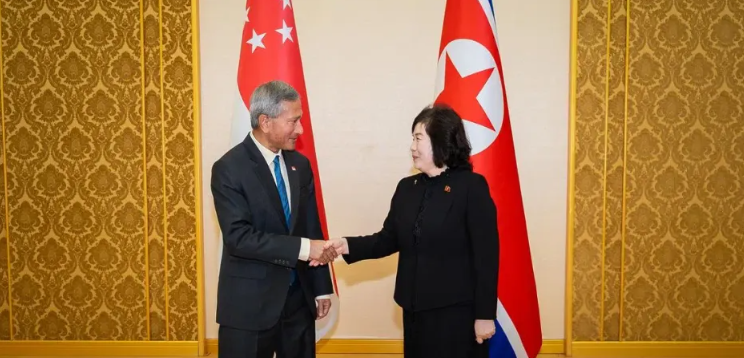
In case you missed it, the foreign minister of Singapore, Dr Vivian Balakrishnan, has just completed a two day meeting in Pyongyang with North Korean Foreign Minister Choe Son Hui. The discussions were officially described in standard diplomatic terms covering trade, regional security and broader geopolitical issues in Asia. But for Korea watchers, the more interesting question is whether this signals something deeper than routine diplomacy, and whether it reflects a possible reset in relations between two countries that were once far more closely connected than they are today.
Singapore and North Korea are not ideological partners and never have been. Their relationship has always been defined by pragmatism rather than alignment, shaped by convenience and the ability of both sides to separate politics from practical engagement when necessary. That pragmatism is what allowed the relationship to develop in the first place, and it is also what makes any renewed engagement worth examining now.
From Cold War caution to commercial engagement
Diplomatic relations between Singapore and North Korea were established in 1975 shortly after Singaporean independence. During the Cold War, the relationship remained limited and formal, shaped by Singapore’s regional positioning in Southeast Asia defined by competing ideological systems and neighbouring communist states including Vietnam, Laos and Cambodia, alongside broader strategic considerations involving China. North Korea at the time remained largely isolated from global economic networks, and engagement between the two countries stayed minimal and largely symbolic.
The more substantive phase of the relationship emerged from the late 1990s through the 2000s and into the early 2010s, when engagement expanded quietly through commercial and semi-commercial channels. Singapore-linked business activity appeared in North Korea in areas such as retail, construction and consumer goods, reflecting a period in which Pyongyang was opening to limited foreign economic models and experimenting with capitalism.
One of the more frequently cited examples from this period is the Singapore-linked burger restaurant in Pyongyang known as Samtaesong. According to accounts from individuals involved in North Korea engagement at the time, the concept emerged after North Korean officials encountered Singapore-style fast food during overseas visits and expressed interest in introducing a localized version in Pyongyang, which resulted in a functioning burger outlet operating under that name. And for a while it was not just popular, but owned and operated by the nomenclature of the Workers Party of Korea.
Alongside this, there were Singapore-linked involvements in retail and commercial developments along Tongil Street in Pyongyang, including shopping facilities and consumer goods spaces associated with Singaporean entities These developments formed part of a broader trend that has continued to this day of economic liberalization within the DPRK.
Singaporean consumer products also appeared in North Korean retail circulation during this period. Beverage items, including products associated with the Pokka range, were reportedly available in Pyongyang shops during the 2010s, reflecting a controlled but noticeable presence of foreign consumer goods in the country’s retail environment.
Tourism also formed part of this engagement. Singaporean visitors travelled to North Korea under structured tour arrangements, and while volumes were never large by Singaporean standards, they were regarded as a stable and reliable Southeast Asian source market within North Korea’s tourism system. In relative terms, this placed Singapore as a key partner in the tourism sector of North Korea.
Sanctions pressure, contraction and the Pyongyang meeting
That phase did not last as international sanctions pressure on North Korea intensified from the mid to late 2010s, gradually narrowing the space for external commercial engagement and significantly reducing the scope for the kinds of semi-open economic interactions that had previously existed. Activities that had once operated in loosely structured or semi-commercial forms became increasingly constrained under tightening regulatory and enforcement frameworks.
Singapore, like other states, adapted to this environment as enforcement expectations increased and scrutiny of any North Korea-linked transactions intensified. This period also saw legal cases in Singapore involving individuals connected to alleged sanctions-related dealings with North Korea, reflecting the broader shift in the global compliance environment rather than a breakdown in diplomatic relations.
Despite this contraction, formal diplomatic ties remained intact and Singapore continued to support multilateral dialogue on the Korean Peninsula while maintaining its position as a neutral regional actor. This neutrality was later reinforced when Singapore hosted the 2018 Trump–Kim summit, a high-profile diplomatic event that highlighted its role as an acceptable venue for North Korea’s engagement with major international actors.
Against this backdrop, the recent meeting in Pyongyang between Dr Vivian Balakrishnan and Choe Son Hui takes on additional significance. The talks were described as constructive and covered bilateral relations, regional security and broader geopolitical dynamics. Singapore reiterated its support for dialogue and stability on the Korean Peninsula, while North Korean officials reportedly expressed appreciation for Singapore’s continued diplomatic engagement despite sanctions pressure and wider geopolitical constraints.
One notable aspect of the visit was the reported invitation for North Korea’s foreign minister to engage with ASEAN foreign ministers at upcoming ASEAN-related meetings. While no commitments were made, this signals that Pyongyang continues to explore pathways for structured regional engagement through Southeast Asian diplomatic platforms, particularly those involving states with historically functional relationships such as Vietnam, Laos and Cambodia. Vietnam famously hosted the second Trump – Kim Summit, while Kim Il-Sung was extremely close friends with King Sihanouk.
No agreements were signed during the visit and no immediate policy changes were announced. However, the symbolism of the meeting lies in the fact that structured diplomatic engagement is still taking place at this level after years of reduced interaction.
The most accurate interpretation is not that relations are returning to their previous commercial phase, but that a limited reset may be emerging within current constraints. Singapore and North Korea have always engaged when conditions allowed and scaled back when external pressures increased, and the current moment appears to reflect a continuation of that pattern rather than a departure from it.What happens next will depend less on bilateral intent and more on regional diplomacy, sanctions frameworks and North Korea’s evolving external strategy. Make no mistake though, Singapore has likely noticed the current economic boom in Pyongyang with great interest. Whether this will mean a resumption of their love affair is yet to be seen. Moments like this though prove that North Korea is far from the Hermit Kingdom it is made out to be.