
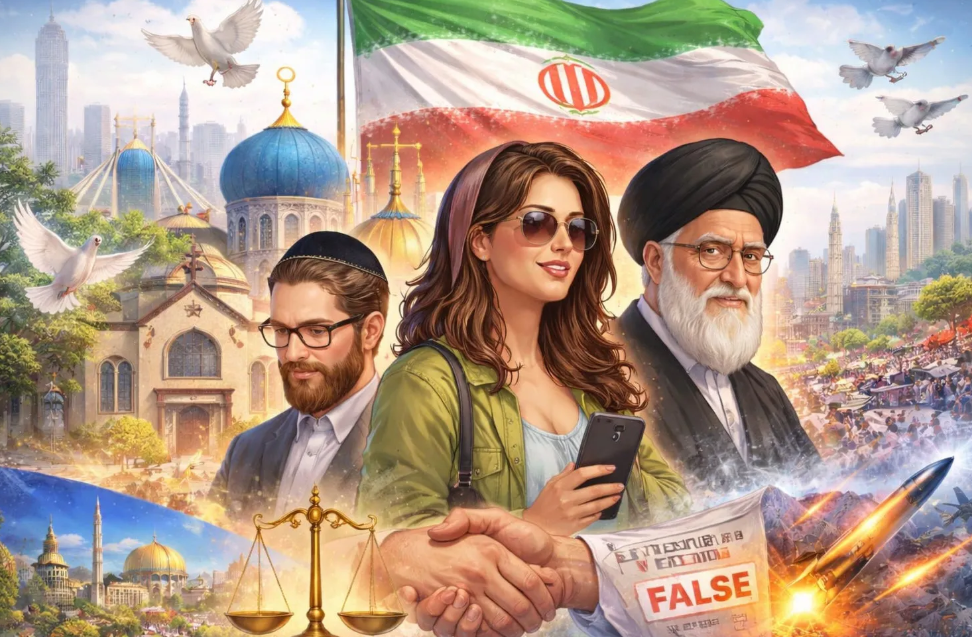
Jewish Life and Minority Rights in Modern Iran
When I was on a business trip to the Islamic Republic of Iran decades ago, I posed the crunch question to a high-ranking government official: How does the state treat its minorities? Without hesitation, he replied: “All citizens are equal before the law. Hate speech and attacks against Christians, Jews, and other minorities are not tolerated and are punished.” Later, when I asked an Iranian Jew whether he felt safe in the Islamic Republic, he confirmed: “Yes, there is no antisemitism here.”
In fact, Judaism in Iran is a constitutionally recognized minority religion with protected status. Historically, there have been dozens of synagogues in the country. The only synagogue that was ever destroyed was the Rafi-Nia Synagogue on April 7, 2026 — not by Muslim extremists, but by reckless Israeli bombing raids that hit this and other civilian targets. The Jewish parliamentary representative Homayoun Sameh visited the ruins and commented on the incident accordingly.
A remarkable example of the integration of the Jewish minority can be seen in the annual celebrations of Shavuot. Like Jews worldwide, Iranian Jews commemorate on this day — seven weeks after Passover — the giving of the Ten Commandments at Mount Sinai. Since this festival often coincides with the national university entrance exams, the Iranian state acts pragmatically and respectfully: the authorities officially postpone the exam dates to ensure that Jewish students can celebrate their religious holiday without disadvantage.
“Before being Jewish, we are Iranian first”. Members of the Jewish community in Shiraz spoke about their deep connection to Iran and emphasised the importance of their national identity. One speaker highlighted their 2,500-year history in Iran, adding that their community is distinct from Zionism and is proud of their Iranian heritage.
The Jewish community in Iran today numbers around 10,000 people. A Jewish-American investigative journalist visited them last year and documented their life in a detailed film.
Ethnic Diversity and National Cohesion
The overwhelming majority of Iran’s 93 million inhabitants — including Persians, Azerbaijanis, Lurs, Gilakis, and Mazandaranis — are Twelver Shiites. This contributes significantly to national unity. Sunni minorities are found mainly among Kurds, Baluchis, Turkmens, and parts of the Arab population in the border regions. While groups such as the Azerbaijanis — to which the late Ayatollah Khamenei also belonged — are firmly integrated into the state, external actors like the USA and Israel regularly try to incite autonomy aspirations among Kurds and Baluchis, which sometimes leads to tensions.
The Question of Israel and the “Death to America” Slogan
When accused of wanting to destroy Israel, the Ayatollahs respond: “We reject a system in which one group discriminates against another, steals its land, and expels it. We stand for a state in which Muslims, Christians, and Jews live together equally and in peace.”
The frequently quoted cries of “Death to America” also require context. In the past, people in the streets of Iran shouted “Death to the Soviet Union” — meaning the Soviet leadership, which was perceived as anti-Iranian, not its population. Today, Iran maintains good relations with Russia. According to Ayatollah Khamenei, the slogan is directed against the policies of the U.S. government, while the American people are explicitly treated with goodwill.
Nuclear Program and the Fatwa Against Weapons of Mass Destruction
Is Iran striving for the atomic bomb? In the early 2000s, Ayatollah Khamenei issued a formal religious ruling (Fatwa), which was reaffirmed at the United Nations in 2005: the production and use of nuclear weapons are forbidden under Islamic law (haram). The nuclear agreement (JCPOA) was intended to guarantee peaceful use. While the IAEA has always certified Iran’s compliance with the obligations, the West did not fulfill its part of the agreement — the lifting of the strangling sanctions.
Scholars Instead of “Barbaric Mullahs”
The image of the “barbaric mullah” barely withstands closer scrutiny. Iranian theologians study not only Islam but also Western philosophies. They are proud of the millennia-old Persian civilization, of which the Islamic era is only one aspect.
Ayatollah Ali Khamenei has been described by his contemporaries as a highly educated man who spoke fluent Arabic and English, had a fondness for world literature such as Victor Hugo’s Les Misérables, and regularly read American magazines like Newsweek and Time.
The Role of Women
The Western view of the oppression of women in Iran also does not hold up under closer examination. The wife of the late revolutionary leader Ayatollah Khomeini reported that in 60 years of marriage, her husband never once instructed her to do housework for him — not even to bring him a glass of water. He regarded housework as her free choice, not a duty.
His successor Khamenei has always emphasized that Islam grants women a unique dignity and a central role in society, as a direct counter-model to the Western “commodity society,” in which women are often degraded to objects.
The status of women in Iran has changed significantly since the 1979 Revolution — a reality that is systematically misrepresented and underreported in Western media, often deliberately.
Today, in the major cities — especially on the lively streets of Tehran — many women, particularly from the younger generation, move freely in public without a hijab: on sidewalks, in cafés, parks, and in the rhythm of everyday life. What once counted as a bold act of resistance has become increasingly normal and inconspicuous among young people.
This development of urban social norms is unmistakable to any visitor. Nightlife is flourishing: women frequently wear stylish, figure-hugging outfits in cafés, parties, and events. Religious minorities, especially Iran’s Christian communities (such as Armenians), produce and enjoy alcohol privately or in places like the iconic Armenian Club in Tehran, known for its homemade wine and vodka.
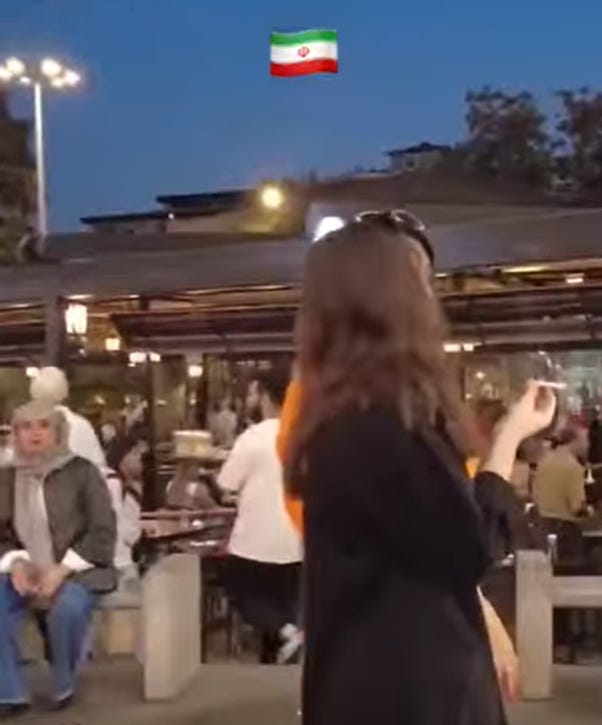
Iranian women in Tehran, with or without hijab, one of whom is smoking a cigarette in public. (Screenshot from a video recorded with a mobile phone)
Among women under 24, the literacy rate is almost 100% (around 99% according to the latest data); women dominate university admissions (63% of registrations for the “Konkur” national exam in 2025).
Women have been driving cars for decades, and recent reforms have expanded freedoms: since the beginning of 2026, women can officially obtain motorcycle licenses (long-standing legal ambiguities have been resolved), and they have long been attending football matches in stadiums together with men.
Myth of Total Oppression: How Free Is Discourse in Iran?
A common narrative in Western media is the image of a hermetically sealed police state in which every critical word immediately leads to arrest. Yet voices directly from the country, such as that of Professor Seyed Mohammad Marandi from the University of Tehran, paint a different picture. In March 2026, Marandi explained on the American Jimmy Dore Show that political criticism is commonplace in everyday Iranian life — whether in taxis, buses, the metro, or openly on the street.
Marandi reported from his more than 22 years of teaching experience at the university: A student provocatively called the system “the worst in the world” in a lecture, even worse than North Korea. Marandi’s reaction was humorous: “And you’re still here?” he joked, without the student ever facing consequences, warnings, or arrest.
A Comparison of Double Standards: Iran vs. Gulf Monarchies
In regional comparison, Iran fares much better in terms of political participation than the Western-allied Gulf monarchies such as Saudi Arabia or the United Arab Emirates. These states are absolute family dictatorships without national elections and with a zero-tolerance policy toward any dissent. While even mild criticism there leads to draconian punishments, this is largely ignored geopolitically in the West. Marandi accuses the West of deliberate hypocrisy here: the demonization of Iran serves to morally justify sanctions and military aggression, while far more repressive allies are spared.
The Dangerous Ignorance of the West
Decades of propaganda have created a caricature of Iran in the West that is now proving to be a strategic disadvantage for Israel and the USA. Based on reports from the New York Times and The Times of Israel, Prime Minister Netanyahu and the Mossad leadership mistakenly believed that Iran was a “house of cards” that would collapse under the slightest external pressure. With this conviction, they persuaded President Trump to start a war against Iran together with them.
At the same time, they expected a massive popular uprising in the country — but it never materialized. The unrest fueled from abroad fizzled out. The Times of Israel headline read: “Netanyahu said frustrated that Mossad promise it could instigate Iran uprising has fallen short.” The reason: Iranians perceive the economic and military attacks against their country as an existential struggle for survival.
A vivid example of how little the West understood Iran’s strategy was President Trump’s statement that the United States had destroyed the entire Iranian air force. The White House and the Pentagon seemed unaware that Iran had already drawn a clear lesson more than two decades earlier from America’s rapid “blitzkrieg” victory against Iraq. Tehran concluded that it would be a mistake to invest in an expensive conventional air force — one that would ultimately prove vulnerable and ineffective.
Instead, Iran switched to asymmetric warfare. It focused on building large drone and missile fleets, manufactured in underground factories and stored in extensive tunnel networks. These networks stretch for kilometers and lie hundreds of meters below the surface. The systems could be moved deep underground by rail and launched from hardened silos.
At the same time, thousands of deceptively realistic decoys from China were distributed throughout the country, equipped with heat sources that mimic real signatures. They are so convincing that bombs and missiles register them as genuine targets — a deliberate means of confusing attackers and causing their strikes to miss. The attackers then mistakenly evaluate the destroyed decoys as military successes.
Iran’s opponents, who had assumed they could overwhelm the Islamic Republic in just days or at most weeks, were completely surprised. Tehran reacted quickly and decisively: it attacked U.S. military bases across the region, forced the major American naval forces to withdraw several thousand kilometers from the Iranian coasts, and overwhelmed the Israeli defense systems with massive salvos that achieved painful hits.
Willingness to Negotiate Instead of Total Refusal
The Iranian guiding principle in this conflict is: “Peace for all — or for no one. Prosperity for all — or for no one.” From this perspective, selective security is nothing other than injustice. Since the USA and Israel consistently ignore this perspective, they contribute to the escalating and increasingly serious consequences.
In contrast to the current Israeli leaders, for whom Iran — after Turkey, which former Israeli Prime Minister Naftali Bennett called “the new Iran” — represents merely the last major obstacle on the path to realizing their “Greater Israel” project, Tehran does not reject negotiations on principle.
It is willing to do business — including politically. But as long as the West and Israel do not understand Iran for what it is, but as what their propaganda has invented, they remain blind to reality. In the words of the Chinese strategist Sun Tzu: “If you know neither the enemy nor yourself, you will succumb in every battle.” Today, the West appears to understand neither Iran nor the realistic limits of its own power.