
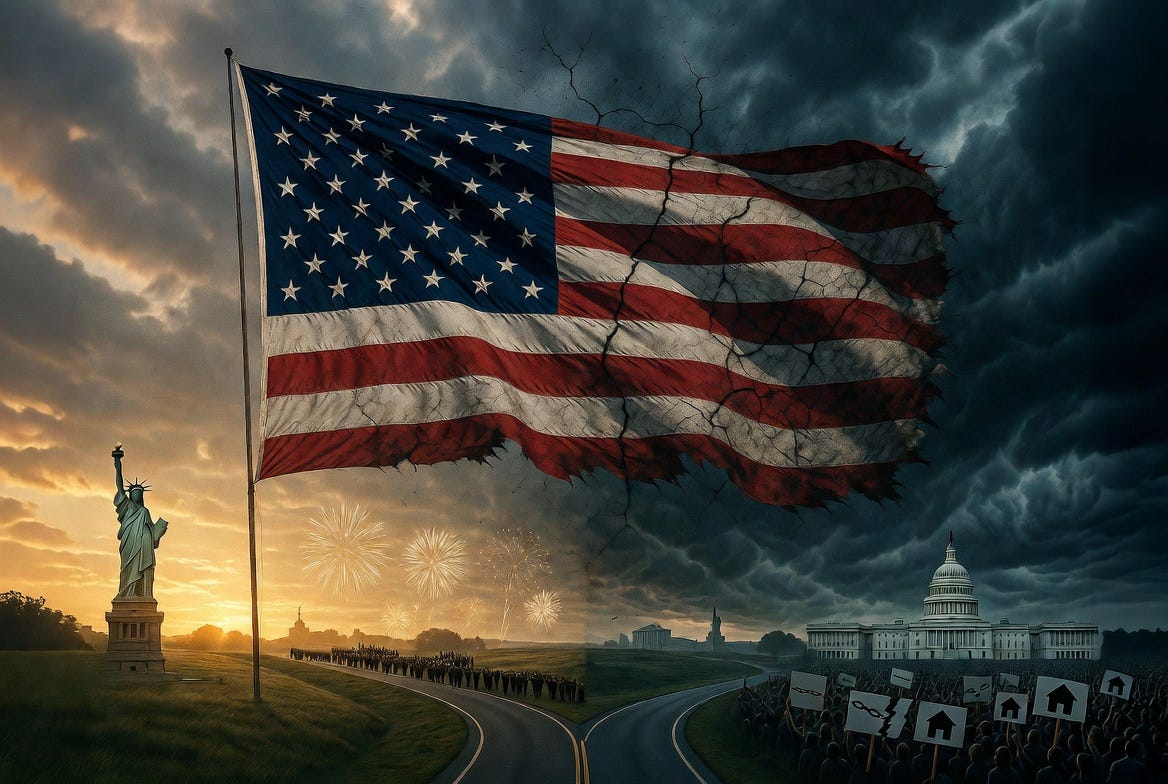
Beneath the celebrations lies a society grappling with deep questions of identity, intensifying culture clashes, soaring inequality, governance captured by oligarchs, and a global role that an increasingly weary world no longer welcomes. Let’s take stock.
National Mood and Celebrations
- A Gallup poll shows U.S. national pride at a 25-year low.
- The celebrations themselves are fragmented: separate events organized by the White House and a Congressional Commission reflect broader political and social divisions.
- Many Americans, particularly younger generations, feel little sense of national pride amid ongoing economic and social challenges.
Political Climate
The United States is experiencing an era of extreme polarization and fragmentation, marked by widespread disenchantment with political institutions.
- Donald Trump’s approval ratings remain historically weak for this stage of a presidency, with roughly 37% approval and 60% disapproval.
- Congressional approval ratings remain in the teens or even single digits.
- Both major parties are widely unpopular, contributing to internal conflicts within the Democratic Party, where younger and more progressive candidates are challenging established leadership.
- Public distrust of government and political institutions has fueled anger and frustration across the political spectrum.
Economic Realities: A “K-Shaped” Recovery
The economy increasingly reflects a sharp divide between those benefiting from asset growth and those struggling with rising costs.
- A small wealthy elite has benefited disproportionately from the AI-driven stock market boom and asset inflation. The top 10% own approximately 87% of stocks, while the top 1% own roughly half.
- Many Americans face a severe cost-of-living crisis characterized by stagnant wages, unaffordable housing, rising poverty, and homelessness.
- Consumer sentiment, as measured by the University of Michigan surveys, remains near historic lows and has fallen below levels seen during the 2008–2009 financial crisis.
- According to Moody’s Corporation Analytics, many local U.S. economies are already experiencing recessionary conditions, while growth is concentrated in a limited number of sectors and regions, such as Silicon Valley technology and Texas energy. Aggregate GDP figures obscure this growing divide.
- Millennials and Generation Z are the first generations expected to experience lower living standards than their parents. Declining life expectancy among younger Americans and uncertainty surrounding AI-driven job displacement have intensified these concerns.
Donald Trump won support partly by promising to address inflation and rising living costs, which he attributed to the previous administration. However, economic pressures have not substantially improved and, in some areas, have worsened.
Broader Western Context and Systemic Issues
Many Western societies face similar structural challenges, including post-2008 economic stagnation, housing bubbles, inequality, and declining trust in institutions.
- Western governments have become more responsive to wealthy donors and corporate interests than to ordinary citizens. Examples include the growing influence of money in politics following Citizens United v. Federal Election Commission and the influence of major donors.
- Politicians often avoid difficult reforms, such as addressing housing affordability and speculative asset bubbles, because of potential backlash from politically influential groups, including older asset-owning generations.
- These conditions have fueled populist movements on both the right and the left. Younger democratic socialist candidates have gained support by focusing on housing affordability and the cost of living.
- Supporters of China’s model argue that its government takes a more proactive role in directing economic priorities and limiting speculative excesses, citing policies such as the “Three Red Lines” regulations targeting real estate debt. Unlike in the USA, billionaires in China cannot influence politics to their own ends.
Social and Psychological Toll
Economic insecurity has created significant social and psychological pressures, particularly among younger generations.
- Many young people experience anxiety and hopelessness due to unaffordable housing, education costs, uncertainty about employment in the age of AI, and social media environments that promote unrealistic standards of wealth and success.
- Some political movements, particularly on the far right, have focused on scapegoating immigrants and cultural issues instead of addressing deeper economic causes. Vilifying Muslims serves as another divisive tactic, often favored by Zionists to distract attention from the ongoing mass murder and displacement in the Middle East.
- The United States also faces longstanding challenges related to gun violence, school shootings, and a historical culture of violence.
Outlook and Advice
There is growing concern about rising extremism, increasing instability if economic grievances remain unresolved, and the possibility of a major financial correction following the rapid expansion of AI-related markets.
However, historical perspective is important. While today’s challenges are serious, they are not unprecedented. The United States has previously faced crises such as the Great Depression, World War II, abolition, and the civil rights struggle.
For younger generations, many of the central challenges are economic and systemic. Addressing them requires governments that are accountable to the broader public rather than primarily to wealthy elites. Policies that curb speculative excess, expand opportunity, and encourage healthier social norms may help restore confidence.
The outlook may justify realism about the current trajectory of the United States and much of the West, but history also shows that societies can overcome profound crises when meaningful reforms occur.
America stands at a critical crossroads, where visible signs of vitality—such as localized celebrations or rising stock markets—may conceal deeper structural fractures in politics, economics, and social cohesion.
Founding Myths and American History
A critical reassessment of American history challenges traditional patriotic narratives and emphasizes the country’s origins in systems of domination and exploitation, including:
- The displacement and destruction of Native American communities through settler expansion.
- Slavery, including forced labor, family separation, physical abuse, and the commodification of human beings.
- The argument that these were not merely historical imperfections but deeply embedded systems of oppression.
This perspective challenges both MAGA-style exceptionalism and what some describe as liberal imperialist narratives for minimizing these historical realities. From this viewpoint, Donald Trump represents a more explicit expression of nationalist, racial, and imperial traditions that have existed throughout American history.
Domestic and Global “Freedom”
The idea of “250 years of freedom” is deeply questionable, as it glosses over the persistent contradictions between American ideals and harsh realities.
Domestically, these concerns include:
- A large for-profit prison system.
- Immigration detention facilities, including those affecting children.
- Persistent poverty, medical debt, housing unaffordability, and lack of universal healthcare.
Globally, U.S. power has often operated through military intervention, sanctions, alliances with authoritarian governments, and a large overseas military presence, frequently in defense of strategic and economic interests.
The United States has experienced only a few decades of complete peace in its 250-year history. For most of that time, the country has been at war—not always through major declared wars, but through frequent military engagements, covert operations, and regime change campaigns abroad, especially since the late 19th century and particularly after World War II.
The United States occupied several nations after World War II and has maintained troops and intelligence networks there to this day. This has prevented countries such as South Korea, Japan, and Germany from enjoying full sovereignty and the ability to freely determine their own destinies.
From this perspective, American freedom has historically benefited elites more than ordinary citizens and has often carried significant costs abroad.
Unlearning Official History
A critical examination of American education—and such honest self-reflection is long overdue—would acknowledge that many aspects of U.S. history have long been presented in a sanitized form, including:
- The displacement and deaths of millions of Native Americans, a genocide that has never been formally acknowledged.
- The scale and brutality of slavery—involving the deaths of millions—which has also never been recognized as a genocide.
- Reconstruction, Jim Crow laws, and segregation.
- Labor struggles, socialist movements, and overlooked histories such as sundown towns.
Some critics also highlight everyday practices like the daily Pledge of Allegiance in schools as examples of institutionalized patriotism.
What Can Actually Be Celebrated?
Rather than focusing solely on official institutions and national achievements, a different interpretation of American history emphasizes movements for justice, equality, and social progress.
Examples include:
- Abolitionism.
- Labor movements that fought for the eight-hour workday, weekends, and workers’ rights.
- Civil rights movements that helped achieve reforms such as the Civil Rights Act and Voting Rights Act through grassroots organizing.
From this perspective, the most inspiring aspects of American history are found in the struggles of ordinary people seeking greater equality, rather than in conquest or elite achievement.
A Vision for a Better United States
A more equitable United States would prioritize:
- Universal access to housing, food, healthcare, education, and clean air and water.
- Addressing extreme wealth concentration through stronger taxation and enforcement mechanisms that prevent the wealthiest individuals from avoiding their obligations.
- Reducing military intervention abroad by closing unnecessary overseas bases, ending wars, and limiting resource extraction driven by geopolitical power.
- Directing national wealth—created collectively by society—toward improving quality of life for all rather than enriching a small number of billionaires and corporations.
The central question is whether the United States can confront its structural inequalities and rebuild public trust through meaningful democratic, economic, and social reforms. If it cannot, it is unlikely to survive another 250 years.