
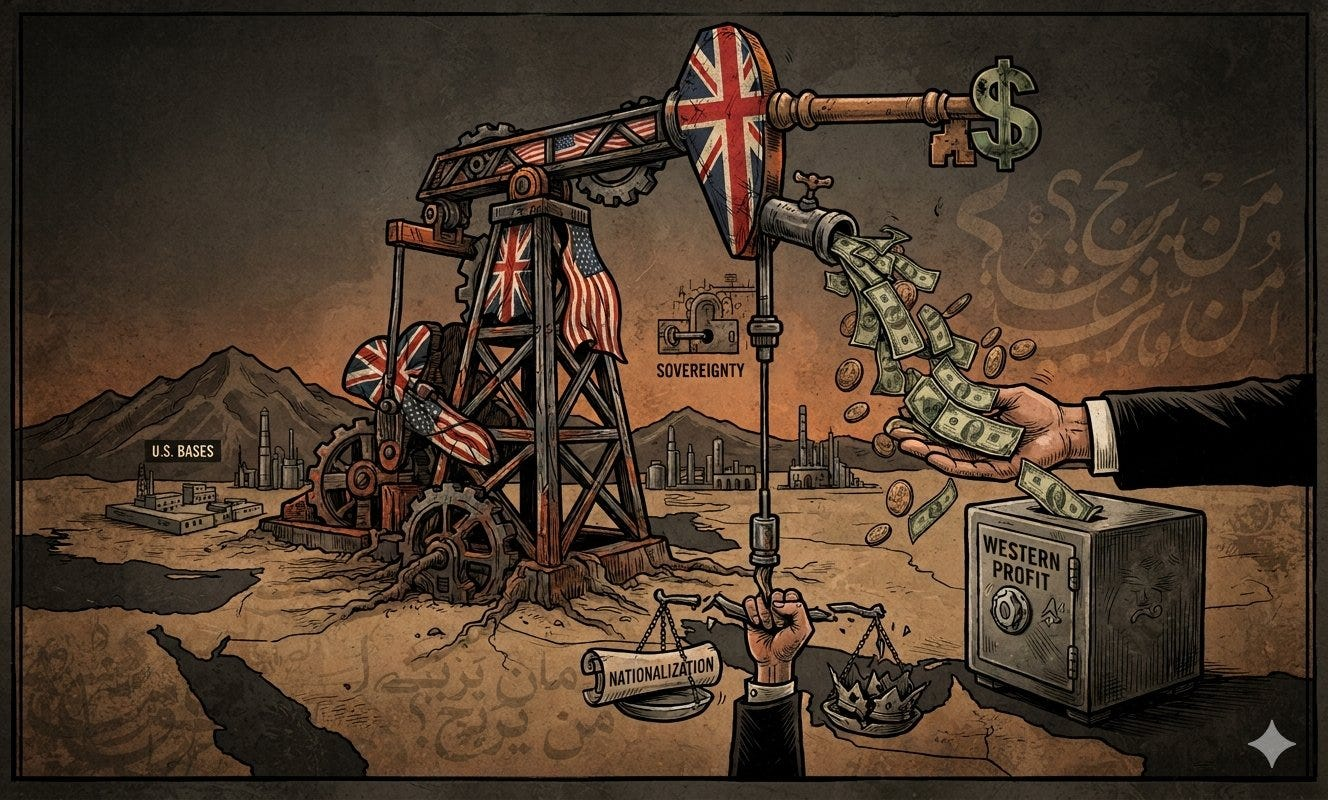
1908: The First Discovery and the Precedent of Theft
To grasp the roots of America’s enduring military involvement in the Middle East, we must rewind to 1908—not to 9/11 or the Gulf War, but to the dawn of the modern oil age. British engineer George Reynolds was drilling in Persia’s (now Iran’s) Zagros Mountains, just three days away from abandoning the site due to impending financial collapse. Then, at 4:00 a.m. on May 26, 1908, a gusher erupted 50 feet into the air, marking the first major oil discovery in the Middle East. Within six years, Britain’s Anglo-Persian Oil Company (later British Petroleum) secured a 90% controlling stake, leaving Iran with a paltry 16% of the profits.
Churchill hailed the discovery as “a prize from fairyland,” yet Iranian workers earned far less than their British counterparts, lived in segregated, disease-ridden barracks in Abadan, and faced systematic exploitation. Crucially, the sovereignty of Iran’s oil was ceded without transparency; Britain routinely refused to share production records, violating its own treaty promises. This 1908 betrayal established a lasting precedent: oil extraction as a tool for imperial control rather than national development.
1951: The Crisis of Trust
Iran’s democratic elections brought Mohammad Mossadegh to power as prime minister. Unlike the dictators who followed, Mossadegh began as a true reformist—a Harvard-educated lawyer elected by the people. When he demanded audit rights to verify Iran’s 16% oil revenue under the 1933 Anglo-Iranian Agreement, Britain’s response was chilling: “No documents. No investigation.“ This was not mere bureaucracy; it was the continuation of a 43-year deception. Under the initial concession, the British calculated the 16% royalty after APOC paid taxes to its own government, meaning the British state effectively drained Iranian wealth into its treasury before throwing crumbs back to Tehran.
Recognizing this theft, Iran’s parliament voted unanimously for nationalization in 1951—not as an act of radical revolution, but as a democratic demand for financial accountability. Mossadegh even offered fair compensation, stating, “We will pay fair value for your investment.“ Britain’s reaction was a punishing 200-day economic blockade, asset freezes, and global oil embargoes designed to starve the Iranian economy. The United States was soon enlisted, acting not as an ally to a fellow democracy, but as an instrument of economic coercion.

The joint CIA-British operation codenamed “Ajax“—officially declassified in 1997—was no conspiracy theory; it was a state-sanctioned coup. As documented by the National Security Archive and various CIA memoirs:
- Cash-Fueled Infiltration: CIA operative Kermit Roosevelt (grandson of Theodore Roosevelt) entered Iran with $1.5 million in cash to bribe the corrupt media, fund criminal syndicates, and smear Mossadegh.
- False-Flag Operations: Staged bombings and attacks were carried out by paid gangs targeting religious figures to frame Mossadegh as a godless communist threat, a lie explicitly designed to exploit Cold War anxieties.
- MI6 Coordination: British MI6 orchestrated the final political takeover, using a forged letter attributed to Mossadegh to ignite mass anti-government riots and destabilize the streets of Tehran.
By August 19, 1953, Mossadegh was jailed. His arrest triggered the 26-year autocratic reign of Shah Mohammad Reza Pahlavi, a U.S.-backed dictator whose CIA- and Mossad-trained secret police (SAVAK) went on to torture and execute thousands of political dissidents. The New York Times described the 1953 crisis as “the most violent overthrow of a government since the French Revolution.“ Yet, Washington prioritized oil over democracy, tacitly endorsing the coup and ignoring the fact that Time Magazine had just dubbed Mossadegh its “Man of the Year.”
The Petrodollar Imperative: 1973–1974
The 1973 oil embargo, triggered by U.S. military support for Israel, exposed America’s deep economic vulnerability. In response, President Nixon and Henry Kissinger forged the historic 1974 “dollar-oil agreement“ with the al-Saud dictatorship of Saudi Arabia:
- Exclusive Pricing: Saudi Arabia agreed to price all its oil exports exclusively in U.S. dollars.
- Security Guarantees: The U.S. guaranteed the Saudi royal family permanent military protection, advanced arms sales, and total regional stability.
This pact birthed the modern petrodollar system, tying the global oil trade intrinsically to the value of the U.S. dollar. By ensuring that every nation required greenbacks to purchase energy, the U.S. gained a structural dependency that permanently cemented its military footprint in the Persian Gulf to guard the flowing pipelines.
1979: The Backlash and Modern Aggression
When the Shah’s brutal regime finally collapsed, Iran’s Islamic Revolution erupted with a vengeful, anti-imperialist manifesto: “America is the Great Satan.“ The 1979 embassy takeover—in which 52 Americans were held hostage—was not a random act of unprovoked hostility, but a direct consequence of the 1953 coup. Having endured decades of U.S.-backed despotism, the Iranian people saw America as the thief of their sovereignty. Crucially, this marked the first major oil-driven conflict where U.S. geopolitical interests directly collided with Iranian self-determination.
Why This Matters Today
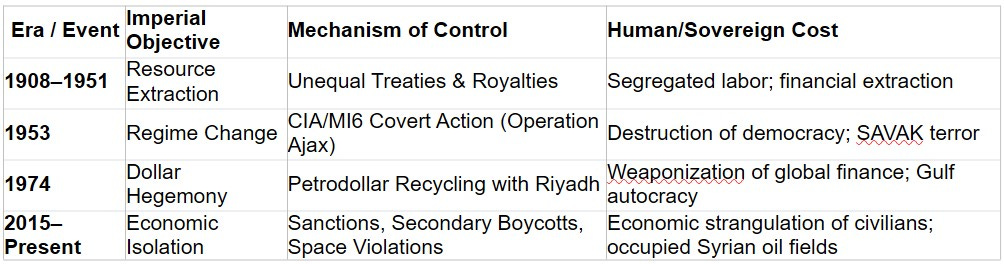
From 1908 to the present day, U.S. foreign policy has been dictated by the exact same oil-for-power calculus. The CIA’s 2013 formal acknowledgment of its role in 1953 (”We are responsible for the coup“) confirms this historical pattern. When Mossadegh demanded proof of Iran’s oil profits in 1951, he wasn’t fighting for communism—he was challenging an imperial theft of sovereignty.
Today, this dynamic echoes loudly:
- Syria: The U.S. military occupies northeast Syria, explicitly holding the country’s primary oil fields to deny revenue to Damascus.
- Iraq: Decades after the 2003 invasion, Iraqi oil revenues remain heavily monitored and routed under Washington’s financial oversight via the Federal Reserve Bank of New York.
- The Gulf: An expansive network of permanent U.S. military bases serves as an insurance policy for compliant regimes that keep the global resource flow pinned to Western economic dictates.
The foundational question remains unchanged: “Who controls the oil—and who profits?”