
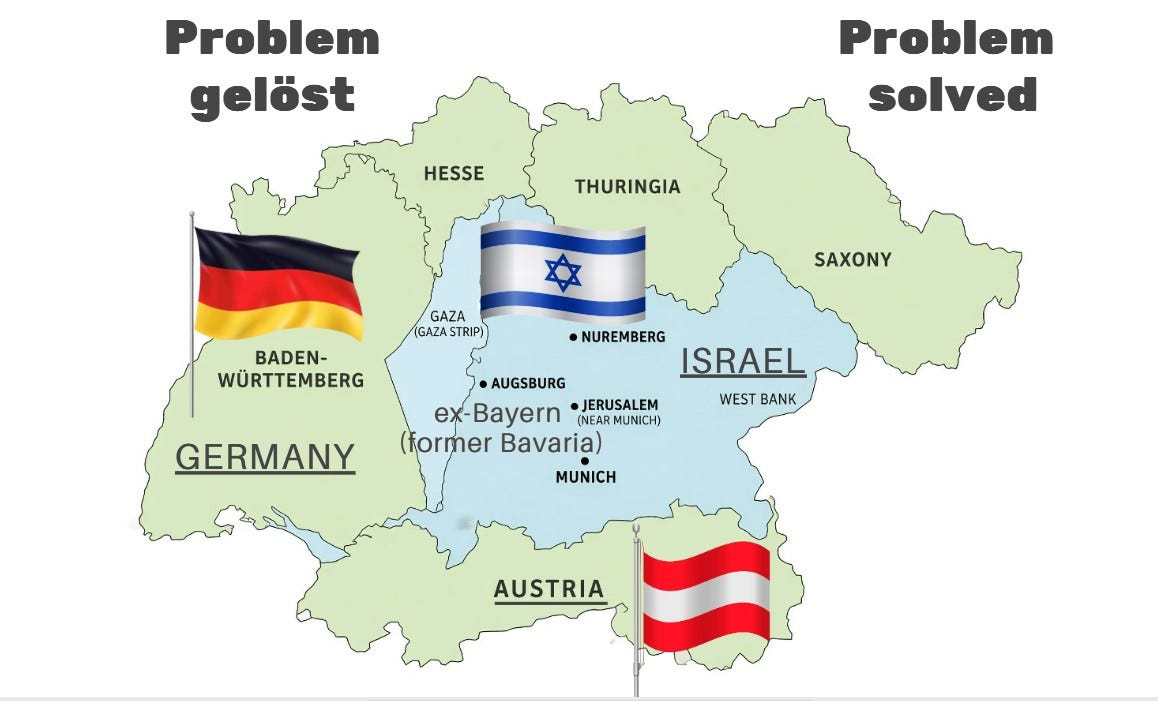
The creation of Israel is usually presented as the inevitable answer to the Holocaust: Jews who had been persecuted and murdered in Europe needed a safe “homeland”. But there is an uncomfortable question that is rarely asked:
Why did that homeland have to be established on land belonging to another people—rather than on land belonging to the country that had perpetrated the Holocaust?
If historical justice, moral responsibility, and symbolic accountability had been taken seriously after 1945, Bavaria would have been an obvious candidate.
Not Palestine.
Bavaria.
1. The Historical Justice Argument: Give Hitler’s Homeland to His Victims
Munich was not some random German city associated with Nazism. It was one of the places where the Nazi movement was born, organized and radicalized.
- The Origin Point: Adolf Hitler joined the German Workers’ Party—the precursor of the NSDAP—in Munich in 1919. After the failed Beer Hall Putsch of 1923, he was imprisoned at Landsberg in Bavaria, where he dictated much of Mein Kampf.
- The “Capital of the Movement”: The Nazi regime officially proclaimed Munich the Hauptstadt der Bewegung—the “Capital of the Movement.” Nuremberg, also in Bavaria, became the spectacular stage for Nazi propaganda rallies and gave its name to the infamous Nuremberg Laws, which institutionalized the persecution of Jews.
- The Ultimate Historical Reversal: Imagine the symbolism. The territory where Hitler’s political movement emerged becomes a refuge for the people Hitler wanted to destroy. Nazi symbols disappear from Munich, and Jewish institutions, schools, synagogues, and communities rise in their place.
The soil on which German antisemitism was organized could have become the soil on which its victims built a new homeland.
That would have been historical justice of almost biblical proportions.
2. The Practical Argument: Bavaria Was Already There
This was not merely a fantasy about finding an empty patch of land somewhere in Europe.
Bavaria had cities, roads, railways, hospitals, factories, farms, universities, and functioning infrastructure. It was economically and geographically capable of supporting a modern state.
And, crucially, after the war it was under American occupation.
- The American Zone: Bavaria fell entirely within the U.S. Occupation Zone. The United States was already exercising political and military authority there and was deeply involved in Germany’s reconstruction and the enormous refugee crisis created by the war.
If the victorious Allies had decided that Germany should make a territorial sacrifice to compensate the Jewish survivors of its crimes, Bavaria was hardly an impossible place to start.
- The Displaced Persons Camps: Bavaria also became a major center for Jewish survivors after liberation. Dachau was just outside Munich, while DP camps were established at places including Landsberg and Feldafing.
Hundreds of thousands of survivors found themselves stranded in postwar Europe, often with nowhere to return.
Instead of telling them, in effect, “Go somewhere else,” the Allies could have offered them a homeland in the country that had tried to annihilate them.
There is a brutal irony here.
Jewish survivors were displaced from their homes across Europe—and then the eventual territorial solution was largely imposed somewhere else.
3. Germany Was Already Being Carved Up
There is another inconvenient fact: postwar Germany was not regarded as an untouchable territorial entity.
The victorious powers were perfectly prepared to redraw its political map.
- The Morgenthau Plan: U.S. Treasury Secretary Henry Morgenthau Jr. proposed dismantling Germany’s industrial power and restructuring its territory. One version envisaged separate northern and southern German states, with Bavaria forming the core of a distinct South German entity.
The plan was ultimately abandoned in its original form. But it demonstrates something important:
The territorial dismemberment of Germany was not unthinkable in 1944–45.
If Germany could be divided for security reasons, why was it inconceivable to transfer part of Germany to the people who had just survived its genocidal campaign?
The answer, of course, is that history did not develop that way.
But that does not make the question illegitimate.
- The Goring Proposal: A lesser-known proposal attributed to civil servant G. Y. Goring reportedly contemplated carving out territory around Hanover for a Jewish state. Whatever its limitations, it demonstrates that the concept of establishing a Jewish territorial “homeland” on German soil was not entirely absent from contemporary thinking.
And if one was going to contemplate such an experiment in Germany, why not Bavaria?
Why not Munich—the city that Nazi Germany itself called the “Capital of the Movement”?
4. The Moral Question Nobody Likes Asking
The conventional answer is that Jews, at least those with Semitic roots, had ancient historical and religious ties to Palestine.
That is true.
But another fact is equally undeniable:
Palestinians did not perpetrate the Holocaust.
They did not build Auschwitz.
They did not pass the Nuremberg Laws.
They did not launch the Nazi war of extermination.
They did not organize the Final Solution.
Germany did.
Yet Germany largely retained its territory, while the political and territorial consequences of the Holocaust fell overwhelmingly elsewhere.
That creates an extraordinary moral paradox.
The perpetrators kept their homeland. The victims were expected to establish theirs somewhere else.
Imagine reversing the logic.
Imagine the Allies announcing in 1945:
Germany has demonstrated that it cannot be trusted with Bavaria. Munich, the birthplace of the Nazi movement, will become the capital of a new Jewish state.
The historical symbolism would have been impossible to miss.
The Jewish state would have been protected by the very armies that had defeated Nazi Germany. Its territory would have been carved from the land of the perpetrators, not from the homeland of another population.
And Germany—not Palestine—would have paid a direct territorial price for Germany’s crimes.
5. The Ultimate Irony
There is something almost unbearably ironic about the alternative history.
Hitler wanted a Germany cleansed of Jews.
Instead, the Allies could have created a Bavaria filled with Jews.
Hitler wanted Munich to become the showcase of his movement.
Instead, Munich could have become the capital of a Jewish state.
The Nazis persecuted Jews as foreigners and outsiders.
Instead, Jewish survivors could have been given sovereignty in the heart of Germany.
And the buildings, streets, and institutions that had once celebrated Hitler could have been transformed into monuments to the people he tried to destroy.
That would have been more than compensation.
It would have been a complete historical reversal.
The Question
Of course, history cannot be rewritten, and there were important political, demographic, and ethical obstacles to such a project.
But thought experiments can expose assumptions that conventional history tends to hide.
So here is the uncomfortable question:
If the Holocaust created the moral imperative for a “Jewish homeland,” why was the territorial cost not imposed primarily on the country that committed the Holocaust?
Why should Palestinians—who had not committed Germany’s crimes—have borne so much of the territorial and political consequences?
And there is an even more disturbing question for Germany today:
Why is Germany, of all countries, among Israel’s most important arms suppliers, providing weapons and military equipment that are used in Israel’s war against the Palestinian population—while the German political establishment so fiercely rejects and denies the fact that Israel is committing genocide in Gaza?
The historical irony is difficult to escape. Germany built its postwar identity around the solemn declaration of “Never Again.” Yet when accusations of mass atrocities are directed at Israel, Germany is far more concerned with defending Israel than with confronting the possibility that the principle of “Never Again” must apply universally.
What would Germans today think if the same conduct were judged by the standards applied to Nazi Germany in the 1940s? What if the argument were made that the systematic persecution and killing of an ethnic population could simply be dismissed, denied or explained away—and that those who supplied the weapons bore no responsibility?
Germany’s historical guilt should not require perpetual political obedience to Israel. It should require an uncompromising opposition to genocide, ethnic cleansing and the dehumanization of any people—regardless of who commits them.
Otherwise, the lesson of German history risks becoming dangerously selective:
Never again—for some.