
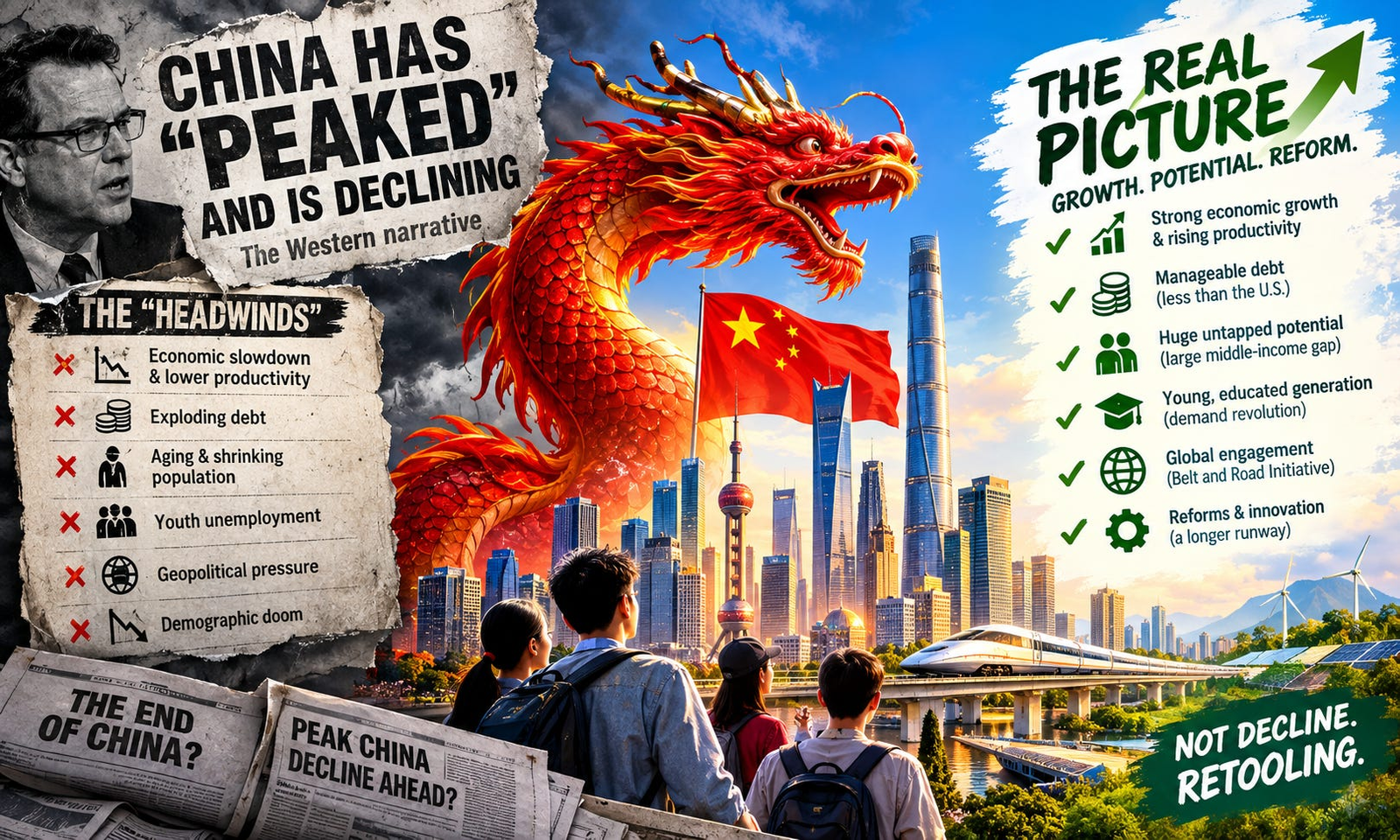
China’s Endless “Final Countdown:” From Gordon Chang to Michael Beckley, the predictions of China’s imminent demise keep coming—and keep missing the mark
Finally, China has “peaked” and is now in decline—if you believe the claims of a prominent American academic and representative of America’s anti-China establishment.
Since the founding of the People’s Republic of China in 1948, Western media, politicians, and academics have repeatedly predicted its imminent demise. Perhaps the most famous case is Gordon Chang, a “China expert” frequently cited in Western media, who famously predicted that China’s Communist government and economic model would collapse by 2011—a deadline he later extended multiple times. Yet the predicted collapse never happened.

Professor Michael Beckley, who has close ties to advocacy organizations, including think tanks associated with the military-industrial complex, paints a picture of a nation whose ascent is stalling, likening China in this discussion to a balloon struggling to gain altitude.
He outlines several significant headwinds:
- Economic Slowdown and Productivity Decline: Beckley points to a slowing economy and declining productivity, arguing that Chinese companies allegedly spend more while producing less.
- Exploding Debt: He claims China’s debt pile is roughly three times the size of its economy, making America’s debt problem look “fiscally responsible” by comparison.
- Aging and Shrinking Population: A significant concern is the demographic shift, with millions more senior citizens and fewer working-age adults each year.
- Youth Unemployment: Beckley highlights a youth unemployment rate of around 20%, suggesting a “double whammy” of fewer workers and fewer jobs.
- Geopolitical Headwinds: Anti-China sentiment, the formation of alliances against Beijing, economic restrictions, and problems with Belt and Road Initiative (BRI) loans are cited as additional external pressures.
- Demographic Doom: Beckley emphasizes demographics as a “tectonic force,” predicting that the worker-to-retiree ratio could collapse from 10–15:1 to 2:1 within 15 years. In his view, this would lead to fiscal problems, reduced productivity, and a contraction in demand because “workers don’t buy things.”
Economists with a thorough knowledge of the Chinese economy, such as Dr. Keyu Jin, offer a robust counter-narrative, challenging Beckley’s assertions with more up-to-date figures and a deeper economic perspective.
Let’s summarize them.
Economic Resilience & Growth
Contrary to claims that China is stalling, its economy continues to demonstrate remarkable resilience:
- Growth Targets Met: China met its 5% growth target in 2025, expanding to a record RMB 140 trillion economy, with Goldman Sachs projecting 4.8% growth for 2026.
- Surging Productivity: Overall labor productivity surged by 6.1% year-on-year, directly challenging the idea of declining productivity.
- Global Contribution: China’s growth contributes a staggering 35% of global growth annually.
Debunking the Debt Narrative
The debt comparison, often used to paint a grim picture of China’s economic future, is also more complicated than Beckley suggests.
- Accurate Debt Figures: China’s official government debt-to-GDP ratio is roughly 96%, significantly lower than the United States’ 126%, with US federal debt having just crossed $40 trillion.
- Per Capita Debt: Debt per Chinese citizen stands at around $13,000, compared with roughly $108,000 per American. If any “balloon is overinflated,” then, it is certainly not obvious that it is Beijing’s.
Clarifying Unemployment and Global Engagement
Beckley’s data on unemployment and international lending also deserve closer scrutiny:
- Updated Unemployment Data: China’s surveyed urban unemployment rate averaged 5.2% in 2025 and stood at 5.1% in December 2025, suggesting that Beckley’s youth-unemployment figures do not describe the broader labor market and may be outdated.
- BRI’s Continued Success: In 2025, China recorded its highest-ever Belt and Road Initiative engagement, with $128.4 billion in construction contracts and $85.2 billion in investments. African engagement alone surged by 283%, challenging claims that China’s overseas lending strategy is simply collapsing under a mountain of unpaid loans.
China’s Untapped Economic Potential: The Convergence Story
Beckley does not appear to put China’s current growth rates sufficiently into context. As an economy matures, growth inevitably slows. But China’s economic potential remains vast because of the principle of conditional convergence.
- Relative GDP: China’s GDP is only about 16% of US levels, indicating significant room for catch-up growth.
- Income Disparity: More than 600 million people in China still live on less than $300 per month, representing immense potential for economic expansion as more people move into the middle-income bracket.
- Agricultural Workforce: Around 25% of China’s labor force remains tied to agriculture, compared with just 3% in industrialized nations. This offers enormous potential for productivity gains through continued urbanization and industrialization.
- Human Capital and Productivity: China’s human capital level is only around one-third of US standards, while its labor productivity is just 12% of US levels. These gaps signify a long runway for improvement through education, technology, and capital investment.
- Future Growth Drivers: China is planning a $16 trillion digital economy, aims to increase the service sector’s share of GDP from 50% to 80%, potentially adding another $3 trillion, and projects $35 trillion in renewable-energy investment over the coming decades.
Demographics: Headwind, Not Death Sentence
Perhaps the most contentious issue is demographics. China’s population is undoubtedly aging, but this is a headwind rather than a death sentence.
- Lessons from Advanced Economies: Japan has experienced what has been described as the “worst aging in human history” for three decades, with a fertility rate of 1.15 and the world’s highest old-age dependency ratio. Yet it remains the world’s fourth-largest economy. Germany’s worker-to-retiree ratio has fallen from 6:1 to 2:1, yet Germany remains Europe’s economic engine. These examples demonstrate that aging populations do not automatically lead to economic collapse.
- Proactive Reforms: China is not simply “sleepwalking” into a demographic crisis. In January 2025, it began its first major retirement-age reform in more than 70 years, gradually raising the retirement age for both men and women over 15 years while increasing minimum pension contributions. The IMF projects that accelerating such reforms could boost GDP by 3% by 2050.
- The Generational Argument: China’s 400 million millennials represent a “radically different” generation. Unlike their more savings-focused elders, they are borrowing, consuming, and driving the experience economy.
- Consumer credit surged nearly 300% over six years, with millennials accounting for 65% of total consumption growth.
- They earn roughly six times what their parents did and hold bachelor’s degrees at a rate of 25%, compared with just 3% among their parents.
- They account for 79% of China’s luxury spending before turning 40.
- This “demand revolution” can already be seen in service retail sales growing 5.5%, outpacing goods at 3.8%, as well as surging spending on sports, recreation, and cinema.
- Productivity Over Numbers: A core insight is that technology adoption and population structure co-evolve. What ultimately matters is not simply how many workers there are, but what those workers produce. China’s better-educated millennials, expanding service economy, and continued rural-to-urban migration can all contribute to productivity gains.
Conclusion: A Future of Potential, Not Decline
Obviously, China’s detractors, such as Professor Beckley, risk confusing slowing growth with stopping growth. China’s economy is maturing, and its growth rate is naturally moderating. But arguments from economists backed by more recent data point to a nation with immense untapped potential.
From a vast population still transitioning toward middle-income status, to significant room for productivity gains in human capital and agriculture, to proactive policy reforms, China is retooling, not retreating.
The “Peak China” narrative, often fueled by outdated data and an overwhelming focus on headwinds, overlooks the powerful forces of convergence, generational change, and strategic investment that continue to shape China’s economic trajectory.
Demographics may be a challenge, but history shows that they are not destiny.
China’s story, driven by productivity gains and evolving societal dynamics, is still very much being written.
Wishful thinking among Western elites, their advocacy organizations, and academics who promote unfounded claims cannot undo China’s economic fundamentals.

Even huge sums—such as the $1.6 billion allocated by US Congress to anti-China propaganda—may be capable of obscuring the reality of China from gullible audiences. But they cannot change the growing perception among many people in the Middle Kingdom of what their country actually is, nor can they fool younger Americans who see everyday life in China on Red Note rather than through the distorted lens of what American vested interests and their mouthpieces want China to be.