
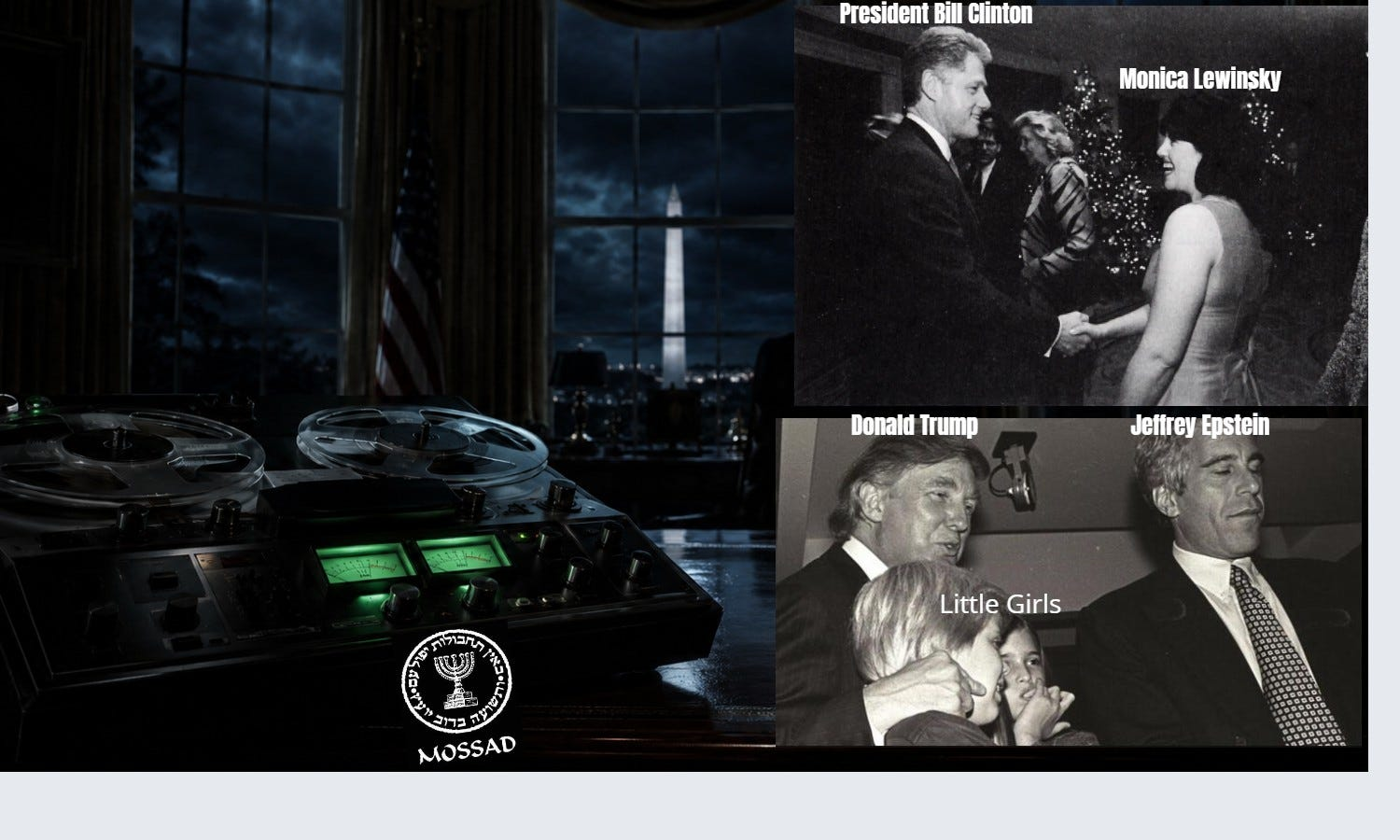
Monica Lewinsky in 2018 stormed off the stage at a major international news conference in Jerusalem when asked about her affair with Bill Clinton. Why? Now you know the story.
A hot young 22-year-old intern catches the eye of the President of the United States. They get intimate in the White House. The world finds out. Late-night TV has a field day. Clinton gets impeached, and so on.
But today, let’s dig into the Monica Lewinsky story you may not know. Specifically, was the Clinton-Lewinsky scandal merely a sordid tale of a reckless, horny president and a young intern—or was it something far more sinister: a highly coordinated international espionage and blackmail operation hidden in plain sight?
In 1998, the Clinton administration was flying high. The Cold War was over. The economy was booming. The Dow hit 10,000 for the first time. Times were good.
That is, until it all came tumbling down.
That’s when President Clinton addressed the American people: “I want to say one thing to the American people. I want you to listen to me. I’m going to say this again. I did not have sexual relations with that woman, Miss Lewinsky. I never told anybody to lie. Not a single time. Never. These allegations are false.”
In January 1998, news broke that a 22-year-old former White House intern named Monica Lewinsky had engaged in a secret intimate relationship with 49-year-old President Bill Clinton. Lewinsky said she put back on the sage green suit she had been wearing the day before when he paid attention to her. She thought, “Well, maybe he’ll notice me again.” And notice her, he did.
The affair between Clinton and Lewinsky had allegedly begun years earlier.
But in December 1998, after independent counsel Kenneth Starr dropped a damning report outlining 11 separate grounds for impeachment, the House of Representatives officially impeached Clinton on charges of perjury and obstruction of justice for attempting to cover up the affair under oath. At the time, much of the mainstream media—especially late-night hosts—hyper-fixated on the sordid details of the affair, distracting the American public with a domestic soap opera. “And you see Monica’s new hairdo all slicked down with that hair gel. At least I think it was hair gel,” one TV comedian blurted out.
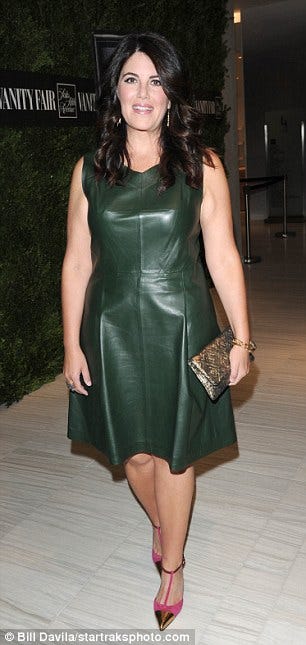
The National Enquirer even offered $500,000 to anyone who had a photo of Monica Lewinsky wearing the infamous dress that was allegedly stained by President Clinton. Here it is.
Now that’s what we today would call slop. But buried underneath the domestic media circus was a real and developing international geopolitical crisis for the Clinton administration.
Just a month after Bill Clinton finally confessed to a grand jury, The Washington Post published a quiet but alarming report citing diplomats and intelligence insiders who warned that the affair wasn’t just a domestic scandal—that Clinton’s sexual promiscuity may have crippled U.S. foreign policy, especially when it came to peace in the Middle East.
Most notably, the article reported that both Israelis and Palestinians were convinced Lewinsky was an agent of Mossad, Israel’s intelligence agency.
You must be wondering: what do we know for sure about what the Israelis were actually doing behind closed doors? The first major revelation came from veteran intelligence journalist Gordon Thomas in his book Gideon’s Spies, which drew directly from well-placed Mossad sources.

“This was a Mossad honeypot operation,” Thomas wrote. He reported that Mossad had recordings of Clinton and Lewinsky’s conversations. Long before Kenneth Starr had ever heard of Monica Lewinsky, Israel’s intelligence service was already in possession of tapes containing 30 hours of intimate talk between the President and his young intern. In other words, even before the scandal became public, Israel was already considering how this information could be used to manipulate and threaten the president.
Thomas explained that Israel was holding these tapes for possible blackmail—and to protect an alleged mole in the White House code-named “Mega.” The strategy wasn’t necessarily to release the tapes and destroy the president. The goal was to blackmail and influence him—or, to put it more bluntly, to control him.
Here we need to examine how Mossad operates, using the Epstein network as an example. Former CIA officer John Kiriakou has described Jeffrey Epstein as a textbook “access agent.” According to Kiriakou, Epstein’s role was to cultivate relationships with high-profile figures such as Bill Gates and Prince Andrew on behalf of Mossad—not to recruit them as spies, but to gain access to their networks and collect potential kompromat for use as blackmail.
This concept relies on distinct intelligence mechanics: the Access Agent uses wealth and connections to insert himself into elite circles; the Unrecruitable Target (prominent figures too visible and unwilling to be formally recruited) is leveraged instead; and kompromat is collected through lavish hospitality and compromising situations such as the rape of underage girls to influence policy or monitor the landscape. Kiriakou has discussed these dynamics in interviews on Piers Morgan Uncensored and Zeteo.
Benjamin Netanyahu was a fierce and prominent opponent of the Oslo Accords. From the moment the peace talks became public in 1993, Netanyahu—then the leader of the right-wing Likud party—spearheaded the political opposition against the agreements signed by Prime Minister Yitzhak Rabin and PLO Chairman Yasser Arafat. Rabin was ultimately assassinated by Greater Israel advocates and opponents of the peace deal.
Just weeks before the assassination, today’s National Security Minister, Itamar Ben-Gvir, famously stole the Cadillac emblem from Rabin’s vehicle, boasting to television cameras: “We got to his car, and we’ll get to him too.” Following the assassination, Ben-Gvir—who later became an attorney—actively participated in legal campaigns and advocated for the release and improved prison conditions of the assassin, Yigal Amir.
Upon becoming Prime Minister, Netanyahu possessed a strong motive to utilize a potential Mossad asset like Monica Lewinsky to sabotage the historic peace accord by leveraging kompromat against President Bill Clinton.
In late 1998, President Clinton invited Prime Minister Netanyahu and Yasser Arafat to the Wye Plantation in Maryland for crucial peace negotiations. Since, as prime minister, he had the power to torpedo the peace agreement with the Palestinians—or even to do the opposite, namely expel them and resort to genocidal practices to advance his “Greater Israel” project—there was no need to use the compromising material against Clinton to undermine the peace agreement. He used it instead to force other concessions.
According to investigative reporter Daniel Halper in his book Clinton, Inc., Netanyahu attempted to use tapes of President Bill Clinton’s steamy conversations with intern Monica Lewinsky as blackmail to leverage the release of Jonathan Pollard—a former U.S. naval intelligence analyst jailed for spying for Israel. Pollard, whom the CIA believed had passed uranium-related secrets enabling Israel’s nuclear program, was serving a life sentence. (He now lives in Israel and has advocated genocidal policies toward Palestinians.)

Netanyahu’s threat, according to Halper, spurred Clinton to consider action. Halper explained that Clinton brought the request to CIA Director George Tenet, who threatened to resign if Pollard was released. Clinton ultimately backpedaled. Pollard was eventually released by the Obama administration as a gesture of goodwill—which raises questions about what kompromat they may have had on Obama.
No hard evidence ever came to light proving Monica Lewinsky was a Mossad agent. Of course, Mossad is a professional organization that protects its assets. But an awful lot of coincidences are revealing:
As the impeachment trial reached its final days in January 1999, the Jewish Telegraphic Agency published a retrospective titled “Queen Esther and a Prayer Book: Jewish Involvement in Monicagate.” It noted that Walter Kaye, a prominent Jewish insurance executive, major Democratic donor, and friend of Bill Clinton (and of Lewinsky’s mother), was the one who recommended Lewinsky for the White House internship in 1995.
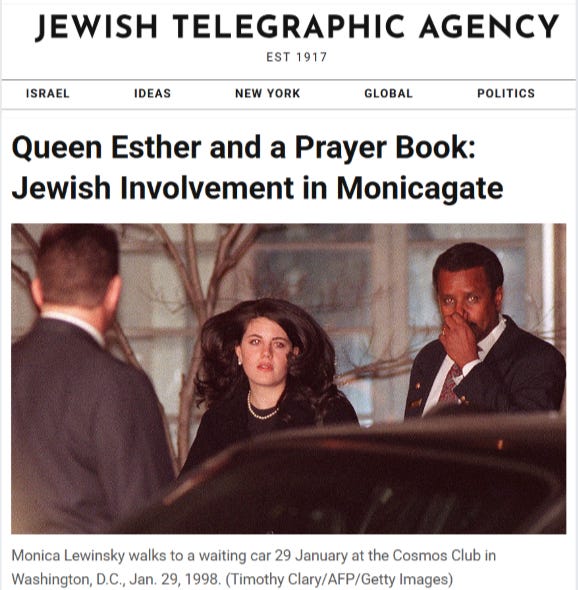
When the scandal broke, Lewinsky retained the services of longtime family friend William Ginsburg, a Jewish medical malpractice lawyer from Los Angeles. Ginsburg remarked that neither he nor his client wanted to see Clinton forced from office because “he is very positive towards Israel and the Jews,” and that “Monica and I are Jews.” He also mused that Monica might move to Israel when all was said and done.
Some Jewish Israelis cited the temporary halt to U.S. pressure on Israel during the peace process by invoking the story of Purim. The Jewish Telegraphic Agency compared Lewinsky to a modern-day Queen Esther. During the investigation, Kenneth Starr revealed that Lewinsky gave Clinton a copy of the book Oi, The Things They Say: A Book of Jewish Wit.
Another striking coincidence occurred on September 11, 1998—the exact day the House of Representatives voted to release the salacious, politically devastating Starr Report onto the internet. Hours before the explicit details of the Lewinsky affair went live, Clinton stood before more than 100 religious leaders at the annual White House Prayer Breakfast and delivered his raw, televised “I Have Sinned” speech. Instead of relying on his standard political or legalistic vocabulary, Clinton turned directly to Jewish theology, quoting verbatim from Gates of Repentance, the official prayer book used by Reform Judaism for Yom Kippur. He read a passage on the grueling nature of teshuvah (repentance), stating: “Now is the time for turning. We are burdened by past deeds which we cannot undo… Turn us, O God, and we shall be turned.”
Just days before the full House of Representatives was scheduled to vote on his actual impeachment, Clinton engaged in another highly unusual pivot. Instead of staying in Washington to manage his collapsing domestic defense, he embarked on a frantic three-day trip to Israel and the Palestinian territories under the guise of saving the stalled Wye River Accord. The itinerary was heavy with ancient, almost apocalyptic symbolism: he visited Gaza to watch the Palestinians amend their charter, lit a Christmas tree in Bethlehem with Yasser Arafat, and climbed Masada—the desert fortress where Jewish zealots famously committed mass suicide rather than surrender to an empire.
The optics were surreal: a split-screen television spectacle where international journalists shouted questions about perjury and resignation, while a stern Israeli Prime Minister Benjamin Netanyahu stood at the adjacent podium, lecturing the press corps. For researchers tracing the threads of the “kompromat” narrative, this eleventh-hour trip is inextricably linked to the intense pressure Netanyahu had applied just weeks prior at the Wye River summit. There, Netanyahu had aggressively demanded the release of Jonathan Pollard, the American naval intelligence analyst convicted of spying for Israel. Clinton had initially capitulated to the demand to secure the peace deal, only to rescind the offer after CIA Director George Tenet—as previously mentioned— threatened to resign in protest.
When looked at in sequence—the sudden adoption of Jewish high holy day liturgy on the exact day his private life was exposed, followed by a physically exhausting, eleventh-hour trip to cater to Israeli geopolitical interests while his own house burned down—it does not look so much like genuine spiritual healing or reflection. It looks a lot more like a coded, geopolitical humiliation ritual.
Of course, Clinton isn’t the only American president or politician who has been forced to perform it. You can’t talk about Israeli Mossad operations without mentioning Jeffrey Epstein, who many believe—with considerable documented evidence—built a global kompromat network on behalf of Israel. And just recently, the Pentagon has warned that Israel is spying on senior U.S. administration officials.
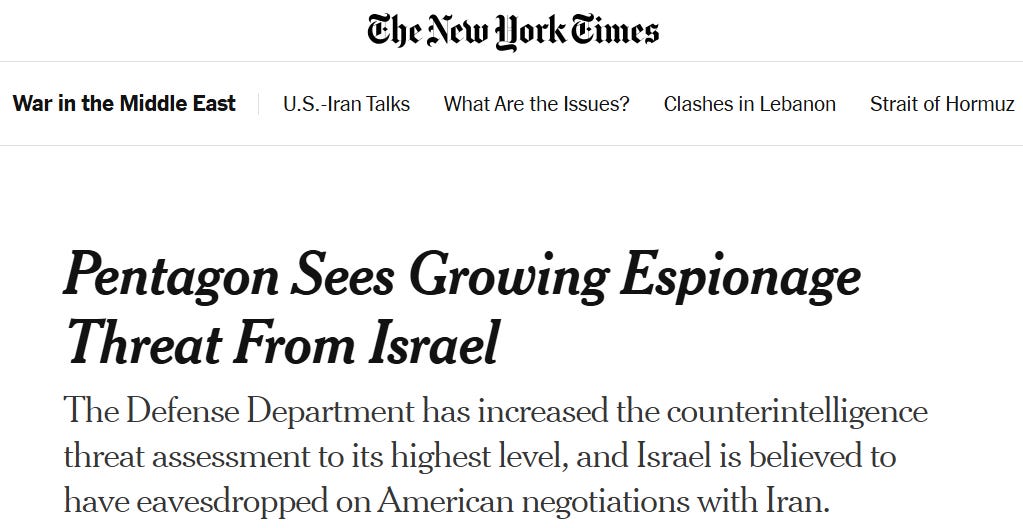
In recent weeks, the United States has been engaged in high-stakes diplomatic peace talks with Iran. But a permanent peace in the Middle East is seen by some as the ultimate threat to Israel’s regional dominance. Israeli leaders have signaled they are ready to sabotage any potential deal—even by deploying blackmail.
According to a *New York Times* analysis of the Justice Department’s recent massive release of documents (around 3 million pages or more—many heavily redacted, millions more withheld), terms related to Trump (including references to Donald Trump, Melania Trump, Mar-a-Lago, etc.) appear in more than 5,300 documents, with a total of over 38,000 mentions.
If a real deal with Iran is progressing, Netanyahu will try to sabotage it, potentially by releasing compromising material on U.S. officials, including Trump. Forgive me for noticing, but the timing does not seem coincidental that, while the Trump administration was negotiating, two New York Times reporters—both Jewish and Zionist supporters of Israel—released their book Regime Change, which included highly sensitive raw tapes from White House Situation Room meetings.
The Situation Room is one of the most heavily secured rooms on the planet. So where did these tapes come from? Which country has the technological sophistication and history to pull that off? I think you know the answer.
Ultimately, whether Monica Lewinsky was a deliberate agent, a passive asset, or simply a fortuitous coincidence for foreign intelligence is secondary to a much more chilling reality. For decades, a nation that Americans are continually told is their greatest ally—and to which they send billions in foreign aid every year—has allegedly conducted aggressive covert operations on American soil.
The pattern extends far beyond domestic surveillance. American journalists and citizens have been killed by Israel in Gaza and elsewhere across the Middle East. Most notoriously, during the Six-Day War, the Israeli Air Force and Navy torpedo boats attacked the USS Liberty—a technical research spy ship operating in international waters off the coast of the Sinai Peninsula. The assault killed 34 American crew members and wounded 171 sailors. The survivors exposed it as a “false flag operation” designed to blame Egypt for an attack on America and to draw the USA into Israel’s war against Egypt.
The overarching goal is clear: to compromise leading American politicians, steer US foreign policy from behind the scenes, and ensure that lasting peace in the Middle East is never achieved on terms other than those of “Greater Israel”—and at the expense of the Palestinians, the Arab nations, and Iran.
Was Monica Lewinsky a Mossad honeypot—or just a fortuitous coincidence for the Israelis? Sound off in the comments below.