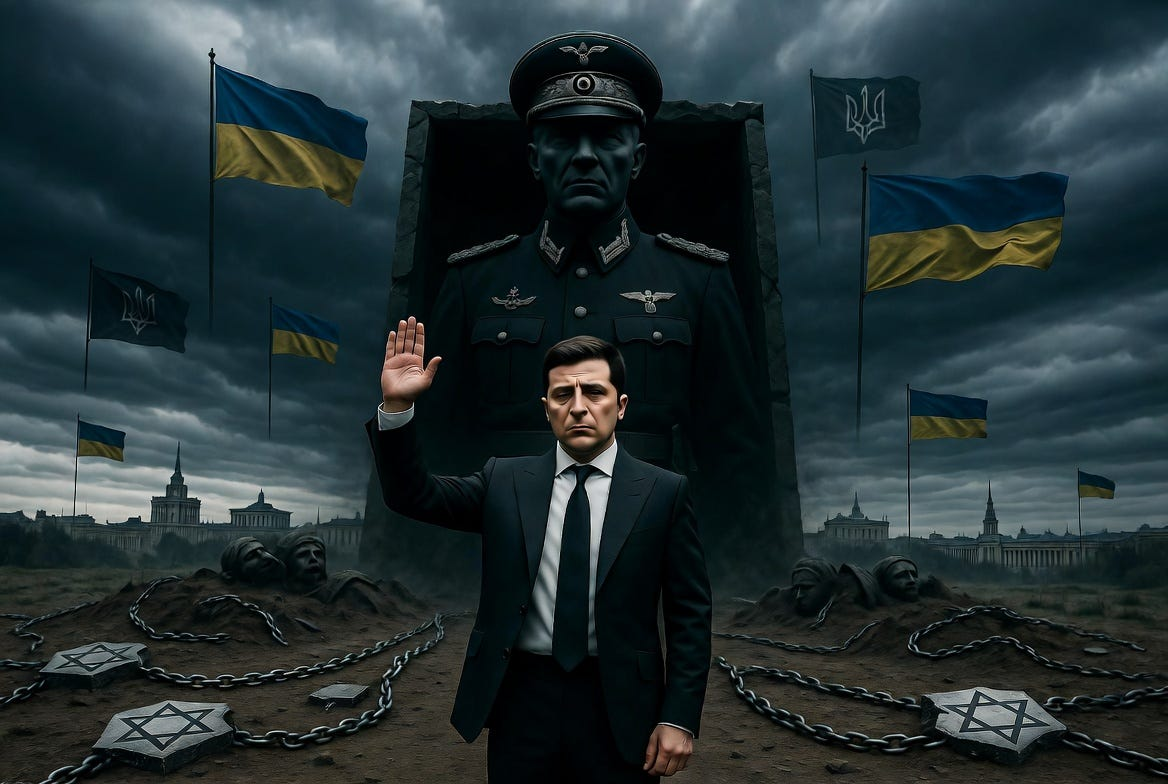
From Anti-Fascist Comedian to Pro-Nazi President
As a comedian, Volodymyr Zelenskyy appealed to audiences both in the Ukrainian-speaking regions in the west of the country and in the Russian-speaking regions as well. He often joked about his own identity—as a Russian-speaking Ukrainian citizen of Jewish descent—to advocate for a Ukraine in which all population groups could live together peacefully.
He was aware that Russia and Ukraine share a common origin: both emerged from Kyivan Rus, founded in Kyiv in the 9th century. Russians and Ukrainians are Slavs. However, western Ukrainian nationalists who sympathize with the Nazi ideology of the 1930s—embodied by the Ukrainian national hero Stepan Bandera—do not see themselves as Slavic relatives of the Russians. Instead, they have cobbled together an ideology based on a kind of Ukrainian “master race.” After the Western-backed coup against the democratically elected government in 2014, they gained considerable influence in politics, the military, the police, and the intelligence services.
At the time, Zelenskyy directly appealed to the new regime in Kyiv to respect the cultural and linguistic rights of eastern and southern Ukraine. He stated: “In Crimea and in the East, people want to speak Russian. Leave them alone. Give them the opportunity to speak Russian on a legal basis. Language should never divide our homeland.”
Ironically, the law pushed through by Ukrainian nationalists in parliament and criticized by the comedian Zelenskyy was later signed by him as president. He himself Ukrainianized his first name by changing it from “Vladimir” to Volodymyr and struggled to learn the Ukrainian language in order to conform to the spirit of the times. Since then, Russian has been banned in public life, in government buildings, state educational institutions, public transportation, on signs, and in business transactions—with the exception of private conversations.
Paradoxically, Western political and media elites have remained conspicuously silent about this cultural genocide in Ukraine. The same elites constantly point to alleged cultural and linguistic suppression in China, such as in Tibet, claims which have been disproven.
“Slava Ukraini” and the Old Nazis
Zelenskyy played a tragicomic role. He was elected president by a large majority, especially by millions of Russian-speaking citizens, because he promised negotiations and peace with Russia. But he quickly realized that his political and even physical survival would be threatened by nationalists if he opposed them. In addition, the West supported the nationalists because they were viewed as reliable proxies in its conflict with Russia and could be deployed with high motivation.
The New York Times knew exactly what was happening but, for opportunistic reasons, expressed it cryptically: “Armed Nationalists in Ukraine Pose a Threat Not Just to Russia.”
The fascist currents in the Ukraine celebrated by the “values-based West” as a “democratic partner” were so strong that even the anti-Russian nationalist and first prime minister after the coup, Arseniy Yatsenyuk, became a target of antisemitism despite not being Jewish. For example, Serhiy Ratushniak, mayor of Uzhhorod and former presidential candidate, referred to Yatsenyuk as a “disgusting Jewish Freemason” and an “impudent little Jew” who “successfully serves the thieves in power in Ukraine” and seeks the presidency with “criminal money.”
Four years after nationalists took power in Kyiv, Ukrainian Jewish Committee Executive Director Eduard Dolinsky published an article in Ynetnews titled “Ukraine’s new heroes: Anti-Semites and murderers of Jews.” The piece highlighted the glorification of historical figures involved in anti-Semitic violence.
The renowned Polish-German historian and Holocaust researcher Grzegorz Rossoliński-Liebe writes in his book Stepan Bandera: The Life and Afterlife of a Ukrainian Nationalist that Bandera’s OUN-B, during its Second Grand Congress in April 1941, adopted “Slava Ukraini!” (“Glory to Ukraine!”)—today repeated uncritically in the West and even chanted in the German Bundestag by representatives of government parties—as its official greeting. The required response was “Heroiam Slava!” (“Glory to the Heroes!”).
Rossoliński-Liebe’s book also documents that this fascist greeting combined a verbal slogan with a physical gesture requiring members to raise the right arm “slightly to the right, slightly above the top of the head” while speaking the phrase, similar to the gestures used by followers of Hitler and Mussolini. They had consciously copied and adapted this from the Nazi salute and the Roman salute of the Italian fascists. It is therefore unsurprising that this greeting was adopted by the nationalist regime after the 2014 coup and that today the slogan is used even by its supporters in the West, especially in Germany, where any alleged Nazi slogan or even the faintest echo of Nazi phrasing is otherwise pursued hysterically.
The Rehabilitation of Nationalist Icons
The new heroes of Ukrainian white supremacy continue to cling to old ideals of a future “cleansed” Ukraine free of Russian speakers, Jews, and other supposedly “inferior” groups. Their veneration is a shameful development that has largely been ignored or downplayed by Western media.
Faced with the overwhelming dominance of Melnyk and Bandera supporters at home and NATO as an external influence, Zelenskyy saw no option but to transform himself from a peace-seeking mediator into an uncompromising hardliner and anti-Russian warmonger. He then even allowed the bombing of his own population in Donetsk, a city that was not even on the front line. He had no choice; the neo-Nazi-dominated regime expected this of its figurehead. His final attempt to make peace with Russia shortly after the Russian invasion in February 2022 in Istanbul was thwarted by the then British prime minister on behalf of the West. The fact that this allowed him to also become a major war profiteer made the reversal easier.
The exhumation of the leading Ukrainian nationalist Andriy Melnyk (not coincidentally the namesake of a later Bandera-aligned ambassador to Germany who repeatedly visited Bandera’s grave, highlighting the deep, enduring ties between past and present nationalist factions) and his wife from a cemetery in Luxembourg, followed by the ceremonial transfer and reburial of their remains in Ukraine on the orders of the Ukrainian president, is a new high point in the history of neo-Nazism in modern Ukraine.
After the assassination of OUN founder Yevhen Konovalets, Andriy Melnyk assumed leadership of the entire nationalist movement in 1938 and became one of the Nazis’ most loyal collaborators and vassals. Before World War II, Melnyk emphasized ideological affinity with National Socialism to German Foreign Minister Joachim von Ribbentrop and pledged unconditional loyalty to Hitler. Members and local militias associated with Melnyk, as well as OUN factions under Bandera, actively cooperated with the Wehrmacht during the invasion of Ukraine beginning in June 1941, assisted German Einsatzgruppen in the Holocaust against the Jewish population, and participated in ethnically motivated massacres. He also supported the 14th Waffen Grenadier Division of the SS “Galicia,” formed in 1943.
On January 1, 1942, after the Babyn Yar massacre in which more than 33,000 Jewish women, men, and children were murdered, Andriy Melnyk sent a New Year’s message to his followers describing German troops as allies in a “crusade against Moscow.”
Azov, Biletsky, and State Recognition
Returning to the year 2026: At a high-profile state memorial event in Kyiv, the 3rd Assault Brigade—originally formed by Azov veterans—received prominent political representation ahead of other long-standing military units. This political visibility coincided with the rapid ascent of the unit’s founder, Andriy Biletsky. Despite his lack of formal officer training, Biletsky was recently promoted to brigadier general and given command of the 3rd Army Corps.
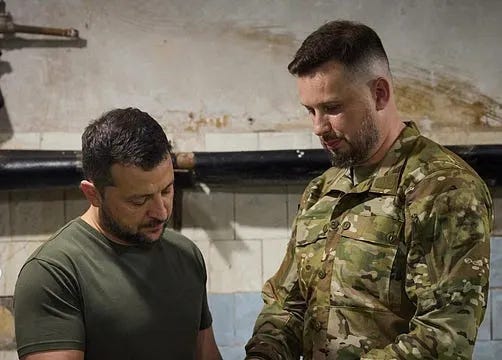
Screenshot from a video on Zelenskyy’s official X (Twitter) channel showing him together with far-right Azov leader Biletsky, who has spoken of “subhumans,” “disgusting Semites,” and “white supremacy” (Photo: Screenshot/X)
Biletsky’s guiding principle was: “The historic mission of our nation in this critical moment is to lead the white races of the world in a final crusade for their survival. A crusade against the Semite-led subhumans.”
Dr. Marta Havryshko posted on X on the day of Andriy Melnyk’s recent state funeral in Kyiv: “Today, as a Ukrainian-Jewish and a scholar of the Holocaust, I feel deeply ashamed. I never could have imagined that in my country — the country where the Nazis murdered 1.5 million Jews, the country of Babyn Yar, the very symbol of the Holocaust in the Soviet Union, a country that claims to be fighting for “freedom and democracy” — a Nazi collaborator and OUN leader like Andriy Melnyk would be buried with full state honors”.
Western media coverage of the event was virtually nonexistent, with The New York Times, a newspaper owned by an American Jewish family, being a rare exception. However, the newspaper minimized Melnyk’s legacy by labeling him a “divisive 20th-century figure.” Such a mild euphemism downplays historical atrocities; by this same logic, even the worst criminals of the twentieth century, including Adolf Hitler, could be sanitized under the same label.
Zelenskyy’s Family Legacy and the Holocaust
Zelenskyy’s grandfather, Semyon Ivanovich Zelenskyy, served in the Red Army as commander of a mortar platoon and later an infantry company and received high decorations for his service. While Semyon fought the Wehrmacht and the SS at the front, his family became victims of the Holocaust. The Nazis burned down his home village and murdered his parents—today’s president’s great-grandparents—burning them alive. For his service, Semyon Zelenskyy was publicly praised by his grandson Volodymyr only a few years ago.
Today, the grandfather would turn in his grave in shame over his grandson and would likely call him a “kapo,” a term originally used for prisoner functionaries appointed by the SS as barracks supervisors or work foremen in Nazi concentration camps. Within postwar Jewish societies, especially in Eastern Europe, the term developed into a deeply charged insult and is widely considered one of the harshest slurs one Jewish person can direct at another.
The Polish-Jewish historian Emanuel Ringelblum, who founded the secret underground archives in the Warsaw Ghetto, ihas condemned the cruelty of the Jewish Ghetto Police with the words: “Their brutality was at times greater than that of the Germans, Ukrainians, and Latvians.” To Ringelblum, the most tragic aspect was that Jews were inflicting this violence upon other Jews.
Against this historical backdrop, President Zelenskyy’s rehabilitation and celebration of figures like Andriy Melnyk—a prominent Nazi collaborator complicit in the mass murder of Jews and Poles—appears all the more serious and troubling. Yet, his hitherto steadfast supporters in the West, particularly in Germany, remain largely unperturbed.