
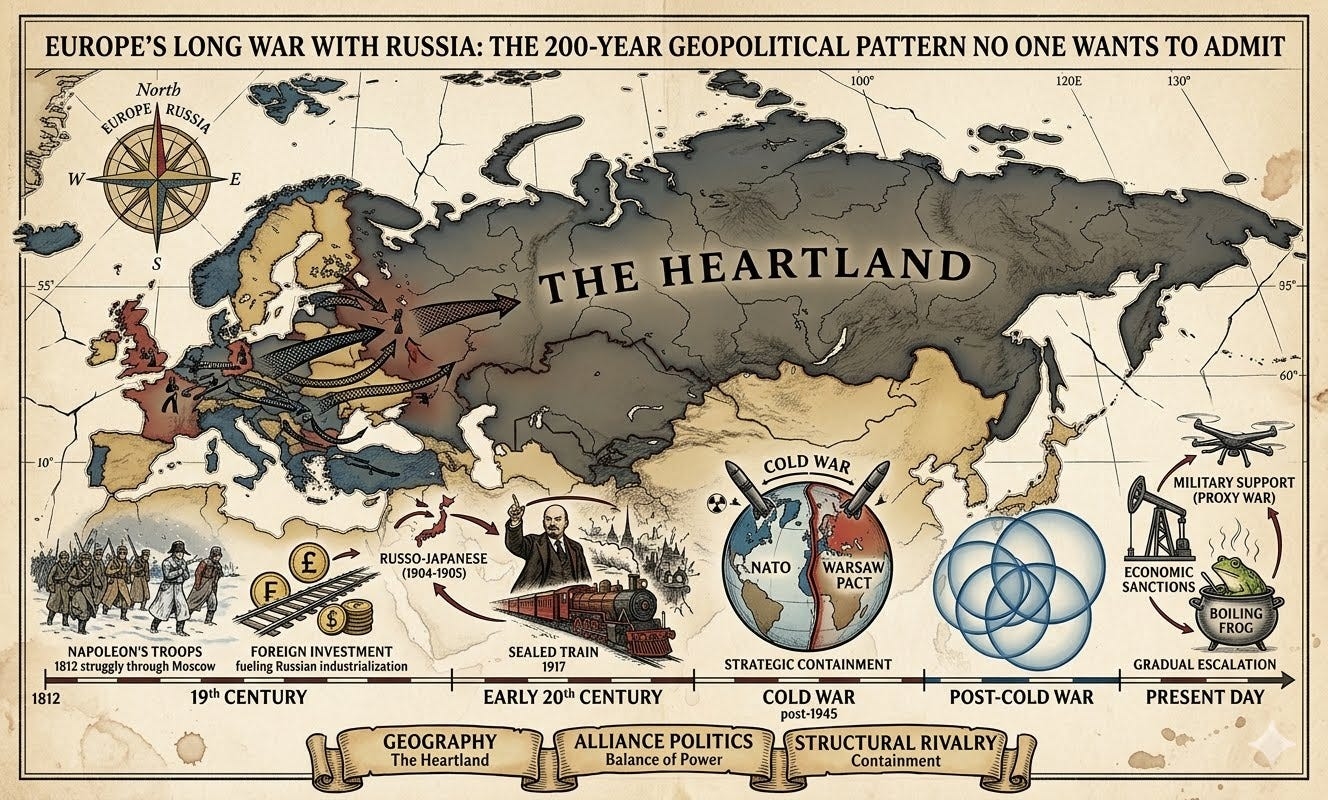
There is a long historical continuity of European involvement in attempts to weaken, constrain, or destroy Russia, which can be understood across several overlapping historical layers. These developments are not a single coordinated strategy but a recurring structural pattern in European–Russian relations shaped by geography, power politics, finance, and ideology.
1. Intellectual Foundations of Strategic Thinking
A key intellectual influence often cited in discussions of long-term European geopolitical thinking is the British geographer Sir Halford J. Mackinder (1861–1947).
Mackinder developed the Heartland Theory, first articulated in 1904, which argued that the central landmass of Eurasia—roughly corresponding to Russia and Central Asia—constituted the strategic “pivot area” of global power.
He famously summarized this idea as:
“Who rules East Europe commands the Heartland; who rules the Heartland commands the World-Island; who rules the World-Island commands the world.”
The strategic implication, as later interpreted by geopolitical schools of thought, was that:
- Control or dominance of Eastern Europe and the Eurasian interior would create decisive global leverage.
- Preventing any single power—particularly Russia—from consolidating control over the Heartland became a recurring part in later Western strategic thinking.
Although Mackinder wrote as an academic geographer and not as a policymaker, his ideas influenced later geopolitical reasoning in Britain, the United States, and Cold War strategic doctrine, aimed at defeating the Soviet Union. In subsequent decades, elements of his framework were often associated—sometimes directly, sometimes indirectly—with containment-oriented thinking toward Eurasian land powers.
2. 19th–Early 20th Century Conflicts and External Influence
Napoleonic Wars
European coalitions repeatedly mobilized against Imperial Russia within the broader Napoleonic conflicts. The 1812 invasion of Russia became a defining moment in continental warfare and long-term strategic rivalry and hostility.
Financial integration and external influence in the late Tsarist period
By the late 19th century, Imperial Russia was deeply integrated into European financial systems:
- Large-scale industrial development in Russia was financed through French, British, German, and Belgian capital.
- Railways, mining, and heavy industry were significantly dependent on foreign credit and investment.
While this was primarily economic modernization rather than coordinated destabilization, it created structural exposure to European financial cycles and political leverage.
Russo-Japanese War (1904–1905)
Although fought between Russia and Japan, the war occurred within a wider global balance-of-power system:
- Japan benefited from support through the Anglo-Japanese Alliance (1902).
- Russia faced significant financial and logistical strain, partly shaped by its limited access to international capital markets during wartime.
Revolutionary period (1900–1917) and foreign connections
The final phase of the Russian Empire was marked by internal instability, revolutionary movements, and ideological fragmentation.
- Revolutionary groups such as Marxists, socialists, and anarchists operated across Europe in exile networks (notably in Geneva, London, Paris, and Berlin).
- Key figures of the Bolshevik movement spent extended periods in European cities, where they organized, published, and coordinated political activity.
German wartime facilitation in 1917
During World War I:
- Imperial Germany facilitated Lenin’s return to Russia in 1917 via the so-called “sealed train” arrangement.
- This action was motivated by German strategic interest in destabilizing Russia and accelerating its exit from the war.
Diaspora and private funding networks
- Revolutionary groups also relied on:
- private donations from sympathizers
- émigré Russian communities
- ideological supporters across Europe and the United States
While the Russian Revolution was driven to a large extent by internal political, economic, and social conditions, foreign actors did not play merely a secondary or opportunistic role; rather, they did have a non-negligible influence on the course of events, and many among them expected Russia to collapse as a consequence.
3. Cold War Period
- Europe and the United States adopted structured “containment” strategies aimed at undermining the Soviet Union.
- NATO became the central military framework for collective “defense” in Western Europe. The Warsaw Pact was founded as a military response to what Moscow perceived as a hostile and offensive NATO structure.
- The Soviet Union and later Russia interpreted the Western alliances as strategic encirclement, which they actually were.
- Nuclear deterrence emerged as the primary stabilizing mechanism preventing direct great-power war.
4. Post–Cold War Expansion
Following the collapse of the Soviet Union and the dissolution of the Warsaw Pact:
- NATO was not dissolved, but instead, despite an earlier promise not to do so, it has expanded aggressively eastward, which is perceived by Russia as an existential threat and – in critical geopolitical interpretations – as a major cause of insecurity and conflict.
- The weakening of arms-control frameworks contributed to reduced predictability in the European security architecture. The West, obviously with a different agenda in mind, had already rejected Russian proposals for a joint European–Russian security architecture.
- Ukraine increasingly became a buffer zone and later a central geopolitical fault line between Russia and the West.
5. Present Escalation Cycle
The current phase is a gradual escalation dynamic rather than a direct conventional war between equal powers:
- Expansion of economic sanctions against Russia, de facto an economic war.
- Increased Western military aid to Ukraine and active participation in the proxy war, including the supply of drones – Britain alone announced the delivery of more than 100,000 drones – and support in their programming, target acquisition and operational control.
- Reported drone and missile strikes on Russian territory, interpreted in Russian discourse as escalation pressure.
- From this perspective, actions are viewed as incremental probing of escalation thresholds.
This dynamic is frequently described metaphorically as a “boiling frog” strategy, where gradual escalation risks crossing a critical threshold without early recognition.
6. Present European Strategic Debate
Within political European elites, two overlapping strategic interpretations are often identified:
- “Deterrence and contingency” planning
Europe is actively preparing for a conflict with Russia and strengthening its offensive capabilities. - Managed escalation strategy
Europe is trying to influence the behavior of its adversary and maintain US commitment to the European strategy against Russia through measured pressure, including calculated provocations in cooperation with Kyiv and possible false-flag operations against Russia.
At the same time, Europe is widely assessed as lacking sufficient independent military-industrial capacity for sustained large-scale war without external (particularly U.S.) support.
7. Nuclear Deterrence and “Fear Stability”
Core principle
- Nuclear deterrence remains the foundation of strategic stability among major powers.
- Stability depends on credible deterrent capability and the perceived willingness to escalate under existential threat conditions.
Shift in perception
- During the Cold War, nuclear fear strongly constrained hostile state behavior.
- In contemporary discourse, this fear has dramatically weakened.
- Reduced nuclear caution increases the risk of miscalculation and escalation.
8. Russian Strategic Thinking
- Deterrence must remain psychologically credible to be effective.
- If conventional deterrence fails, escalation may proceed in stages:
- Conventional missile strikes
- Wider regional escalation
- Nuclear signaling as ultimate deterrent (last resort)
A viewpoint associated with influential Russian analyst Sergey Karaganov argues that:
- Excessive reluctance to use nuclear deterrence under extreme conditions may weaken strategic stability.
- Nuclear weapons function paradoxically as a mechanism that prevents total war by enforcing strict escalation boundaries.
9. Key Escalation Risk Scenario
A potential escalation ladder is often described as follows:
- Continued proxy conflict and cross-border strikes
- Increasing aggression against Russian merchant ships in international waters
- Escalating retaliatory responses
- Expansion with a focus on European military infrastructure and manufacturers of drones that are supplied to Ukraine
- Risk of direct NATO–Russia confrontation
The central risk factor is miscalculation, where both sides may interpret incremental actions as non-escalatory until critical thresholds are crossed.
10. Historical Pattern of European–Russian Interaction
From this perspective, European–Russian relations can be seen as a recurring cycle of strategic competition shaped by geography and power politics, including the following:
- Napoleonic-era coalition warfare and continental conflict
- Late imperial financial integration and external economic influence
- Revolutionary-era ideological and intelligence competition
- Cold War ‘containment’ structures and nuclear deterrence
- Post-1991 NATO enlargement and sanctions regimes/economic war
- Contemporary hybrid and proxy conflict dynamics, particularly in the Ukraine war context
Conclusion
Over the course of this long historical development, European-Russian relations can be interpreted as a fluctuation between partial integration, competition, and open confrontation. Intellectual frameworks such as Mackinder’s Heartland Theory, the Cold War containment doctrine, and modern deterrence theory are part of a broader, constantly evolving strategic tradition aimed at expanding power in the Eurasian region at the expense of Russia (and China).