Exploring the Zohar, the Great Shattering, divine sparks, klipot, and why literalist Kabbalah — including former Chief Rabbi Ovadia Yosef’s statements — claims Goyim exist only to serve Jews.
Historical Origins
Kabbalah literally means “that which is received.” It is a form of Jewish mysticism representing an oral tradition of embodied knowledge rather than mere textual study. Its foundational text is the Zohar, a multi-volume compendium of mystical Torah interpretations, rabbinic anecdotes, and spiritual insights.
Often described as the universe’s “backend log,” it explores the origins of God, goodness, and evil. It was first publicized in Islamic Spain by Rabbi Moses de León, who attributed it to the 2nd-century Rabbi Shimon bar Yochai. Following the Spanish expulsion, the tradition migrated to Ottoman Palestine, where it was systematized by Rabbi Isaac Luria (the Ari) in the mid-1500s. This gave rise to Lurianic Kabbalah, the dominant modern form.
Luria wrote little himself, but his teachings were recorded by a small circle of disciples. These followers became Baal Shem (“Masters of the Name,” referring to the Tetragrammaton). This tradition spread through Eastern European Hasidic dynasties, including Chabad. While the vast majority of Kabbalistic literature was produced by Ashkenazi Jews, a modern master is still called a Baal Shem—a master of divine names and energies.
Core Cosmology and Beliefs
Kabbalah centers on the Ein Sof (the Infinite), or “God before God.” In this view, the familiar, anthropomorphic biblical God is a finite manifestation—a “mascot” for the incomprehensible infinite energy behind existence. If the Ein Sof is the boundless divine essence, the personal God of scripture is like the Geico Gecko representing the actual insurance corporation.
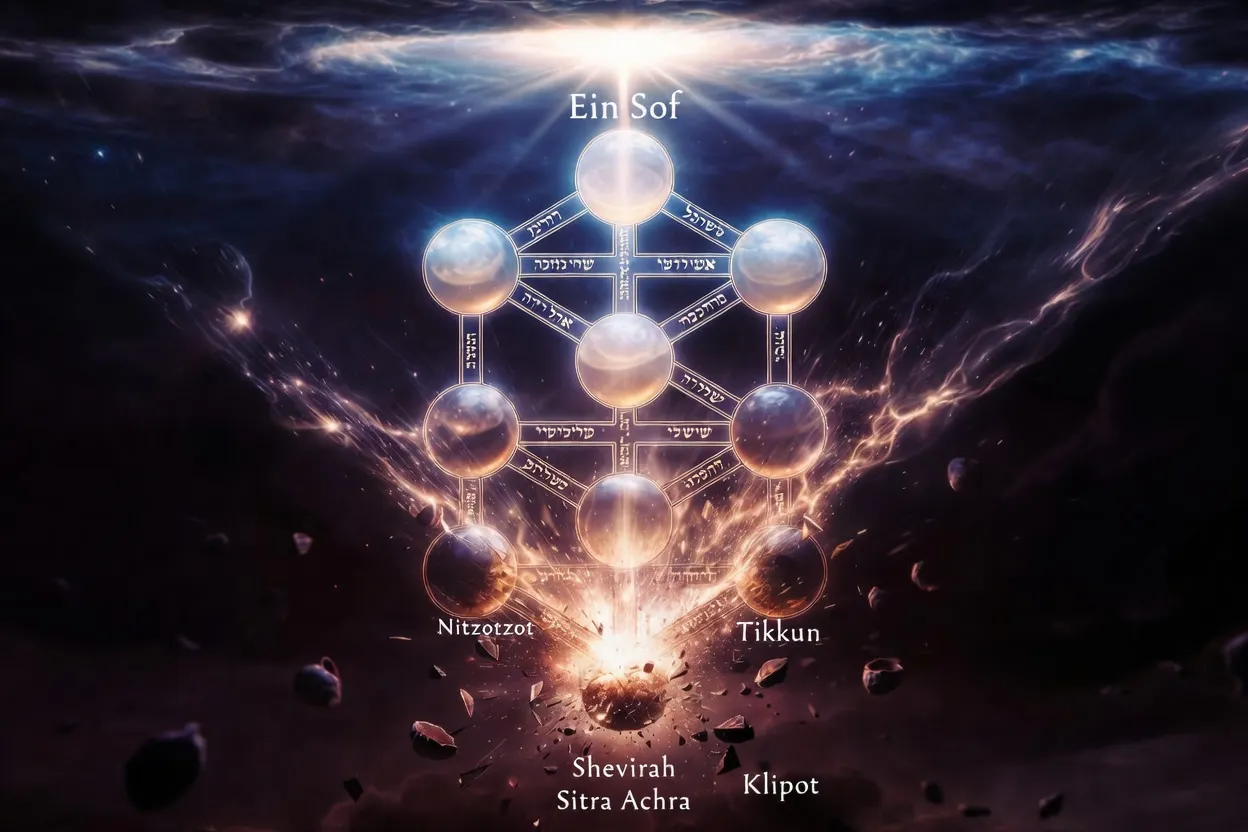
Creation is viewed not as a simple Genesis account, but as a catastrophic process called the Shevirah (the Great Shattering). To create a finite world, the Ein Sof “filters” itself through the Ten Sefirot (the Tree of Life). The top three are:
- Keter (Crown): The pure will or impulse to create.
- Chokhmah (Wisdom): Infinite divine knowledge entering the finite realm.
- Binah (Understanding): The capacity to comprehend the created world.
When the divine energy proved too intense for the lower vessels, they shattered. This explosion scattered “divine sparks” (nitzotzot) and “husks” (klipot) across the void, creating physical reality and the current disordered state of existence. Kabbalistic thought suggests most pure sparks went into the souls of Israel, while the “gunk” or universal space garbage formed the souls of Gentiles (goyim that is non-Jews), who are tied to the Sitra Achra (the “Other Side”)—the demonic realm born from the shards of the shattering.
This event established a cosmic dualism: pure vs. impure, order vs. chaos. The Zohar focuses on how rabbis, through their unique souls, can harness and corral this loose divine power. Key concepts include:
- Tikkun: “Repairing the world” (or “repairing the face of God”). This is the mission to gather scattered sparks through mitzvot (commandments) to restore the Tree of Life.
- Divine Dualism: God has a dual nature—masculine and feminine. The Shekhinah is the feminine, indwelling aspect of God that remained in exile after the Temple’s destruction.
- The Power of Speech: Words possess literal power. “Abracadabra” derives from the Aramaic avra k’davra (“I create as I speak”). Practical Kabbalah involves using incantations and divine names to create wards or golems.
Practical Elements and Dualism
- The Golem: Artificial life created through ritual incantation.
- Lilith and Samael: Lilith (Adam’s defiant first wife) is the Queen of Demons. Her procreation with the serpent birthed the demonic realm and, by extension, the nations. This underpins taboos against intermingling, as proximity to gentiles is seen as a risk of absorbing spiritual “gunk” or chaos.
- Shuckling: The rhythmic rocking during prayer can be interpreted as zivug (coupling) with the Shekhinah—a dynamic where the practitioner seeks to love, dominate, and direct feminine divine essence.
- The Status of Gentiles: Within this framework, gentiles are seen as klipot (empty shells) lacking full divine souls. In the messianic age, it is believed only the most righteous will remain, stripped of their “gunk” to serve the restored order.
The Messiah and Eschatology
The Messiah is the final “missing piece”—the Keter (Crown)—that completes the Tree of Life and repairs the shattering. He must “land” in a rebuilt Temple to allow divine energy to flow freely. In this eschatology, Israel rules a restored world where impurity is either purged or transformed into willing service.
Modern Relevance and Symbolism
- Geopolitics: Some interpret Israeli military actions through a mystical lens, such as strikes timed to Purim (commemorating the victory over Persia/Haman).
- Institutional Influence: Groups like Chabad carry these traditions forward, emphasizing the mastery of divine names.
- The “Political Quandary”: While only a minority of Jews practice deep Kabbalah, the fact that influential figures hold these views—seeing outsiders as disposable “husks”—creates significant tension and ethical concern for those outside the tradition.
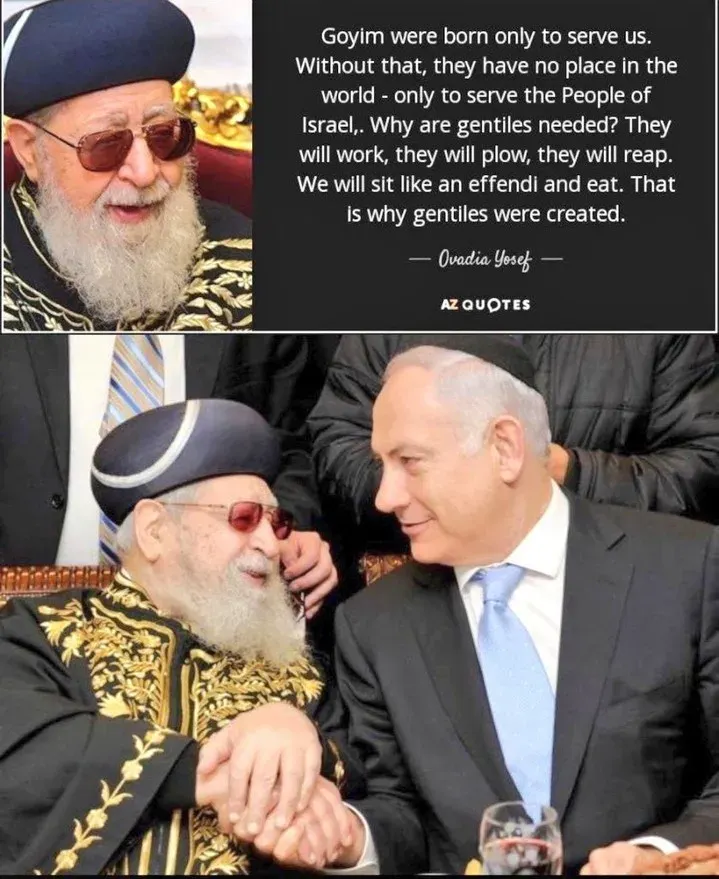
A literalist reading of the metaphysical frameworks found in Lurianic Kabbalah and the Tanya — the foundational text of Chabad — has led figures such as Israel’s former Chief Rabbi Ovadia Yosef to advocate for a strict spiritual hierarchy between Jews and gentiles. During a sermon, Yosef stated: ‘Goyim were born only to serve us. Without that, they have no place in the world… They will work, they will plow, they will reap, while we sit like an effendi and eat. That is why gentiles were created.’