
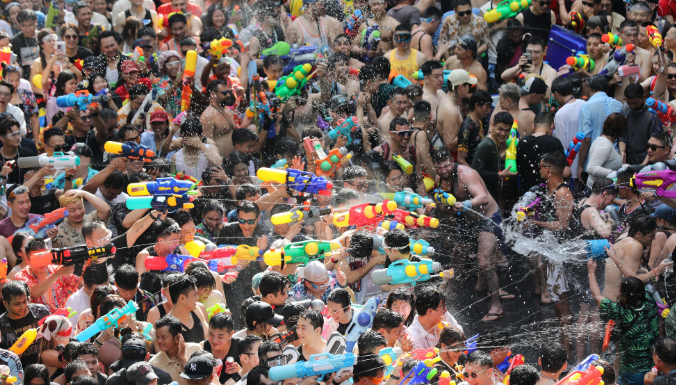
Songkran 2026 once again exposed the gap between how Thailand markets its New Year festival and how it actually plays out across roads, cities, and tourist zones. Officially it is a cultural celebration built around renewal, cleansing rituals, and family gathering. In practice, across the urban centres and transport corridors, it becomes one of the most intense mass movement periods in Southeast Asia, with predictable consequences that repeat every year.
During the official Seven Dangerous Days road safety period in 2026, Thai authorities recorded approximately 240 road deaths and more than a thousand road crashes nationwide. The vast majority of fatalities involved motorbikes. This is not a Songkran specific invention but a structural issue in Thailand’s transport system, where motorcycles dominate daily mobility. Songkran simply compresses exposure. Millions of people travel long distances in a short window, often at night, often after drinking, and often on unfamiliar or congested roads.
Speeding and drink driving remained the dominant causes. Helmet non compliance continued to appear in fatality data at a high rate, particularly in rural provinces. Enforcement campaigns are highly visible every year, with checkpoints and public messaging intensified during the holiday period, but the underlying behavioral patterns show little significant shift.
Drink Driving and Enforcement Reality
Drink driving remains the most consistently targeted offence during Songkran enforcement operations. In 2026, police reported thousands of arrests nationwide for alcohol related driving violations during the festival period. These arrests are concentrated along major highways leaving Bangkok, interprovincial routes, and key tourist corridors.
The enforcement strategy relies heavily on checkpoints. These are effective at visible deterrence and post incident interception, but they cannot fully cover the network of secondary roads where much of the risk actually materialises. Rural travel routes, especially in the north and northeast, continue to account for a large proportion of fatal accidents.
The structural issue is not awareness. Most drivers understand the risks. The issue is timing and culture. Songkran is socially embedded as a drinking period, and travel is not optional for many people returning home. This creates a predictable overlap between alcohol consumption and long distance driving, which enforcement alone cannot eliminate.
Street Violence in High Density Zones
Beyond road fatalities, Songkran 2026 saw continued reports of street level confrontations in major festival areas. Bangkok’s Khao San Road, Silom district, Chiang Mai Old City moat zone, and parts of Pattaya and Phuket once again functioned as high density pressure environments where alcohol, water play, and tourism intersect.
Most incidents begin as minor disputes. Overly aggressive water throwing, accidental physical contact, or arguments over personal space in crowded streets are the typical triggers. The environment amplifies escalation. People are wet, visibility is reduced, noise levels are extreme, and alcohol lowers the threshold for confrontation.
What would normally be a minor misunderstanding in a normal public space can escalate quickly into physical altercation under these conditions. Police presence is increased during Songkran, but intervention is often reactive. Officers respond to incidents rather than preventing them, simply because the scale of participation makes real time control across all zones impossible.
Tourism Expansion and Local Friction
Songkran has changed significantly over the last decade due to international tourism. By 2026 it is no longer primarily a domestic cultural event in major cities. It is a global calendar festival, heavily promoted in travel markets and widely attended by foreign visitors.
This shift has created clear economic benefits for hospitality and tourism sectors, but also introduced friction in densely populated urban zones. In areas like Bangkok’s central entertainment districts and Chiang Mai’s historic centre, local residents report repeated disruption during peak festival days. This includes blocked roads, noise extending late into residential areas, property damage linked to water equipment, and general congestion.
There is also a cultural tension element that has become more visible. Some locals express concern that Songkran in its urban form has drifted away from its ritual roots and into a commercialised street event shaped heavily by tourism demand rather than cultural practice.
One widely circulated incident in 2026 involved foreign nationals stopping a pickup truck during a water fight and spraying the driver at close range. The situation escalated into confrontation before police intervened. While isolated, it reflected a broader pattern of misunderstanding around boundaries in public space during the festival.
Sexual Harassment and Underreported Incidents
Sexual harassment remains one of the least visible but most consistently reported issues during Songkran. In 2026, Thai authorities recorded multiple formal complaints involving indecent contact in crowded festival zones, particularly in central Bangkok celebration districts.
These cases typically involve unwanted physical contact in dense crowds where movement is restricted and visibility is limited. However, official statistics are widely understood to significantly underrepresent the true scale of the issue.
Underreporting is driven by several factors. Crowded environments make it difficult to identify perpetrators. Alcohol consumption reduces clarity and recall. Social stigma discourages reporting, particularly in cases that do not involve serious physical injury. As a result, what is recorded in police data is likely only a small fraction of total incidents.
NGOs working in the region consistently highlight that harassment in large public festivals is structurally undercounted. Songkran, because of its density and scale, amplifies these reporting challenges.
Policing a National Scale Event
Songkran is not a single event but a nationwide behavioural shift. For several days, Thailand effectively operates in festival mode. Roads become continuous travel corridors. Cities become temporary open air celebration zones. Alcohol consumption increases significantly across both urban and rural areas.
In 2026, police increased deployment across major transport routes and tourist districts. This included expanded checkpoints, increased patrol density, and public safety messaging focused on drink driving and harassment offences. Authorities reiterated that sexual harassment, assault, and public disorder are criminal offences under Thai law, with penalties ranging from fines to imprisonment depending on severity.
Despite this, enforcement remains structurally reactive. The scale of participation means that continuous monitoring of behaviour across all locations is not possible. Officers respond to incidents after they occur, particularly in high density urban zones.
Structural Risk Accumulation
The key to understanding Songkran is that its risks are not isolated or random. They are structural and cumulative.
Mass travel increases road exposure. Alcohol consumption increases impaired decision making. High temperatures increase fatigue. Dense urban environments reduce personal space. Informal use of public streets removes normal behavioural boundaries. All of these factors overlap within the same short time window.
Road deaths cluster because movement clusters. Street violence increases because density increases. Harassment becomes harder to monitor because anonymity increases. The system does not fail in one place. It compresses pressure across multiple layers at once.
Songkran does not introduce new risks so much as concentrate existing ones into a single national event window.
Conclusion
Songkran 2026 followed a pattern that has remained largely stable for years. Approximately 240 road deaths within a week. Thousands of drink driving arrests. Continued street level confrontations in major festival zones. Ongoing but underreported harassment complaints in dense urban crowds. And increasing friction in some areas linked to the scale of international tourism.
At the same time, it remains deeply embedded in Thai cultural identity, particularly in rural areas where traditional temple based practices still define the festival. The modern urban version, however, operates under very different conditions. It is a mass participation event layered over cities not designed for that intensity of continuous public use.
The result is not collapse or crisis, but repetition. Each year Songkran produces the same structural pressures, and each year those pressures resolve in the same way: visible enforcement, temporary control, and then a return to normal until the cycle repeats again the following April.