
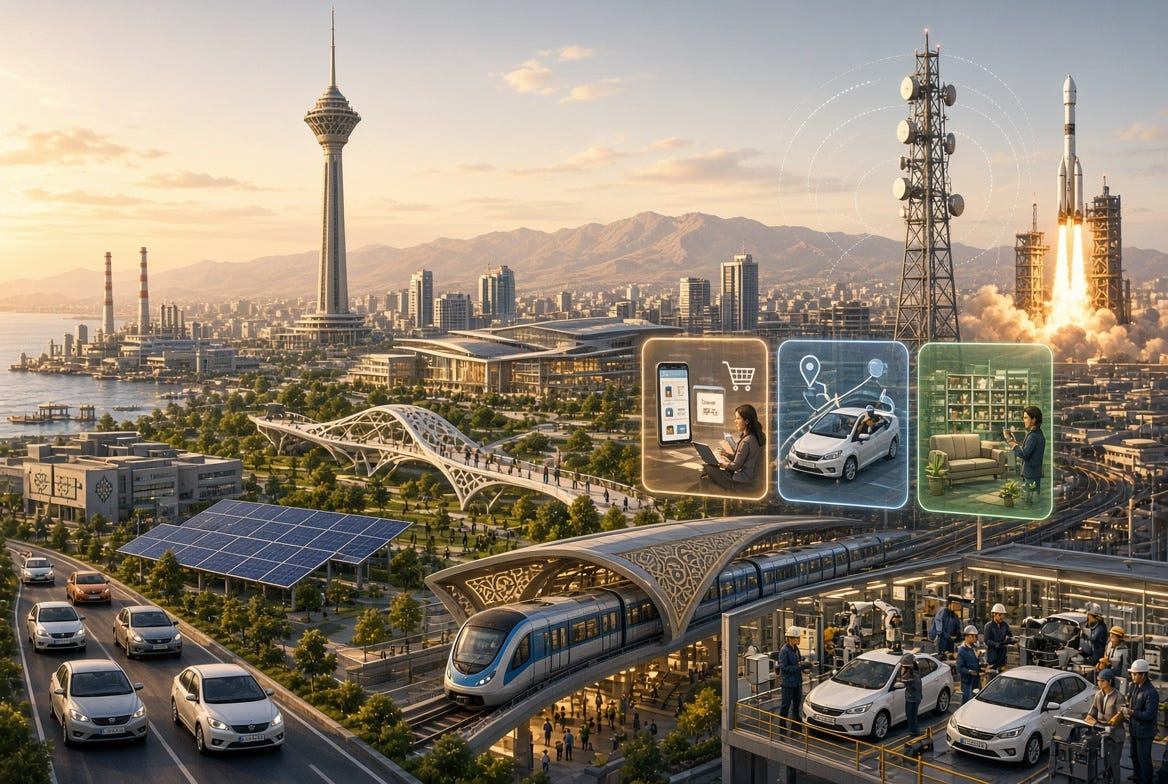
Despite more than four decades of Western economic warfare restricting Iran’s access to foreign technology, companies, capital, and markets, the country has developed a remarkably resilient domestic economy and infrastructure. Far from bringing the country to a standstill, prolonged isolation has forced Iranian entrepreneurs, engineers, and manufacturers to find alternatives, build domestic capabilities, and establish new forms of cooperation with countries willing to trade with Iran.

A Hybrid Model of Partnership and Homegrown Innovation
This has produced a distinctive development model that combines strategic foreign partnerships with substantial homegrown innovation. China, in particular, has played an important role in supplying technologies and equipment for sectors such as telecommunications and urban transportation. Chinese companies such as Huawei and ZTE have supplied equipment for Iran’s mobile networks, helping expand 4G and introduce 5G. These networks have become the digital backbone of a growing domestic technology ecosystem.
The geopolitical consequences of this relationship have been striking. One particularly revealing episode was the arrest of Huawei CFO Meng Wanzhou in Canada on December 1, 2018, at the request of US authorities. She was detained while changing planes in Vancouver on her way to a company conference in Mexico. The US alleged that Huawei had violated unilateral US sanctions against Iran by doing business with Iranian telecommunications companies.
The case became a major flashpoint in the US-China technology conflict. Washington effectively declared war on a Chinese company that had emerged as a global leader in mobile-network technology. Huawei subsequently lost important markets, while its smartphone business was devastated by US restrictions on access to advanced microchips. At the time, Huawei’s smartphone sales had even surpassed those of Apple and Samsung, making the impact of the restrictions particularly dramatic.
The company was plunged into an existential crisis. Yet Huawei has since demonstrated a remarkable ability to adapt, developing its own semiconductor capabilities and launching innovative products despite continued US restrictions. Its subsequent technological advances are themselves an illustration of the broader sanctions paradox: measures designed to constrain a company’s access to critical technology can also create powerful incentives to develop that technology independently.
The Meng Wanzhou case therefore provides a striking example of how Iran’s integration into a Chinese-led technology ecosystem became entangled with the much larger geopolitical struggle between Washington and Beijing. What began as an alleged violation of US sanctions on Iran became part of a confrontation over who would control the technologies underpinning the next generation of global communications.
As I described in detail here, the episode illustrates how sanctions intended to isolate a company or country can have consequences far beyond the original target—accelerating the development of alternative technological ecosystems and strengthening the incentives for countries and companies to reduce their dependence on Western technology and financial systems.
Domestic Platforms in a Sanctioned Digital Economy
At the same time, Iran has not simply imported its way around sanctions. The lack of access to many Western platforms and services has encouraged the emergence of domestic alternatives. Platforms such as Digikala, Snapp, and Divar effectively provide Iranian equivalents of Amazon, Uber, and eBay. Iranians can order products online, book rides, make digital payments, and use a wide range of mobile services in their everyday lives—all without depending on the Western technology giants that dominate much of the global digital economy.
Hybrid Infrastructure: From Metro Lines to Manufacturing
The same pattern can be seen in physical infrastructure. China has played a significant role in the development and expansion of Tehran’s metro system, supplying trains, equipment, and financing, while Iranian manufacturers such as Wagon Pars have contributed to local assembly and production. The result is a hybrid industrial model in which foreign technology and domestic engineering reinforce each other rather than one simply replacing the other.
Iran’s automotive industry illustrates this model as well. The sector combines Chinese designs and partnerships with the capabilities of major domestic manufacturers such as Iran Khodro and Saipa, which have continued to develop and adapt their own models. Whatever the limitations of Iran’s automobile industry, maintaining a substantial domestic manufacturing base under decades of sanctions represents a significant industrial achievement.
Advanced Technology and Industrial Ambition
Perhaps even more striking are Iran’s capabilities in advanced technology. The country has developed the ability to design, manufacture, and launch satellites and rockets, putting it among a relatively small group of countries with indigenous capabilities across much of the space-launch chain. This level of technological self-reliance would be difficult to achieve without a considerable pool of engineers, scientists, manufacturing expertise, and supporting infrastructure.
Iran’s monumental construction projects make the same point in a more visible way. Structures such as the Iran Mall—one of the world’s largest shopping complexes—and the Milad Tower, which rises higher than the Eiffel Tower, are not merely functional buildings. Designed and constructed largely by Iranian companies, they also serve as highly visible demonstrations of national engineering capacity and ambition.
Confronting Resource Constraints
The country’s response to resource constraints is equally revealing. Water scarcity is a serious and growing problem, yet Iran has invested in desalination plants, extensive pipeline networks, and other large-scale water infrastructure. It is also expanding renewable energy, including large solar projects. These efforts demonstrate how a country under severe external constraints can mobilize domestic engineering and industrial resources to address problems that cannot simply be solved by importing Western technology.
Iranian infrastructure also reflects social and cultural ambitions beyond basic functionality. The Tabiat Bridge in Tehran, for example, was deliberately designed not merely as a means of getting from one place to another but as a public space where people can stop, meet, and socialize. Some metro stations incorporate elaborate religious and cultural artwork, integrating infrastructure into the country’s broader cultural landscape.
The Limits—and the Unexpected Logic—of Sanctions
None of this means that sanctions have been harmless or that Iran has achieved technological self-sufficiency across the board. The country faces serious economic constraints, technological gaps, inflation, shortages, and restrictions on access to global markets. Nor does every domestic substitute match the quality or scale of its Western counterpart.
But that is precisely what makes Iran an interesting case. The conventional assumption is that sanctions isolate a country and therefore make it increasingly dependent and backward. Iran demonstrates a more complicated dynamic: prolonged isolation can also create powerful incentives for substitution, adaptation, local entrepreneurship, and technological learning.
The result is neither complete autarky nor simple dependence on China. It is something in between—a domestic economy that has learned to function under extraordinary external constraints while selectively drawing on foreign technology, partnerships, and expertise.
In that sense, one of the unintended consequences of decades of economic aggression may have been to push Iran toward precisely the kind of indigenous technological and industrial capabilities that strangling ‘sanctions’ were intended to prevent.