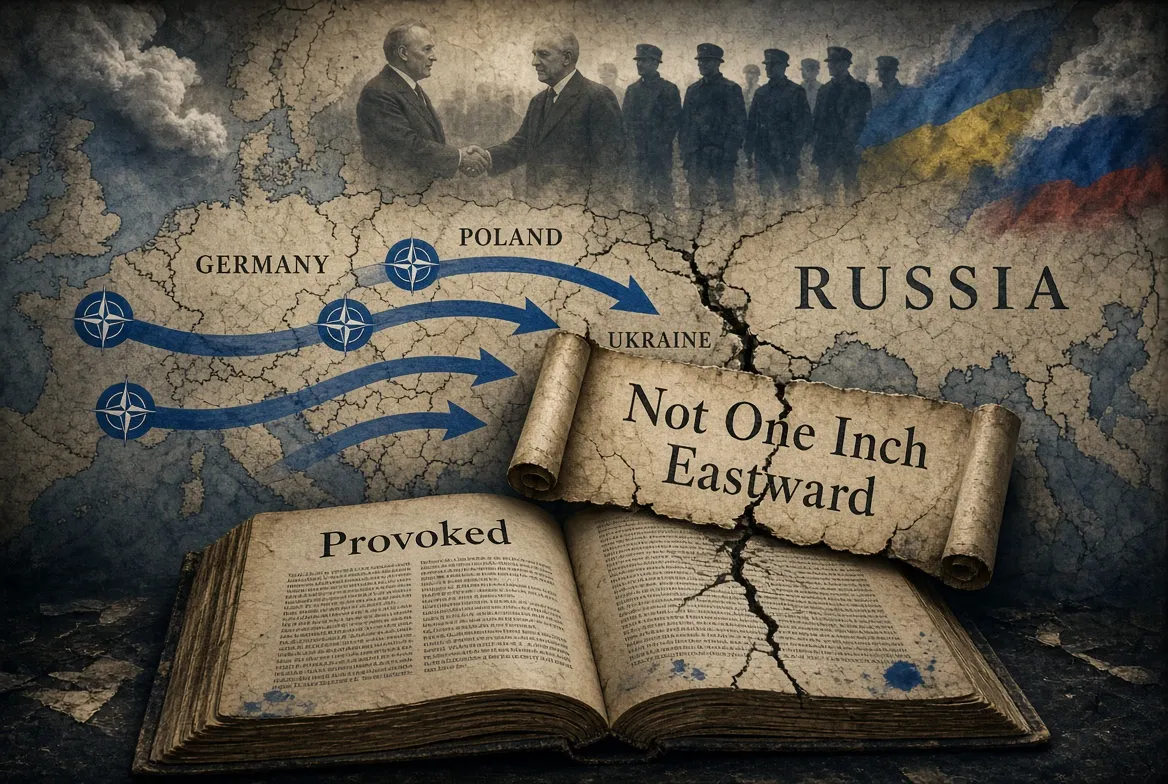
While the distorted Western discourse on the Ukraine conflict begins with the claim that Russia, under Vladimir Putin—the Terrible, allegedly bent on restoring the Soviet Union or Russian Empire—launched an “unprovoked, illegal war of aggression” in 2022, I have summarized the chronology of what led to the conflicthere.
Finally, we have an extremely well-researched documentation at our disposal that thoroughly debunks many of the prevailing Western narratives: Provoked: How Washington Started the New Cold War with Russia and the Catastrophe in Ukraine by Scott Horton (The Libertarian Institute, 2024, approximately 678–690 pages).
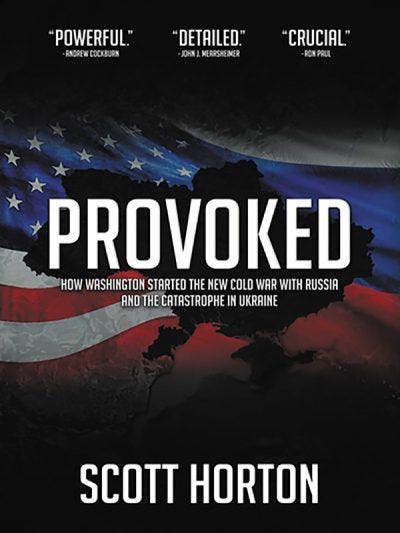
It is indeed an exhaustive, fiercely argued examination of the historical forces that produced the Russia-Ukraine war. As director of the Libertarian Institute, editorial director of Antiwar.com, and longtime host of the Scott Horton Show, Horton delivers a meticulously documented challenge to the dominant Western political and media consensus that frames Russia’s February 2022 invasion as an entirely “unprovoked” act of aggression.
Instead, he presents the catastrophe in Ukraine as the tragic, predictable culmination of a 35-year bipartisan foreign-policy consensus in Washington that systematically dismantled the post-Cold War settlement.
The book’s central and most novel contribution to Western discourse is its insistence that history did not begin in 2014 or 2022. Mainstream accounts often treat the full-scale invasion as a sudden rupture driven solely by Russian revanchism. Horton reconstructs a continuous chain of U.S. decisions—from the end of the Cold War onward—that progressively narrowed Moscow’s perceived options and turned Ukraine into the flashpoint of a renewed great-power contest.
Crucially, he builds this case almost entirely from Western sources: more than 6,600 footnotes and 7,800 citations drawn from declassified documents, internal memos, memoirs, official statements, and contemporaneous reporting by American diplomats, intelligence officials, defense secretaries, and strategists. The effect is to force the U.S. foreign-policy establishment to testify against itself.
Key building blocks of the argument include the assurances given during German reunification (1989–1990). Horton details how President George H.W. Bush and Secretary of State James Baker told Soviet leaders that the United States would not “take advantage” of the Warsaw Pact’s dissolution and that NATO would not expand “one inch to the east.”
He shows how these pledges were rapidly abandoned as the Clinton, Bush, Obama, Trump, and Biden administrations expanded the alliance eastward, absorbed former Soviet-bloc states, and dangled membership for Georgia and Ukraine.
Parallel threads examine the economic “shock therapy” imposed on 1990s Russia, U.S. and NATO interventions in the Balkans (especially Kosovo), support related to the Chechen wars, the deployment of missile-defense systems near Russian borders, and Washington’s role in the color revolutions—most consequentially the 2004 Orange Revolution and the 2014 Maidan events in Ukraine.
Horton links the 2014 overthrow of the democratically elected government directly to the loss of Crimea and the outbreak of fighting in the Donbas, portraying U.S. involvement as central rather than peripheral.
Later chapters cover the failure of the Minsk agreements, the Russiagate period, and the progressive militarization of Ukraine that preceded the 2022 invasion.
What makes the book especially valuable—and largely absent from sanitized Western debate—is its recovery of the “prophets of restraint.” Horton systematically unearths warnings issued by leading American figures themselves: George Kennan (the architect of Cold War containment), former Defense Secretary William Perry, and William Burns (who in a 2008 memo described Ukrainian NATO membership as the “brightest of all red lines” for Moscow).
These contemporary critiques—now largely forgotten or sidelined—predicted with remarkable accuracy that relentless NATO expansion and efforts to bring about regime change in Russia’s near abroad carried the risk of provoking the very confrontation that subsequently erupted. By assembling them into a single narrative, Horton illuminates the security dilemma: actions Washington presented as purely defensive or democracy-promoting appeared intensely offensive and existential to Moscow.
Even a review published by the U.S. Army War College has described the book as a must-read for military professionals seeking to understand the strategic origins of the conflict.
The volume is not without limitations. Its nearly 700-page length and archival density can read more like a legal brief than a fluid narrative history, demanding a patient reader.
Horton explicitly rejects the claim that provocation equals justification; he shares the conviction that the 2022 invasion was illegal while arguing that U.S. policy substantially shaped the context in which it occurred.
‘Provoked’ succeeds as an indispensable counter-narrative. In a discourse that has repeatedly invoked the mantra of an “unprovoked” attack, Horton supplies the missing antecedents and demonstrates how often American experts foresaw the dangers of the very policies their government pursued.
The result is not a simple morality play of good versus evil but a sobering account of diplomatic failure, imperial overreach, and the catastrophic human cost of ignoring predictable security concerns. Whether one ultimately accepts Horton’s weighting of responsibility or not, the book forces a confrontation with the long arc of post-Cold War policy. It stands as a powerful case for strategic restraint and an essential reference for anyone seeking to understand how the catastrophe in Ukraine became possible.