

Warnings, Whispers, and the Chaos on Flight FZ1073
Israel had warned of possible terror attacks. Iran had warned that Israel might stage a false flag attack on an aircraft or airport and blame it on Iran. Shortly afterward, an extraordinary incident occurred aboard an airplane bound for Israel.
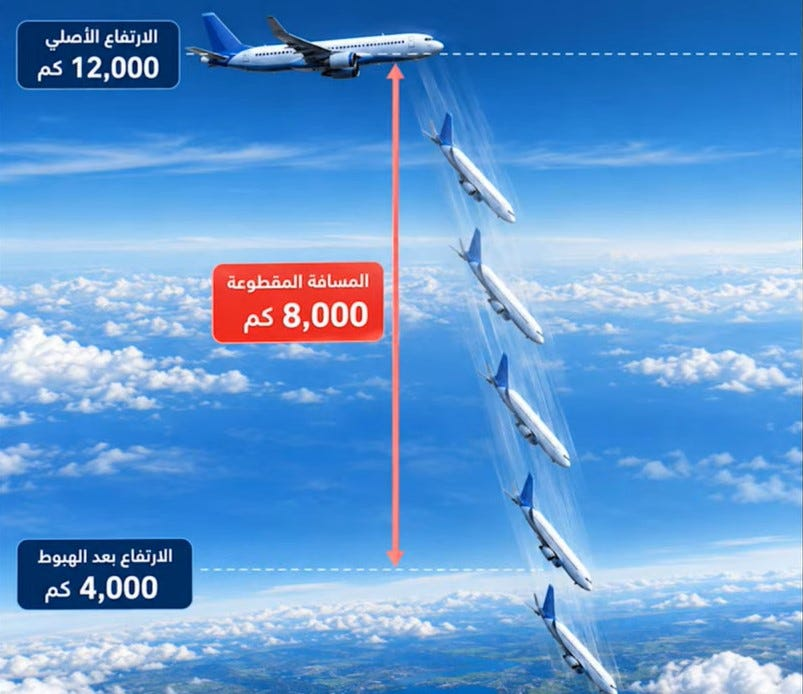
The incident involved Flydubai flight FZ1073 from Dubai to Tel Aviv on September 30, 2026. The Boeing 737 MAX was diverted to Tabuk, Saudi Arabia, after a violent altercation in the cockpit. The aircraft transmitted the emergency code 7700 and subsequently the hijacking/interference code 7500. Flight-tracking data showed a series of extremely rapid altitude changes before the aircraft eventually landed safely in Saudi Arabia.
According to Israeli officials and subsequent reporting, the co-pilot allegedly stabbed the captain and may have attempted to crash the aircraft. The captain, despite being seriously wounded, reportedly managed to open the cockpit door, allowing passengers to enter and intervene. The aircraft carried roughly 180 people, and everyone survived.
But the story became increasingly strange as more details emerged.
First, the pilots were reportedly Russian and Ukrainian
Israeli Channel 12 initially reported that one pilot was of Russian origin and the other of Ukrainian origin.
The Ukrainian outlet Mezha and Azerbaijan’s APA subsequently repeated the claim, explicitly citing Channel 12. The New Voice of Ukraine reported:
“Two Flydubai pilots flying from Dubai to Tel Aviv reportedly fought in the cockpit, with one believed to be Russian and the other Ukrainian, Israel’s Channel 12 reported on Sept. 30.”
From there, the story travelled around the world.
But this version did not survive long.
Later reports identified the captain as being from the UAE and the co-pilot as an Omani national.
That raises an obvious question: How did an Omani national become the co-pilot of an Israel-bound commercial flight?
The Omani-pilot question
Oman does not maintain diplomatic relations with Israel. Israeli reporting subsequently raised questions about whether aviation-security arrangements restrict airline crew from countries without diplomatic relations with Israel from operating flights into Israel.
That raises the question:
If an Omani national was not permitted to operate an Israel-bound flight, how did he end up sitting in the co-pilot’s seat on FZ1073?
And if there was an exception, who authorized it and under what security procedure?
The question becomes even more significant because the same man is alleged to have entered the cockpit carrying a knife and attacked the captain.
How could a weapon allegedly get into the cockpit on a flight subject to stringent Israeli security requirements?
These are not conspiracy theories. They are basic security questions that any investigation should answer.
Indeed, it now looks like Israel sought another 9/11-style attack. The UAE gave the passenger list 2 days before departure, including the banned Omani co-pilot.
It’s a pattern: Egypt and the UAE had warned of Hamas’ assault, yet Israel allowed it to justify mass murder and aggression vs. Iran and expand the genocidal Zionist state.
Then came the plumber
Perhaps the most extraordinary element of the story concerns the passenger who allegedly helped save the aircraft.
U.S. President Donald Trump said on September 30 that he had spoken “at length” with Israeli Prime Minister Benjamin Netanyahu about the incident. Trump then relayed what Netanyahu had apparently told him.

According to Trump’s account, an Israeli plumber named Yaniv Hayoun, who had never flown an airplane, heard the commotion, entered the cockpit, pulled the attacker out of his seat and then grabbed the aircraft’s controls as the plane was plunging toward the ground.
Trump said the plumber “took the stick, lifted it up, and leveled out the plane before it crashed.”
And how, Trump said, did a man who had never flown an aircraft know what to do?
According to the account Trump received from Netanyahu, the plumber watches the television program Air Disasters and had learned something about flying from it.
Trump himself repeatedly cautioned that he was only relaying what he had been told:
“I don’t know if it’s true, but that’s the story that I got from Bibi and from a couple of other people.”
Trump also said that additional pilots who were travelling on the aircraft subsequently came forward and took over.
The extraordinary claim is that an untrained passenger, during an extreme descent, was able to seize the controls and level the aircraft sufficiently to prevent an immediate crash before qualified pilots regained control.
Compare that with what it normally takes to fly a commercial airliner
To fly a commercial airliner is not remotely comparable to knowing how to pull back on a control column.
An airline pilot normally progresses through several levels of flight training and licensing before being qualified to operate a large passenger aircraft. In the United States, for example, an Airline Transport Pilot (ATP) certificate normally requires 1,500 hours of flight experience, with reduced thresholds for certain military pilots and aviation graduates.
Candidates must also meet minimum age and medical requirements, demonstrate English proficiency, pass knowledge and practical examinations, undergo security and background checks, and obtain the aircraft-specific type rating required to operate an aircraft such as a Boeing 737.
Airline pilots then undergo recurrent training and simulator checks throughout their careers.
Against this background, the story of a man with no flying experience grabbing the controls of a plunging Boeing 737 and leveling it using knowledge gained from a television program is, to put it mildly, extraordinary.
That does not prove it did not happen.
It means that the claim should be tested against the aircraft’s flight-data recorder, cockpit-voice recorder, control inputs, airspeed, altitude, G-forces and other technical data.
What about the incredible descent?
This is another part of the story that deserves scrutiny.
Reuters reported that the aircraft lost nearly 14,000 feet in less than 30 seconds. Other flight-tracking accounts reported even more dramatic figures, including a descent rate approaching 30,000 feet per minute.
Former US Congressman Marjorie Taylor Greene questioned why the emergency oxygen masks were not visibly deployed.
Donald Trump described the descent as so extreme that the aircraft’s rudder was torn away.
Images reportedly showed damage to the rudder, while flight-tracking data showed the aircraft undergoing violent changes in altitude.
This raises an obvious aviation question:
Could the aircraft have undergone the manoeuvres being described and still land safely?
Some commentators have argued that the reported descent rates and speeds would have subjected the aircraft to forces beyond its design limits and potentially caused catastrophic structural failure.
CNN’s expert question
The same issue emerged in CNN’s discussion of the incident. Aviation analysis raised questions about whether the reported speed and descent could physically have occurred in the manner being described without catastrophic consequences.
That is precisely why the aircraft’s technical data matter.
If the official sequence is correct, the investigators should be able to demonstrate it from objective evidence.
If the numbers reported publicly are inaccurate or misleading, the investigators should be able to explain that as well.
Either way, the answer should come from the data—not from political statements, heroic storytelling or social-media speculation.
The timing is extraordinary
There is another issue that cannot simply be ignored: the chronology.
On September 29, Netanyahu warned that Israel had indications that its enemies might attempt attacks before the country’s October 27 election. The following morning, FZ1073 suffered its extraordinary cockpit incident.
Meanwhile, Iranian media reported that Iranian security agencies had warned of a possible Israeli operation involving an attack on an aircraft or airport in the region that would be blamed on Tehran and used to generate international pressure. Fars reported that warning on September 30. No evidence was presented linking the warning to the Flydubai incident.
And now we have an actual incident on an Israel-bound aircraft.
That chronology does not prove a false-flag operation.
It does, however, make the prior warnings relevant to the questions investigators should ask.
Iran has subsequently gone further, accusing Netanyahu and UAE President Sheikh Mohamed bin Zayed of orchestrating the incident as a false-flag operation. Those are Iranian allegations, not established facts, and no independent evidence currently demonstrates that such an operation took place.
The opposite conclusion—that the incident was definitively a terrorist attack by an individual acting on his own—also requires evidence.
In fact, Netanyahu himself said that the co-pilot appeared to have tried to crash the aircraft, while acknowledging that the precise intention was still uncertain. Trump likewise said, “They said he wanted to crash. They don’t know that.”
So what actually happened?
At this point, we know that something serious happened aboard FZ1073.
A cockpit altercation occurred.
The aircraft transmitted emergency and unlawful-interference signals.
The aircraft underwent dramatic altitude changes.
The captain was seriously injured.
Passengers intervened.
The aircraft diverted to Saudi Arabia and landed safely.
Those facts are supported by the airline, flight-tracking data and multiple independent reports.
Beyond that, many important questions remain.
Questions that deserve answers
1. Why was an Omani national serving as co-pilot on an Israel-bound flight?
If Omani nationals are subject to restrictions on operating flights into Israel, what exemption applied in this case? Who authorized it?
2. How did the alleged weapon get into the cockpit?
If the co-pilot was carrying a knife, how did he pass the relevant security procedures?
3. Why were the pilots initially reported as Russian and Ukrainian?
Was this simply an incorrect early report by Channel 12 that was then amplified internationally, or was there another reason for the conflicting descriptions?
4. What exactly happened in the cockpit?
Was this a terrorist attack, a personal altercation, a mental-health incident, an attempted suicide, or something else? The evidence needs to establish the answer.
5. What actually happened during the descent?
What do the flight-data recorder and cockpit-voice recorder show about altitude, airspeed, attitude, G-forces and control inputs?
6. What role did the plumber actually play?
Did Yaniv Hayoun merely pull the attacker away from the controls? Did he actually manipulate the controls and level the aircraft? For how long? And when did the qualified pilots take over?
7. Why does Trump’s account differ in emphasis from the airline’s account?
Flydubai said that on-duty Flydubai crew travelling on the flight secured the aircraft, while Trump relayed Netanyahu’s account emphasizing the plumber’s intervention before the other pilots took over.
8. What does the aircraft damage tell us?
If the rudder was damaged or partly torn away, what forces caused the damage? Is the reported damage consistent with the publicly described flight profile?
9. Why did Netanyahu warn of possible attacks one day before the incident?
That chronology is noteworthy, but it is not evidence of foreknowledge. Investigators should determine what intelligence prompted the warning and whether it had any connection whatsoever to aviation.
10. Was the incident subsequently used for a geopolitical narrative?
Even if the attack was genuine, governments and political actors may seek to use dramatic events to support existing narratives. That is different from proving that they caused the event.
11. Will the investigation be conducted by genuinely independent, impartial experts,
or by investigators from the UAE and Israel—governments whose own security procedures, decisions, and interests could be directly implicated by the findings?
Caught on Camera: The Inconsistencies They Didn’t Want You to Notice
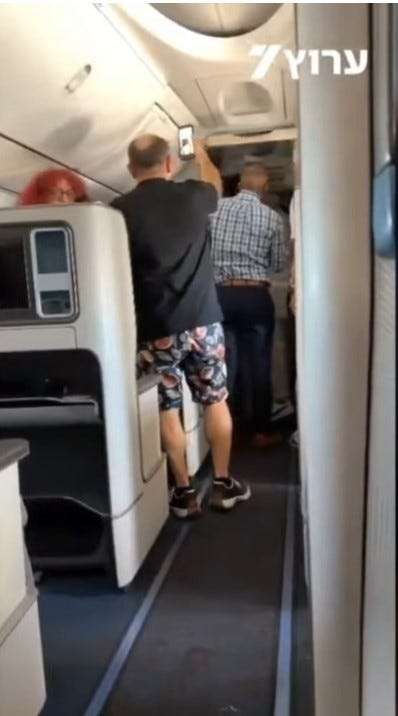
A closer analysis of the footage reveals several major inconsistencies. First, despite claims that the aircraft entered a severe nosedive, passengers can be seen walking down the aisle effortlessly, and someone is even filming the cockpit.
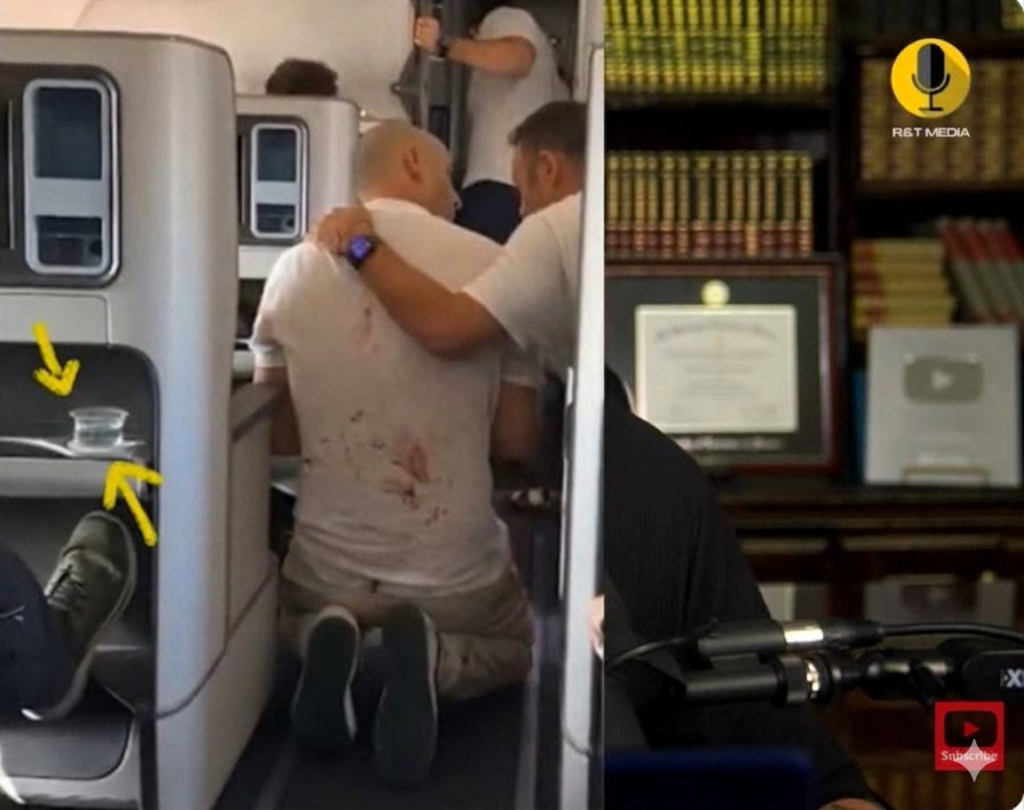
The cabin floor is completely immaculate; a sudden drop would have left food, drinks, and handbags scattered everywhere, yet there is zero clutter.
Another glaring detail is a nearly full cup of water that remains perfectly stable with no spills.
While this Israeli passenger claimed in an interview that the nosedive’s G-forces were visibly stretching her face, her own selfie-video shows no distortion at all.

The monitors are also completely black mid-flight, which is highly unusual.
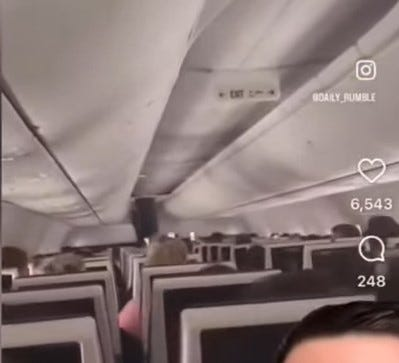
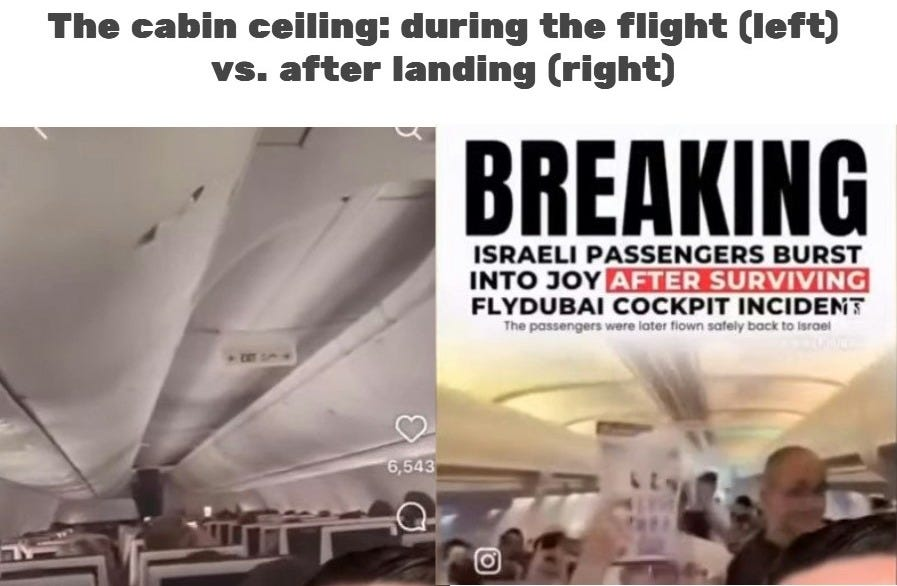
The most damning evidence lies overhead. The airplane’s ceiling during the flight shares zero structural similarities with the ceiling visible after landing. This blatant physical mismatch makes it highly probable that the footage was taken inside two different aircraft and edited together to create a false narrative.
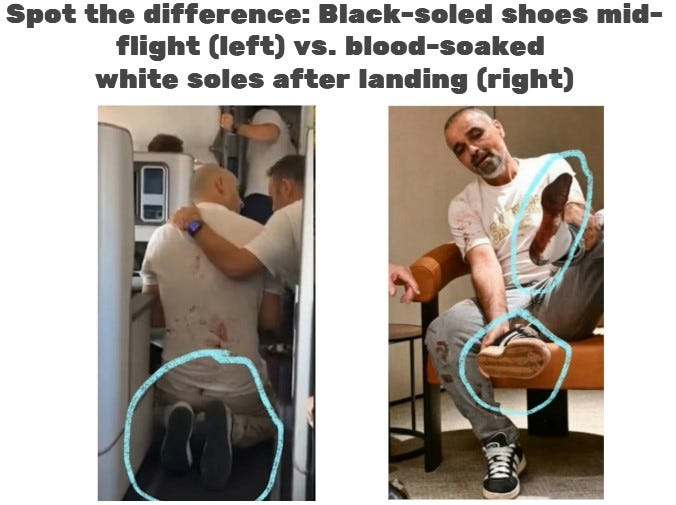
Finally, we see the heroic Israeli plumber who supposedly saved the plane. During the flight, he is kneeling with black-soled shoes. However, post-landing footage reveals that his blood-soaked shoes inexplicably have white soles.
Motives for Other Unexplained Incidents
President John F. Kennedy was the only US president who was highly critical of Israel, challenging it, among other things, over its secret and illegal nuclear programs. He was assassinated. If there was a political motive for such an act, one would not have to look much further.
The US spy ship USS Liberty was attacked by Israeli airplanes, leaving many sailors killed and injured. The objective was to blame Egypt in a false-flag operation to draw the US into a wider war against Israel’s neighbors.
On 9/11, Mossad agents who were observing the terrorist attacks on the Twin Towers were seen joyfully dancing. The attack was taken as a pretext to go to war against Saddam Hussein’s Iraq, although Iraq had nothing to do with it. Most of the terrorists stemmed from Saudi Arabia and allegedly even had support from the Saudi government. But Israel’s prime minister had pushed Washington to go to war against Iraq. So, while there is no evidence that Israel was behind 9/11, it did have the motive for it. And of course, one of the world’s most professional spy agencies may not leave behind traces that could easily be identified.
When Charlie Kirk, one of the most influential young politicians among American conservatives with the potential of becoming US president later, started distancing himself from Israel and its genocidal policies toward Palestinians and opposed a war against Iran that Israel’s Prime Minister advocated for decades, his days were numbered. He was assassinated under suspicious conditions that were never properly investigated. If Charlie Kirk had continued his trajectory and attained high office, it would have been a major blow for Israel. So, while there is no evidence that it was behind the assassination, it certainly would have had the motive for doing so.
Looking Through the Lens of Cui Bono?
Ultimately, applying the ancient principle of cui bono—who benefits?—provides a vital framework for analyzing these historical and geopolitical turning points. When physical evidence is obscured, compromised, or entirely missing, examining who gains the most from a major event can offer the clearest path forward. By methodically identifying the underlying motives and the ultimate beneficiaries, researchers and historians can begin to piece together the broader picture, potentially leading us closer to solving the puzzle behind these otherwise unexplained incidents.
P.S. There was another false-flag operation blamed on Iran—this time in Britain. Judge Andrew Napolitano deconstructs the case here: