
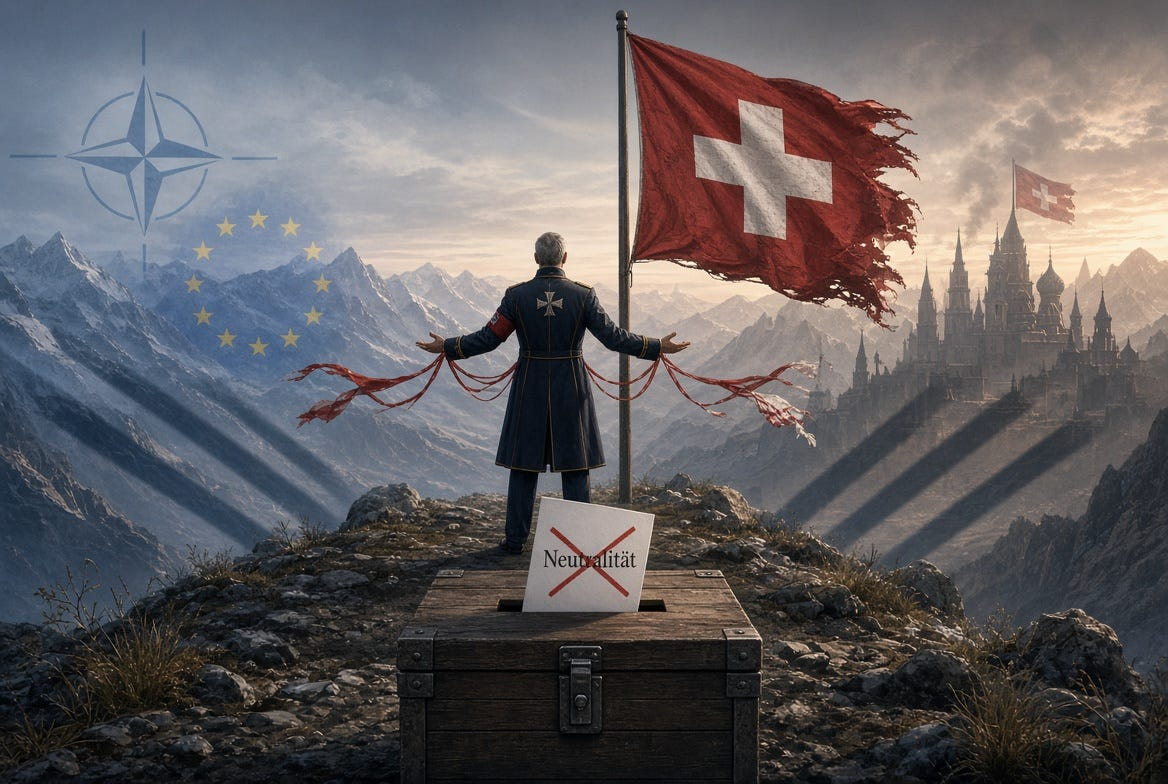
The defeat of Switzerland’s strict-neutrality initiative reflects—and may reinforce—a broader European shift away from traditional neutrality
Switzerland has long occupied a peculiar position in Europe. Its neutrality was not merely a legal status but an important instrument of foreign policy: it allowed the country to maintain relations with opposing powers, offer its “good offices,” and present itself as a credible mediator in international conflicts.
That tradition has come under massive pressure since the escalation of the Ukraine war in 2022. Politicians and much of the media showed little interest in the root causes of the conflict, which dated back long before 2022, and instead quickly sided with the Kyiv regime and its NATO allies, which had been heavily involved in training, arming, and guiding the Ukrainian military. Peter Wanner, a Swiss billionaire who lives in a castle and owns a media group comprising newspapers, television, and radio stations, even issued a directive to his journalists: “Take a firm stand against Russia!” (“Gegen Russland klare Kante zeigen!”)
On September 27, 2026, Swiss voters were asked whether they wanted to reinforce that tradition constitutionally. The initiative would have required Switzerland to maintain permanent armed neutrality, prohibited membership in military alliances except in the event of an attack or imminent attack, and restricted participation in sanctions against belligerent states, with exceptions for UN sanctions and measures against sanctions evasion. It would also have explicitly emphasized neutrality as an instrument of mediation.
The answer was decisive: 70.15 percent voted against the initiative and 29.85 percent in favor. Turnout was just 47.06 percent. Not a single canton approved it.
The result does not mean that 70 percent of Swiss voters support NATO membership, nor does it prove that 70 percent support every aspect of Switzerland’s current foreign policy. The referendum specifically sought to reinforce the definition of neutrality, safeguarding it against ongoing efforts by political and media elites to dilute its core principles. Nevertheless, it represents a clear rejection of an attempt to constrain Switzerland’s present freedom to cooperate with Western states and impose sanctions on their adversaries.
And that makes the Swiss vote interesting far beyond Switzerland itself.
The country that once stood between the blocs
Switzerland has not formally abandoned neutrality, nor is NATO membership imminent. But Swiss neutrality is gradually being hollowed out in practice.
There is an informal network spanning parts of the federal administration, security establishment, defense industry, think tanks, and major media that investigative Swiss journalist Rafael Lutz has identified. In his findings, this network increasingly favors closer relations with NATO and the European Union while marginalizing people who advocate a more traditional conception of neutrality.
The decisive acceleration, in his view, came after Russia’s invasion of Ukraine in February 2022.
Switzerland rapidly aligned itself with EU sanctions against Russia, departing from its previous practice of deciding on sanctions more selectively. Lutz argues that this was partly the result of direct pressure from Washington and Brussels. He points, for example, to a February 27, 2022 conversation involving then-U.S. Deputy Secretary of State Wendy Sherman and Swiss State Secretary Livia Leu.
Whatever weight one assigns to that interpretation, the practical consequence is clear: Switzerland’s position became much more closely aligned with that of the EU and the United States.
And that created a fundamental problem for the country’s traditional diplomatic role.
Neutrality: Switzerland’s Ultimate Geopolitical Capital, Squandered
Switzerland possesses little military or geopolitical power compared with the major European states. Its traditional influence came from something else: trust.
Geneva could host negotiations precisely because Switzerland could plausibly communicate with opposing sides. Its neutrality gave it diplomatic capital that larger countries often lacked.
But this capital has been steadily depleted.
The Ukraine war and the 2024 Bürgenstock conference are striking examples. Russia was not included in the Bürgenstock meeting, and Switzerland thereby behaved less like an impartial mediator and more like a member of the Western political camp.
Geneva’s traditional role has already diminished in other conflicts, with countries such as Qatar, Turkey, and Pakistan increasingly assuming important intermediary functions.
This raises a fundamental question:
What is the practical value of Swiss neutrality if a major party to a conflict no longer recognizes it? This challenge is already unfolding with Russia, which has disqualified Switzerland as a mediator on the grounds that the alpine republic is no longer impartial.
From neutrality to alignment
It is all connected to a transformation inside the Swiss security establishment.
There are several controversial personnel cases, including former diplomat Jean-Daniel Ruch, the case of a Swiss military adviser investigated over contacts with Russian representatives, and the career of Finnish-born Pälvi Pulli within the Department of Defense.
According to Lutz, officials who favor closer cooperation with NATO increasingly advance within the security bureaucracy, while advocates of a more traditional neutrality allegedly encounter greater obstacles.
The same shift can be observed in Swiss think tanks. Organizations such as Foraus and ETH Zurich’s Center for Security Studies are important recruitment pools for the federal administration. A professional ecosystem has developed in which EU- and NATO-oriented positions are increasingly rewarded.
There is no need to assume a secret conspiracy against Swiss neutrality. It is more about institutional self-reinforcement:
Think tanks produce experts → experts enter government → government adopts new policies → media rely on those experts → the resulting consensus becomes harder to challenge.
The defense-industrial dimension
The same process can be seen in Switzerland’s military procurement.
There is a close relationship between the Swiss military and international defense companies, particularly Israel’s Elbit Systems. There is also a revolving door involving personnel moving between Swiss defense procurement institutions and private defense companies.
Again, the existence of such relationships is not in itself evidence of a coordinated political project. Defense procurement inevitably creates relationships between governments and arms manufacturers.
However, the question arises: How compatible is increasing integration into Western military structures with a traditional conception of Swiss neutrality?
That question becomes more relevant as Switzerland purchases systems such as F-35 fighter aircraft and Patriot air-defense systems and steadily deepens its cooperation with—and dependence on—NATO countries.
The media battlefield
The transformation is not confined to government and the military.
The Swiss media, as mentioned earlier, and above all the Neue Zürcher Zeitung (NZZ), have enormous influence within the federal administration.
Today’s NZZ can be contrasted with the newspaper’s earlier tradition under editor-in-chief Willy Bretscher, who was a passionate defender of neutrality at a time when Switzerland was under greater pressure than ever to take sides during World War II.
Today’s media environment has become much more sympathetic to NATO cooperation and much more hostile toward arguments for strict neutrality.
This became especially visible during the referendum campaign.
Supporters of the neutrality initiative were repeatedly associated with Vladimir Putin and Russia. After years in which Putin and Russia have been demonized by much of the Swiss media, this form of political stigmatization was used to turn the neutrality initiative into a referendum on Russia and Putin, rather than a debate about whether Switzerland should remain strictly neutral.
In short, the debate was reframed as a question of whether one was “pro-Putin” or “pro-Ukraine.”
The same phenomenon is visible elsewhere in Europe, where complex foreign-policy questions are frequently reduced to a binary choice between supporting Ukraine and supposedly supporting Russia.
That makes a genuine discussion about Swiss national interests, neutrality, sanctions, and mediation difficult, if not impossible.
The referendum changed the question
This is perhaps the most important lesson of the September 27 vote.
The neutrality initiative’s opponents succeeded in making the referendum about something larger than the constitutional definition of neutrality.
It became, to a considerable extent, a referendum about Russia and the Ukraine war.
The question effectively shifted from:
Should Switzerland reinforce its traditional neutrality?
to:
Should Switzerland change course in response to Russia?
That reframing mattered.
The initiative was ultimately rejected by 70.15 percent to 29.85 percent, with only 47.06 percent of eligible voters participating.
The result was remarkably broad geographically. Every canton rejected the initiative. Even in Ticino, where support was highest, the initiative received only 48.25 percent. In the German-speaking cantons it received 28.93 percent, and in French-speaking Switzerland 29.45 percent.
But the low turnout also matters.
More than half of eligible voters did not participate. It would therefore be misleading to interpret the 70.15 percent as meaning that 70 percent of the Swiss population actively demanded a more confrontational foreign policy toward Russia.
What can safely be said is narrower—and perhaps more revealing:
Among those who voted, a large majority rejected the attempt to constitutionally tighten Swiss neutrality.
The status quo therefore prevailed.
What does this tell us about Europe?
This is where the Swiss vote becomes potentially more significant.
Switzerland’s system of direct democracy allows citizens to vote directly on a specific constitutional question. That makes the result unusually useful as a snapshot of public attitudes toward a particular foreign-policy issue.
In parliamentary democracies, voters normally choose among parties that bundle foreign policy together with dozens of domestic issues. A voter may dislike a government’s Russia policy while voting for it because of pensions, taxation, immigration, or housing—or vice versa.
The Swiss referendum isolated one particular question much more clearly.
And the result suggests that strict neutrality does not currently command majority support among Swiss voters who participated. The Russia fearmongering campaign has clearly succeeded.
That is relevant to the broader European debate because Switzerland has historically occupied a position somewhat outside the principal military alliances. If even Switzerland’s electorate rejects a constitutional attempt to reinforce that exceptional status, the political space for a return to the old European model of neutrality may be narrower than its defenders assume.
But there is an important caveat.
The Swiss result cannot be mechanically converted into a European-wide statistic. It would be unjustified to conclude from a 70.15 percent Swiss “No” vote that only approximately 30 percent of Europeans favor reconciliation with Russia. European countries differ enormously in their historical experiences, security perceptions, political systems, and attitudes toward the Ukraine war.
The Swiss referendum is better understood as one data point—and an unusually revealing one—in a much larger European debate.
The question of the “elite project”
The conflict in Ukraine has been primarily propelled by Western political and security elites, with European governments subsequently aligning their policies with Washington’s strategic objectives. Consequently, many European leaders opted to override the concerns of a domestic electorate deeply critical of diverting billions into a proxy war while the socio-economic welfare of ordinary citizens declined.
If the war is primarily an elite project, why does a substantial proportion of the electorate continue to support the policies associated with it?
The Swiss referendum provides part of the answer.
Political elites do not necessarily have to manufacture public support from nothing. They can shape the framework within which citizens make their judgments. Media narratives, political rhetoric, security warnings, and repeated references to external threats can establish the assumptions within which a referendum is debated.
Once the debate has been framed as neutrality versus Putin, rather than neutrality versus strategic alignment, the range of politically acceptable arguments changes.
That does not necessarily mean Swiss voters were manipulated. It means that political framing matters.
And voters may simultaneously dislike their government’s domestic performance, distrust individual politicians, and nevertheless support its broad foreign-policy orientation.
This distinction is important elsewhere in Europe too. Discontent with leaders such as Emmanuel Macron or Friedrich Merz does not automatically translate into opposition to their governments’ Russia policies. Political dissatisfaction can be driven primarily by domestic economic, social, or immigration issues.
What about the people who did not vote?
The 47.06 percent turnout deserves particular attention.
The non-voters cannot simply be counted as silent supporters of the status quo. Some may have been indifferent, some uninformed, some opposed to both sides, and some may have had practical reasons for not participating.
But the result does tell us something about political mobilization.
The issue was sufficiently important to generate an extensive national campaign, yet fewer than half of eligible voters ultimately cast a ballot.
That suggests that, for a large part of the Swiss electorate, changing the country’s neutrality framework was not compelling enough to motivate participation.
The most cautious interpretation is therefore not that non-voters supported the government’s policy, but that they did not express a preference through this referendum.
The international-law argument
Another issue raised in the debate concerns sanctions.
Supporters of Switzerland’s existing policy argue that Russia’s invasion violated international law and that Switzerland should therefore participate in international sanctions.
Western sanctions, however, were imposed by a relatively small group of European and North American states, which often equate themselves with the “international community.”
But this international community is not synonymous with the NATO alliance, the European Union, or the Western states supporting Ukraine. Switzerland’s traditional neutrality partly rested on precisely this understanding: international legitimacy is not identical to alignment with one geopolitical bloc.
The debate over sanctions therefore involved two separate questions:
- Was Russia’s invasion contrary to international law?
- Does that automatically require a neutral third country such as Switzerland to adopt unilateral sanctions?
The first proposition did not logically settle the second.
That distinction was largely obscured during the referendum campaign.
The missing question: What happens after neutrality?
The defeat of the initiative does not mean Switzerland has joined NATO.
Nor does it mean that Swiss voters have voted for abandoning neutrality.
The existing constitutional framework remains in place. Switzerland continues to describe itself as neutral and retains its traditional “good offices.” As outlined in the official referendum guidelines, Switzerland could still have preserved the constitutional authority to cooperate with international partners on security and to adopt standard sanctions regimes.
What the vote does mean is that Swiss voters rejected an attempt to impose much tighter constitutional limits on how that neutrality can be practiced.
That leaves the central question unresolved:
How far can Switzerland move toward NATO and EU security structures before neutrality becomes more a historical label than a meaningful policy and practice?
That was arguably the real issue behind the referendum.
A Warning or a Confirmation? What Switzerland Tells Us About Europe’s Future
The Swiss vote can therefore be read in two very different ways.
For supporters of closer Western alignment, the result confirms that the Swiss electorate does not want to return to a more restrictive interpretation of neutrality. It provides democratic legitimacy for maintaining the current framework.
For defenders of traditional neutrality, the result demonstrates something more troubling: that even Switzerland, once the European symbol of armed neutrality and mediation, is moving with the broader continent toward geopolitical alignment.
Either way, the vote is significant.
Switzerland has now rejected, by a margin of more than two to one, an attempt to constitutionally strengthen the country’s traditional neutrality.
The question is what comes next.
Will Switzerland remain a neutral state that cooperates selectively with the West?
Will it become an increasingly integrated member of the Western security architecture without formally joining NATO?
Or will a future generation rediscover the strategic value of keeping channels open to all sides?
The September 27 referendum did not answer those questions.
It answered something narrower but important: when asked whether Switzerland should constitutionally reinforce its traditional neutrality, the voters who participated said no.
For a country whose international influence has historically depended on being different from the military blocs around it, that is more than an ordinary referendum result.
It may be one of Europe’s clearest indicators yet of how far the continent’s political center of gravity has shifted since February 2022.
And the role played by political and media elites in shaping that shift—through framing, fearmongering, demonization, and the narrowing of acceptable debate—deserves much closer scrutiny.