
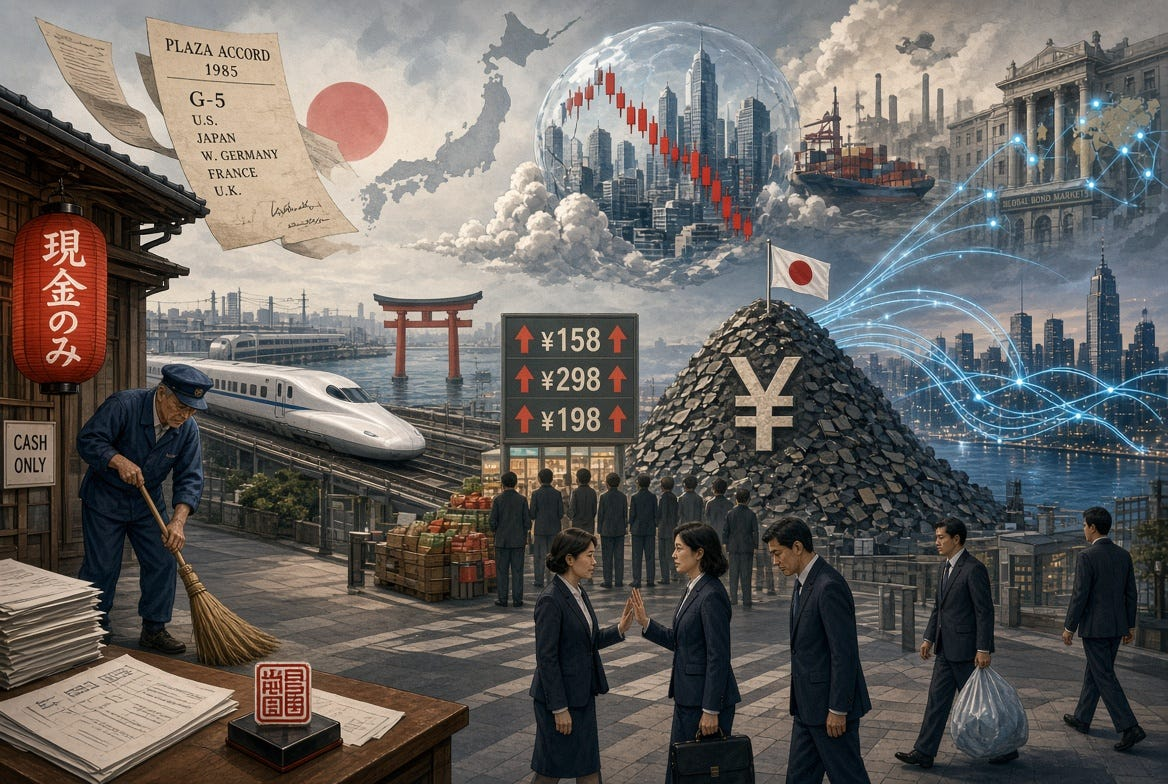
Before the Numbers: First Impressions of a Beautifully Flawed Japan
Prior to diving into the complexities of Japan’s economy, let me share a few personal observations from my time traveling through the country.
Wherever I traveled, I felt incredibly safe. The environment was pristine, people were exceptionally polite, and the infrastructure worked flawlessly.
Despite the distinct lack of public dustbins, Japanese people routinely carry plastic bags to take their waste home and sort it carefully. I did the same, carrying my trash back to the hotel each evening to dispose of it in the recycling containers pictured here.

However, the flip side of this politeness is just how frustratingly indirect communication can be. I first noticed this four decades ago when dealing with Japanese customers; we would exchange faxes that were sometimes several meters long just to ensure that both sides were perfectly aligned. It was an exhaustive process I never experienced with any other Asian clients.
Furthermore, many Japanese people remain deeply socially reserved. Even after a long, friendly conversation, most will still politely decline to take a photo with you.

These two ladies, who spoke some English and were accustomed to dealing with a Gaikokujin (official term meaning “outside-country person”), were rare exceptions in happily taking a picture with an outsider like me.
Interestingly, this restraint coexists with a unique visual paradox: while individuals often look highly distinct and unique in their personal appearance, the undercurrent of social conformity remains incredibly powerful.
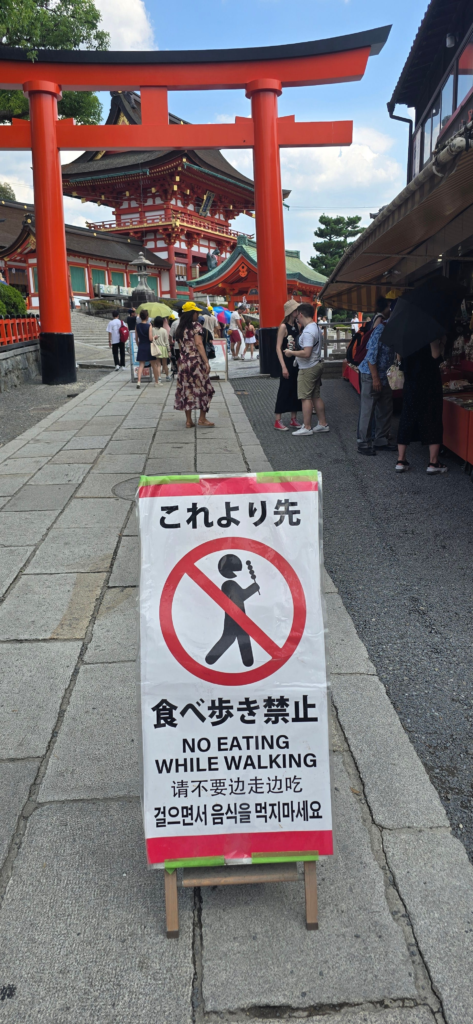
Culturally, Japanese etiquette dictates that food should be appreciated mindfully—rather than rushed through as a distracted, secondary task while dodging pedestrians. This is just one of many intricate social rules that Japanese citizens strictly respect, but foreign visitors often inadvertently ignore. Consequently, when buying street food or a snack from a convenience store, the unspoken rule is to stand right next to the stall or storefront, finish eating completely, and hand the trash back to the vendor before moving on.
The Shinkansen high-speed train is a technological marvel, but the experience felt somewhat depressing to me. Everyone is expected to remain silent, something I have never experienced on trains anywhere else in the world.
Japan clearly has one foot in the future with its fully automated hotels and shops—standing not far behind China in this regard.

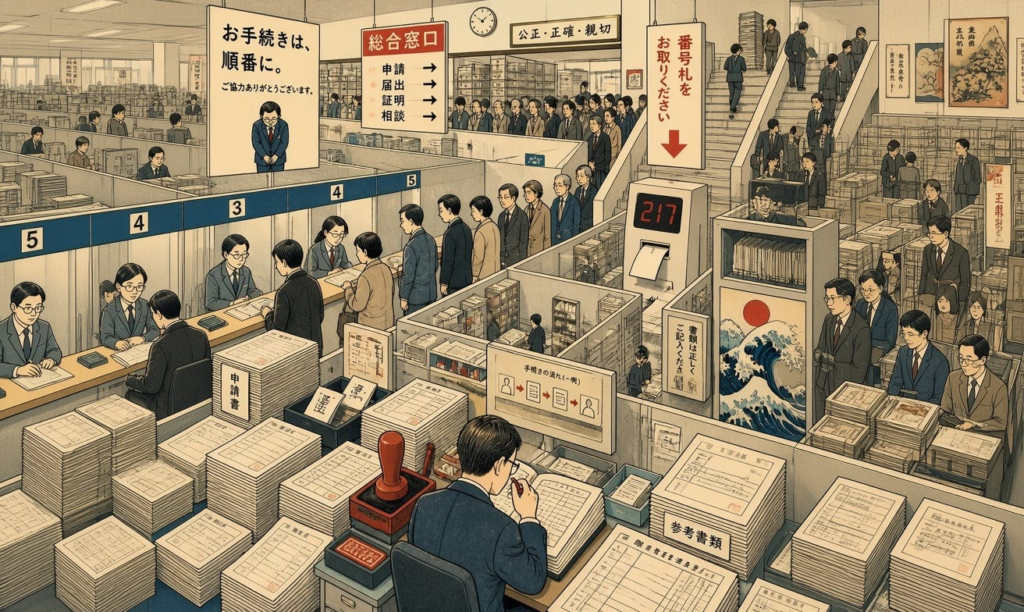
Yet, in a striking paradox, restaurants and retail businesses remain largely cash-driven, while government bureaucracy remains massive and heavily paper-based. In fact, citizens still constantly carry small personal stamps (hanko) to validate official papers, contrasting sharply with China, where almost everything is signed electronically.
Japan’s current economic woes stem from a complex mix of persistent inflation, fragile domestic growth, and irreversible demographic decline.
Wholesale inflation hovers near 7.6%, while rising consumer prices continue to pressure household budgets. Consumer spending remains weak despite recent fast-paced nominal wage growth.
To combat inflation and defend a historically weak yen, the Bank of Japan is attempting a delicate transition away from its ultra-loose monetary policy, moving to raise its benchmark interest rate to 1.25%.
However, this creates a severe dilemma: higher interest rates can support the yen, but they simultaneously increase the cost of servicing Japan’s enormous sovereign debt, which now towers over 200% of GDP. Meanwhile, the economy remains structurally constrained by chronic labor shortages.

Exploring the country, this demographic reality quickly becomes impossible to ignore. I found myself constantly noticing bus drivers, security guards, and shop attendants well above the age of 65 still working—a striking, visible reminder of Japan’s rapidly aging and shrinking population.
But there is another aspect of Japan’s working culture that is difficult to ignore: long hours in the office do not necessarily translate into high productivity.
Japanese salarymen routinely complain about staying at work for 15 hours or more, even when their actual tasks were completed long before. They remain in the office because leaving before the boss—or before everyone else—can be seen as socially inappropriate. In some workplaces, simply being physically present for a long time can matter more than whether there is any productive work left to do.
In Part 1 of my fact-finding mission report, I described how Japan rose from the ashes of World War II through enormous gains in genuine productivity. But those days are long gone.
In other words, staying late is not necessarily about getting more work done. It can be about demonstrating loyalty, endurance, and conformity.
That distinction matters when thinking about Japan’s economic performance. A culture that rewards long presence rather than measurable productivity can create the appearance of extraordinary diligence while masking significant inefficiencies.
The Making of an Economic Superpower—and the Friction That Followed
Japan’s current predicament cannot be understood without looking back at how the country became an industrial and financial powerhouse—and how its relationship with the United States changed as that power grew.
Japan was the first major Asian country to industrialize. Beginning in the late nineteenth century, it rapidly transformed itself into a modern industrial and military power and eventually joined the imperial competition dominated by the European powers.
That transformation came at an enormous human cost.
Japan fought China in 1894–95, colonized Taiwan, annexed Korea, and subsequently invaded large parts of China. During the 1930s and World War II, Japanese occupation caused immense civilian suffering across China and Southeast Asia. An estimated 20 million Chinese people died as a result of the Japanese invasion and occupation.
Japan’s wartime history remains deeply contested. The country never fully confronted the consequences of its actions in East and Southeast Asia. Those historical grievances, combined with the resurgence of Japanese nationalism and military spending, remain important issues for Japan’s neighbors—particularly as Tokyo, with Washington’s support, moves toward a larger military role in East Asia.
But Japan’s postwar economic rise created a different kind of conflict.
By the 1980s, Japan had become an extraordinary industrial success story. Its automobile, electronics and semiconductor companies were taking market share from American competitors, while Japanese exports were flooding global markets.
Washington increasingly viewed Japan not just as an “ally”, but increasingly an economic competitor.
The US-Japan economic confrontation
The United States responded with a combination of protectionism, trade pressure and currency diplomacy.
This matters because it challenges the idea that Japan’s subsequent economic stagnation was simply the inevitable result of an internal market cycle.
The Plaza Accord
The most consequential measure was the Plaza Accord of 1985, negotiated by the United States, Japan, West Germany, France and the United Kingdom.
The one-sided agreement was intended to weaken the overvalued US dollar and allow the yen and other currencies to appreciate. The yen subsequently rose dramatically against the dollar, roughly doubling in value over the following two years.
For Japan, the adjustment was painful.
The stronger yen made Japanese exports more expensive and reduced the competitiveness of the country’s export-oriented industries. The shock became known in Japan as endaka, or a high yen.
The Bank of Japan responded by cutting interest rates and maintaining an accommodative monetary policy. Cheap credit cushioned the immediate impact—but also helped inflate one of the largest asset bubbles in modern history.
Money poured into Japanese equities and real estate. Land prices soared. Stock valuations reached extraordinary levels.
Then the bubble burst.
Japan entered a prolonged period of weak growth, low inflation, falling asset prices and eventually deflation that became known as the Lost Decades.
‘Voluntary’ export restraints
Currency policy was only one part of the pressure.
In 1981, under pressure from US automakers and Congress, Japan agreed to limit the number of passenger vehicles it exported to the United States.
The restrictions were formally voluntary, but they were adopted against the backdrop of threats of stronger protectionist measures. They also pushed Japanese automakers to establish factories inside the United States, allowing them to produce locally and avoid some trade barriers.
Semiconductors and Section 301
Washington also invoked Section 301 of the Trade Act of 1974 to challenge what it considered unfair Japanese trading practices.
The United States imposed punitive tariffs, including 100% tariffs on selected Japanese electronics products, and pressured Tokyo into the 1986 US-Japan Semiconductor Agreement.
The agreement sought to increase access for foreign semiconductor producers to Japan’s domestic market and address US concerns over Japanese pricing and market practices.
The National Security Alibi: Dismantling Foreign Competitors
The semiconductor dispute was particularly significant because Japan was then the world’s leading producer of memory chips.
And just like four decades later in the case of China’s high-tech giant Huawei, Japan’s industrial giant Toshiba became a U.S. target under the banner of “national security.”
According to an August 1992 Los Angeles Times article, Toshiba was Japan’s leading chipmaker in the 1980s and commanded about 80% of the global market for dynamic random access memory (DRAM) in 1987.
After Toshiba and a Norwegian firm sold advanced milling machines to the Soviet Union in 1986—just as other European companies had done—Washington pounced.
It imposed a sweeping two- to five-year ban on all Toshiba products, claiming a “threat to U.S. security”. The move dealt a major blow to Toshiba and opened opportunities for American competitors, while other foreign companies that sold similar equipment to the USSR escaped unscathed.
The broader lesson is that economic warfare is nothing new. Trade restrictions, technology controls and legal pressure have repeatedly been used against major foreign competitors.
It was not limited to Japan then or China now.
Alstom, once hailed as the “jewel of French industry,” became a target too. A world leader in energy and transport technology, it competed directly with U.S. giant General Electric.
In 2013, Alstom executive Frédéric Pierucci—author of The American Trap: My Battle to Expose America’s Secret Economic War Against the Rest of the World—was arrested at a New York airport on disputed bribery charges linked to a contract in Indonesia.

Pierucci recalled being offered a draconian choice: plead guilty and walk free within months, or risk 125 years in prison. Several Alstom executives were also detained, and U.S. courts imposed a $772 million fine.
Facing this blackmail, Alstom was compelled in 2014 to sell its core energy and grid divisions to GE, effectively dismantling a major European competitor.
The pattern, in different forms, has appeared elsewhere. Under massive U.S. pressure, Switzerland was forced to abolish banking secrecy and anonymous numbered accounts, long a cornerstone of its financial industry.
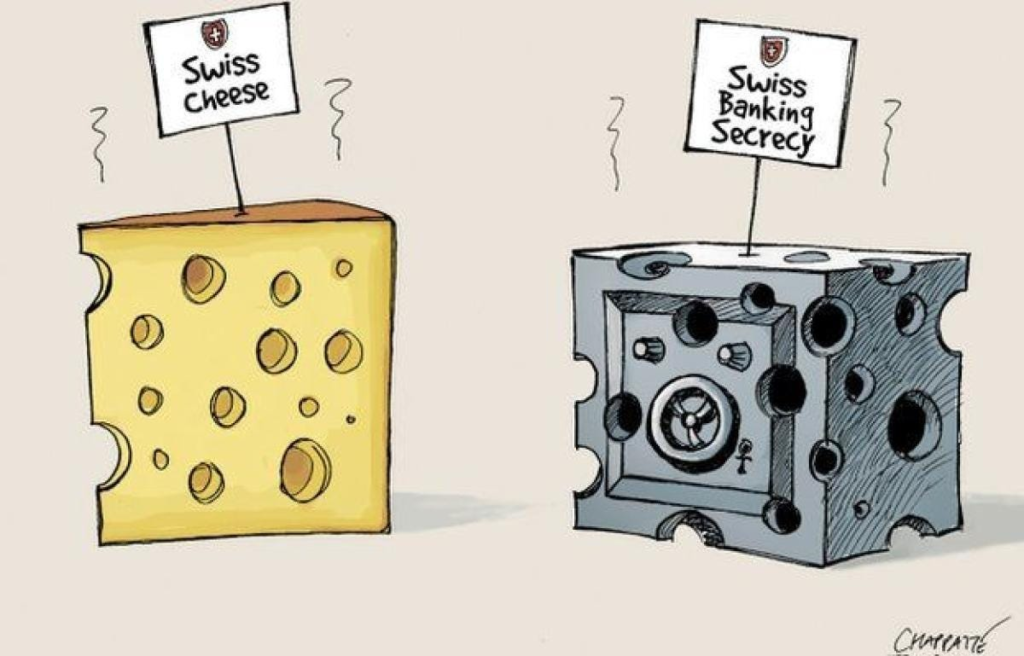
In the meantime, U.S. states have expanded their system of anonymous shell companies, and the United States has become a major destination for assets held abroad. Latin American drug cartels are key clients of these shell companies, using them to securely store their illicit profits.
Offshore financial centers in Panama, Singapore, and the Caribbean were rocked by leaks and scandals—but never U.S. institutions. That was no accident: The NSA and other U.S. spy agencies target foreign banks, not American ones.
These examples point to a broader reality: economic competition between major powers is rarely confined to tariffs. Instead, trade rules, financial regulations, technology restrictions, and legal mechanisms are routinely weaponized as instruments of geopolitical coercion. Ultimately, there is scarcely a single economic lever the United States has not deployed against its rivals or countries that resist its hegemonic strategic interests.
Was Japan’s collapse really “natural”?
The conventional explanation for Japan’s “Lost Decades” focuses on domestic mistakes: an enormous asset bubble, poor banking regulation, delayed recognition of bad loans, demographic problems and ineffective monetary and fiscal policies.
That explanation holds some weight, but as we’ve already seen, it isn’t the entire truth.
Nevertheless, the Bank of Japan helped fuel the late-1980s bubble, and Japanese policymakers made serious mistakes after it burst. Banks were slow to recognize losses, while policymakers struggled to revive demand and escape deflation.
But the domestic story cannot be separated from the international pressure that preceded it.
The Plaza Accord and the rapid appreciation of the yen delivered a major external shock to Japan’s export-dependent economy. The monetary response then helped produce the asset bubble whose collapse ultimately generated decades of stagnation.
The distinction matters.
While Japanese policymakers were responsible for many of the subsequent decisions, those choices were made within an economic environment heavily shaped by international political pressure and outright coercion.
Economic crises are not always purely natural market events. Currency agreements, tariffs, export restrictions and technology controls can alter the trajectory of entire economies.
The US-Japan conflict was not simply a dispute over trade balances. It was ultimately a struggle over industrial and technological power.
That history provides an important backdrop to Japan’s situation today.
The long-term consequence: Japan became a source of cheap capital
After the asset bubble burst, Japan spent decades struggling with weak growth, low inflation and extremely low interest rates.
For Japanese savers, this created a new problem: there was little return available at home. Pension funds, insurers, banks and other investors increasingly looked overseas for yield.
Japanese savings flowed into US Treasury bonds, European government debt, Australian property and other foreign assets.
Japan effectively became one of the world’s largest exporters of capital. The country accumulated more than $1 trillion in US government bonds, making it one of the most important foreign holders of American debt.
But the story did not end there.
Extremely low Japanese interest rates also encouraged investors around the world to borrow yen cheaply and invest the proceeds in higher-yielding assets. This became known as the yen carry trade.
And that is where Japan’s economic history connects directly to today’s global financial system.
Japan’s Yen Trap Could Become the World’s Problem
Japan now faces a new economic dilemma.
The yen is weak, squeezing households through higher import costs. At the same time, Japan carries government debt of more than twice its annual economic output.
Raising interest rates could support the currency, but it would also increase the cost of servicing that enormous debt.
Japan is therefore caught between two unattractive options:
Strengthen the yen, and risk damaging government finances.
Keep rates low, and risk keeping the yen weak.
The problem extends far beyond Japan because decades of near-zero interest rates made Japanese capital a major force in global markets.
The yen problem starts at the supermarket
A weak yen might sound like a problem for currency traders. For Japanese households, it is much more tangible.
Japan depends heavily on imported energy, food, oil and other commodities, many of which are priced in US dollars.
When the yen falls, Japanese companies need more yen to buy the same goods. Those higher costs eventually reach consumers.
Food becomes more expensive. Energy bills rise. Businesses face higher input costs. Consumers lose purchasing power.
That is why currency weakness matters even when wages are rising. If prices increase faster than incomes, households can still become poorer in real terms.
Household spending fell 3.3% in June despite expectations for an increase, while a reported 71% of Japanese respondents said the government had failed to deal adequately with rising prices.
The political pressure to support the yen is therefore understandable.
The problem is what happens next.
The debt trap
Japan’s government debt is more than twice annual economic output, among the highest levels in the developed world.
That makes interest rates unusually important.
Higher rates could make yen-denominated assets more attractive and support the currency. But they also increase the government’s interest bill.
For a heavily indebted government, even modest increases in borrowing costs can become significant as debt is refinanced.
So the dilemma is straightforward:
Higher rates: better for the yen, worse for government finances.
Lower rates: better for government finances, worse for the yen.
Currency intervention can buy time, but it cannot necessarily overcome the underlying forces.
Japan tried intervention
When a government wants to strengthen its currency, it can sell foreign currency and buy its own.
Japan has spent tens of billions of dollars doing exactly that. The yen jumped roughly 5% following one intervention.
But the gains did not last.
The yen soon moved back toward its previous level.
The lesson is simple: intervention can move a currency, but it cannot necessarily overcome the forces driving it.
If investors still expect Japanese rates to remain relatively low, they have an incentive to continue borrowing yen or selling it.
And that brings us to the bigger story.
The world borrowed Japan’s cheap money
The carry trade is straightforward:
Borrow yen cheaply → convert it into another currency → buy a higher-yielding asset → pocket the difference.
For example:
Borrow yen at near 0% → convert to dollars → buy a US asset yielding 4%.
As long as the yen remains weak and stable, the strategy can be attractive.
But if the yen suddenly strengthens, repayment becomes more expensive in foreign-currency terms.
Investors may then be forced to sell assets, close positions and buy yen.
When many investors do this simultaneously, a feedback loop can emerge:
Yen rises → carry-trade losses increase → investors sell assets → investors buy yen → yen rises further.
A relatively small change in Japanese monetary policy can therefore become a global market event.
August 2024 was the warning shot
The mechanism became painfully visible in August 2024.
The Bank of Japan raised its policy rate by 0.25 percentage points. The yen strengthened sharply, putting pressure on investors who had borrowed the currency and invested elsewhere.
Japan’s stock market fell 12.4% in a single session—the worst one-day decline since 1987. Wall Street also opened lower, and markets around the world were caught in the shock.
The important lesson was not simply that Japanese stocks could fall.
It was that global financial markets had become exposed to the price of the yen.
Nobody really knows how big the carry trade is
That creates another problem.
The Bank for International Settlements estimated the carry trade at roughly $250 billion at the beginning of 2024, but acknowledged that the true exposure could be larger. Some estimates run into the trillions.
There is no single database recording every yen-funded position.
The exposure can sit inside hedge funds, banks, pension funds, corporations, derivatives and other structures.
That makes the carry trade difficult to measure—and potentially difficult to unwind in an orderly fashion.
The danger may not be the size of any individual position. It is that thousands of seemingly unrelated positions are exposed to the same underlying variable:
the yen.
Japan is changing the equation
For years, the carry trade depended on Japanese interest rates being exceptionally low.
That era is ending.
As Japanese rates rise, domestic assets become more attractive. Japanese pension funds, insurers and other investors have a stronger reason to keep money at home.
A Japanese government bond offering a meaningful yield can increasingly compete with foreign assets, particularly after accounting for currency-hedging costs.
That creates a potentially powerful reversal:
Japanese yields rise → domestic assets become more attractive → Japanese money returns home → foreign bond demand falls.
And that is where Japan’s problem becomes everyone else’s problem.
The world’s bond markets could lose a major buyer
Japan has historically been a major buyer of foreign government debt.
If Japanese investors become less willing to purchase US, European or British bonds—or begin selling existing holdings—those governments need to find other buyers.
Markets have a simple mechanism for doing that:
Offer higher yields.
Higher yields mean higher borrowing costs, not only for governments but eventually for companies, households and investors.
Japanese monetary normalization could therefore contribute to a broader rise in global borrowing costs even though the Bank of Japan is acting primarily to solve a domestic problem.
Why Washington is concerned
The United States has an obvious stake in what happens next.
The American government already has enormous financing requirements. Higher Treasury yields mean higher interest costs.
Now consider aggressive Japanese intervention to support the yen.
To buy yen, Japan needs to sell foreign assets or use foreign-currency reserves. Significant sales of US Treasuries could add pressure to an already critical market.
The potential chain becomes:
Yen intervention → potential Treasury selling → lower Treasury prices → higher US yields → higher US borrowing costs.
Japan owns a huge amount of US government debt, while the United States remains one of the world’s largest borrowers.
Their monetary and fiscal decisions are therefore deeply interconnected.
The Japanese savings machine may be turning inward
For decades, the global financial system benefited from Japan’s unusual position.
Japanese capital flowed into the United States, Europe, Britain, Australia and other markets, helping create demand for foreign government bonds and providing a relatively cheap source of financing.
But Japan’s domestic investment environment is changing.
If Japanese bonds now offer meaningful returns, investors no longer need to go overseas to find yield.
The world’s former source of cheap capital could gradually become a buyer of its own country’s assets.
That is a major structural shift.
The pressure extends beyond the US
Other governments also face heavy borrowing requirements.
The United States faces enormous deficits and refinancing needs. Britain faces its own fiscal constraints. Germany is confronting increased spending requirements, including major defense investment. France faces significant political and fiscal pressures.
All need investors willing to buy their debt.
For years, Japanese investors were an important part of that investor base.
If Japanese capital becomes less available, someone else has to fill the gap.
The likely price is higher yields.
Asia has another layer of risk
The effects do not stop in the US and Europe.
Japan, South Korea and Taiwan compete in major export industries including automobiles, electronics and semiconductors.
A major move in the yen changes the relative competitiveness of Japanese companies and can alter investor allocations across the region.
Hong Kong provides another example through a different mechanism.
Because the Hong Kong dollar is pegged to the US dollar, Hong Kong effectively imports US monetary conditions rather than operating an independent floating currency.
Japan’s monetary policy can therefore affect Asian markets through multiple channels: exchange rates, interest rates, capital flows and investor risk appetite.
The real risk is the transition
This is not necessarily a story about Japan going bankrupt or the yen collapsing.
The more important risk is transition.
For decades, the global financial system became accustomed to exceptionally cheap Japanese money. Investors built strategies around it. Japanese institutions accumulated foreign assets. Global bond markets absorbed Japanese savings. The yen became a funding currency.
Now that system is changing.
If the yen rises rapidly, carry trades can unwind.
If Japanese yields rise, capital can return home.
If Japanese investors reduce their purchases of foreign bonds, global yields can rise.
And if borrowing costs rise while governments are already heavily indebted, the pressure can compound.
Japan may therefore be less a standalone crisis than a potential trigger for a broader repricing of global capital.
The bigger picture
Japan’s current economic dilemma is the product of a much longer history.
The country rose from an industrializing Asian power into a formidable economic competitor. Its success eventually generated intense friction with the United States, culminating in trade restrictions, export restraints, and the Plaza Accord.
The resulting appreciation of the yen placed enormous pressure on Japan’s export economy. The monetary response helped inflate an extraordinary asset bubble, whose collapse ushered in decades of stagnation.
Yet those same decades of ultra-low interest rates transformed Japan into something else: a giant source of cheap global capital.
Japanese savings flowed overseas. Foreign investors borrowed yen. Global bond markets absorbed Japanese demand.
That system worked for decades.
Now it is changing.
The potential chain reaction is straightforward:
Higher Japanese rates
→ stronger yen
→ carry-trade unwinding
→ Japanese capital repatriation
→ reduced foreign bond demand
→ higher global yields
→ higher borrowing costs.
The crucial question is not whether Japan will single-handedly cause the next global financial crisis.
It is whether the unwinding of decades of cheap Japanese capital could amplify vulnerabilities that already exist elsewhere.
There is also a deeper historical lesson.
Economic power does not develop in a vacuum. Trade rules, currency agreements, tariffs, technology restrictions, and geopolitical alliances can profoundly shape the fortunes of entire nations.
Japan’s experience demonstrates how economic policy can become an instrument of geopolitical strategy—and how the consequences can persist for decades.
The same question now hangs over the US-China relationship.
If the history of Japan offers a warning, it is that the economic consequences of great-power rivalry do not necessarily end when the political confrontation is over.
They can become embedded in currencies, industries, capital flows and financial markets.
The yen may be Japan’s currency. But the money behind it has become part of the global financial system. When Tokyo finally pulls the plug on cheap capital, the entire world will feel the shockwave.