
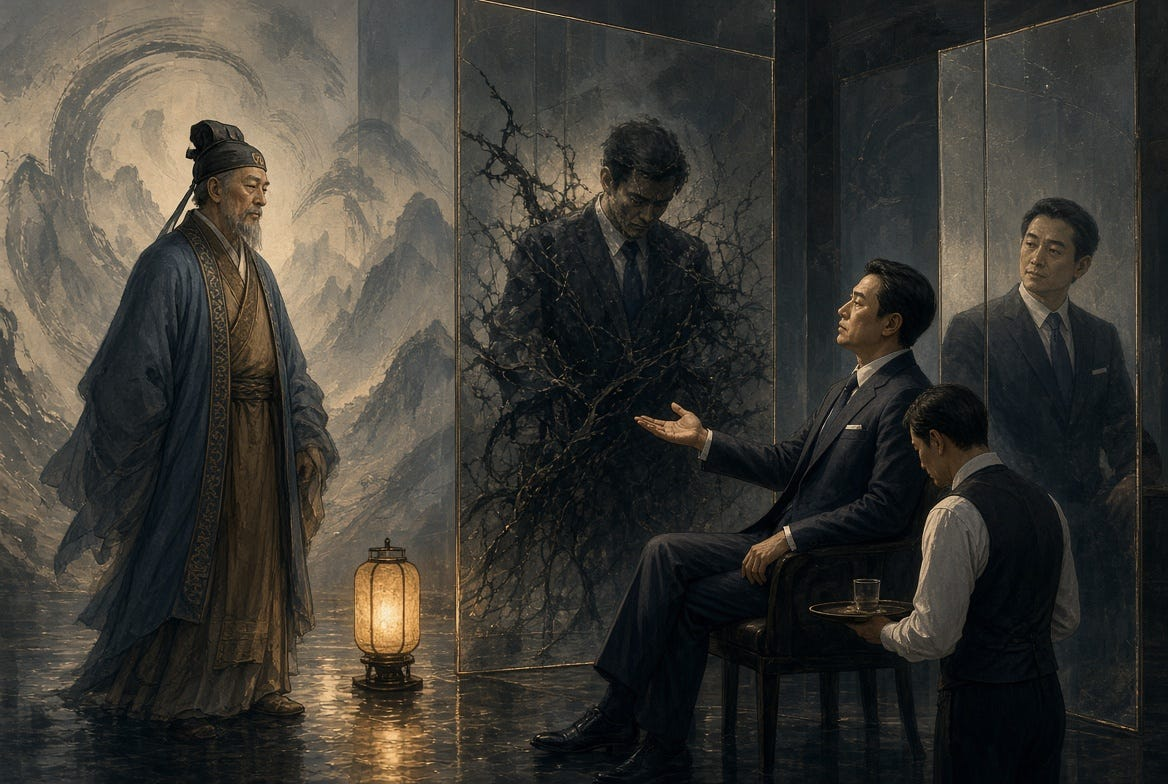
What People Reveal When the Mask Comes Off
What if the most revealing thing you can learn about someone is not how they behave under pressure, but how they behave when they feel completely safe?
More than two thousand years ago, the Chinese strategist Sun Tzu understood something that reaches far beyond armies and battlefields. Conflict is not simply about weapons, territory or numbers. It is about information, perception, fear, incentives—and, above all, people.
His most famous advice is usually reduced to three words: “Know your enemy.”
It sounds simple. It isn’t.
To understand an adversary, you need to understand what they want, what they fear, what they believe, and what they are prepared to do to get what they want. You also need to pay attention to what people do when they think nobody important is watching.
That last part may have little to do with warfare, but it has a great deal to do with human nature. And that is why Sun Tzu remains relevant. His ideas can be useful not only to generals and statesmen, but to anyone trying to understand other people—and themselves.
The Battlefield of the Mind
Sun Tzu lived during China’s Warring States period, when rival kingdoms fought repeatedly for territory and survival. A bad decision by a ruler or commander could mean more than losing a battle. An entire state could disappear.
Yet the contest often began long before armies met.
Commanders had to read their opponents. Were they strong or weak? Confident or frightened? Aggressive or cautious? Was a particular movement genuine, or was it designed to make the other side draw the wrong conclusion?
A retreat could mean weakness. Or it could be a trap.
A show of strength could reflect genuine confidence—or insecurity.
A friendly gesture could be sincere, or carefully calculated to lower someone’s guard.
In that sense, the battlefield was also a battlefield of the mind.
One of Sun Tzu’s best-known principles is that warfare is based on deception: appear weak when you are strong, strong when you are weak; appear near when you are far and far when you are near. Create uncertainty. Encourage the other side to act on a mistaken understanding of reality.
The point was not simply to conceal your own strength. It was to influence the other side’s perception so that they made mistakes themselves.
That is also why Sun Tzu regarded victory without fighting as the highest form of victory. If you can achieve your objective without destroying the other side, you have accomplished something more difficult than simply overpowering it.
This is one reason The Art of War has survived for so long. Whatever we can know with certainty about the historical Sun Tzu, the ideas associated with him continue to resonate because human beings have not changed nearly as much as our technology has.
We still misread motives. We still underestimate people we dislike and overestimate those we admire. We still tend to believe what fits the story we already want to believe.
What “Know Your Enemy” Actually Means
Knowing an enemy is not simply counting soldiers or listing weapons. You want to understand the person—or the group—behind them.
What do they want?
What do they fear?
What do they value?
What do they believe?
What can they not afford to lose?
What are they willing to sacrifice?
And what are they willing to sacrifice other people for?
What motivates them? What makes them angry? What makes them feel important? And, perhaps most revealingly, what do they do when they believe there will be no consequences?
That last question can tell you a great deal.
Sun Tzu understood the importance of an opponent’s inner state. What does a leader fear most—humiliation, loss of face, isolation, failure? Where are the weaknesses in an alliance? What incentives are driving decisions?
Once you understand those things, you can often predict behavior more accurately than by listening to official statements.
But there is an important distinction here. Understanding how people can be influenced is not the same thing as manipulating them. The first is observation. The second is a choice.
Watch What People Do When Nobody Important Is Watching
If you really want to get a sense of someone’s character, watch how they treat people who cannot do anything for them.
Watch how a manager treats an employee who has no influence over their career.
Watch how a wealthy person treats a waiter.
Listen to how someone talks about a friend who is not in the room.
Watch how a powerful person behaves toward someone who cannot fight back.
And pay attention to what happens when the cameras are gone.
These moments can tell you more than a polished speech about someone’s supposed values.
It is easy to be charming when you want something. It is easy to be generous when people are watching. It is easy to show respect toward someone who can reward or punish you.
The more interesting question is what happens when none of those considerations exist.
What do you do when there is nothing to gain?
That is often when character becomes visible.
Of course, one incident does not define a person. We all have bad days. We all make mistakes. Someone who behaves badly once should not automatically be written off.
Patterns are different.
Repeated behavior tells you much more than a single episode.
Power Can Be Very Revealing
Power is one of the clearest tests of character because it removes some of the restraints people experience when they have little power themselves.
Give someone authority over people who cannot challenge them and watch what happens.
Some become cruel. Others become more protective and generous. Some grow suspicious. Others become obsessed with themselves. And some handle power remarkably well.
Power does not necessarily create these traits. Sometimes it simply gives them room to emerge.
That is why I have often found it more revealing to watch how people treat those below them than those above them. Anyone can be polite to the person who can fire them. The more revealing relationship is often with the person who has nothing to offer in return.
The same principle applies to organizations.
A senior executive may be told that everything is going perfectly. Middle managers may confirm it because they have learned that bad news is dangerous. Meanwhile, the people actually doing the work may have a completely different story.
If you really want to know what is happening inside an organization, sometimes you have to go several levels down and talk to the people with the least incentive to impress you.
Otherwise, you can become a prisoner of your own information system.
Sun Tzu understood the importance of cohesion. A united group is difficult to defeat; a divided one is much easier to weaken. That is why he paid attention to rivalries, jealousies and mistrust within the opposing camp.
Once people begin wondering whether the person beside them is loyal, energy that should be directed outward gets consumed by internal suspicion.
The More Powerful You Become, the Harder It Is to Hear the Truth
There is a strange paradox in power.
The more powerful you become, the more information comes toward you—and the harder it can become to know whether that information is true.
People want to please those who have power over them. They flatter. They hide problems. They tell you what they think you want to hear. They avoid disagreement because the price of disagreement has become too high.
Eventually, a leader can find himself surrounded by people who agree with him about almost everything.
It feels reassuring.
It can also be dangerous.
If nobody around you ever tells you that you are wrong, either you are extraordinarily wise or people no longer feel safe enough to tell you the truth. The second explanation is probably more common.
A good leader needs people who can disagree with him.
You need someone who can say, “I think you’re wrong.”
You need someone who will point out your blind spots instead of protecting your ego.
In other words, build a circle that protects your judgment, not your vanity.
That may be one of the most practical lessons to take from Sun Tzu.
Follow the Incentives
Another useful way of understanding people is to look at what they are rewarded for.
People often tell us what they value. But when their stated values collide with their interests, their actions can become much more revealing.
A company may say that its employees are its greatest asset—until protecting them hurts quarterly profits.
A politician may talk endlessly about ordinary people—until acting on those promises upsets powerful supporters.
A salesperson may genuinely care about customers, but if his income depends on closing deals, that incentive will inevitably influence his behavior.
A manager may praise long-term thinking while rewarding almost exclusively short-term results.
The incentive system often tells you more than the official slogans.
This does not necessarily mean that the people involved are hypocrites or bad people. Human beings respond to circumstances. Incentives matter.
If you want to understand what someone is likely to do, ask a simple question:
What happens to this person if they do the opposite?
Sometimes that tells you more than anything they say.
Don’t Confuse Your Interpretation With Reality.
One of the most common human mistakes is to see something happen and immediately invent an explanation.
Someone insults you, so you decide they are jealous.
Someone suddenly becomes friendly, so you assume they genuinely like you.
Someone withdraws, so you decide they are angry.
Someone offers you an attractive opportunity, so you assume they are trying to help you.
Maybe.
But perhaps not.
Once we have created an explanation, we have a tendency to treat it as fact. Strategic thinking requires a little more patience.
A general retreats. Why?
Is he frightened? Is he reorganizing? Is he short of supplies? Or is he trying to lure you somewhere?
A competitor suddenly cooperates. Why?
Have they genuinely changed their position? Do they need something? Are they under pressure? Or are they simply trying to lower your defenses?
The emotional reaction is immediate:
“What should I do?”
The strategic reaction is different:
“Why are they doing this?”
That small difference can matter enormously.
This does not mean becoming suspicious of everyone. Constant suspicion is not intelligence. It is simply exhausting.
The useful habit is to remain curious a little longer before becoming certain.
Sun Tzu also understood the importance of tempo. Whoever controls the sequence of events often gains a psychological advantage. Force the other side to react while you retain the initiative.
When someone else dictates the pace, you spend more time responding and less time thinking.
The Weakness Someone Can Use Against You
Understanding another person’s psychology can give you an advantage. But there is an uncomfortable side to it.
If someone knows exactly what makes you angry, they may be able to provoke you.
If they know what makes you insecure, they can push that button.
If they know what kind of praise makes you feel important, they may flatter you into doing something foolish.
And if they know what you desperately want, they may know exactly how far you can be pushed.
Someone who understands your weaknesses may not need to defeat you directly.
They may only need to make you defeat yourself.
Which brings us to the other half of Sun Tzu’s lesson:
Know yourself.
The Enemy Within
It is relatively easy to study another person’s weaknesses.
It is much harder to examine your own.
Your pride can be manipulated. So can your fear, greed, need for recognition, resentment, desire to be right, fear of looking foolish and need for approval.
Sometimes an opponent does not need to outsmart you. They only need to make you angry enough to stop thinking clearly.
So ask yourself some uncomfortable questions.
What makes me angry?
What makes me desperate?
What makes me feel inferior?
What kind of praise makes me reckless?
What kind of criticism makes me defensive?
What temptation could make me abandon a principle I normally consider important?
If someone else knows the answers to these questions about you, they may know how to move you.
If you know the answers yourself, you become much harder to manipulate.
The best defense is not paranoia.
It is awareness.
Sun Tzu’s famous formulation was essentially this: know the enemy and know yourself, and you will not be imperiled in a hundred battles.
The point is not that you can eliminate uncertainty. You cannot.
It is that knowing your own emotional triggers makes it much harder for someone else to turn them against you.
Trust Without Becoming Blind
None of this means going through life assuming that everyone has a hidden agenda.
That would be exhausting—and often simply wrong.
Sun Tzu’s lesson is not “trust nobody.” It is closer to this:
Do not confuse trust with blindness.
You can trust someone and still pay attention.
You can love someone without pretending they are incapable of disappointing you.
You can admire a leader without assuming every decision is correct.
You can cooperate with another country or another organization without imagining that it has no interests of its own.
And you can respect an opponent without underestimating them.
That is not cynicism. It is realism.
And realism is often a stronger foundation for relationships than idealization.
People are complicated. Someone can be generous in one situation and selfish in another. They can be brave at one moment and frightened at the next. They can sincerely believe something and still behave differently when the incentives change.
That does not necessarily make them monsters.
It makes them human.
Look for Patterns, Not One-Off Moments
One bad decision does not define a person.
Neither does one generous act.
If you want to understand someone, look at what happens repeatedly.
Does their kindness disappear when nobody is watching?
Do they become respectful only when they need something?
Do they become arrogant as soon as they gain power?
Do they take responsibility when things go wrong, or immediately look for someone else to blame?
Do they remain loyal when loyalty becomes inconvenient?
Do they treat people decently even when there is absolutely nothing to gain?
These are useful observations.
But they are still observations, not verdicts.
The point is not to rush to judgment. It is to gather information.
Patterns are more reliable than performances.
Seeing What You Don’t Want to See
There is another blind spot that may be even more dangerous: our own desire to believe a particular story.
We do this with people we love. We do it with people we dislike. We do it with political leaders, parties, and entire countries.
Once we decide that someone is good or bad, we tend to interpret everything through that lens. Evidence supporting our view gets noticed. Evidence contradicting it gets explained away.
This is where strategic thinking becomes uncomfortable.
Ask yourself two questions:
What evidence supports my interpretation?
And, more importantly:
What evidence would prove me wrong?
The second question is much harder.
It requires intellectual humility.
If no conceivable evidence could change your mind, you are no longer testing your interpretation against reality. You are defending a belief.
Sometimes Understanding Prevents the Fight
There is a positive side to all this that is easy to overlook.
Understanding an opponent does not necessarily mean finding a better way to defeat them. Sometimes it means discovering that you do not need to fight at all.
If you understand what the other person actually wants, you may discover that the conflict is less fundamental than it first appeared.
Perhaps they want recognition rather than control.
Perhaps they fear humiliation more than defeat.
Perhaps they want security rather than domination.
Perhaps both sides want something similar but have become trapped in mutual suspicion.
This is one reason I have always found Sun Tzu more interesting than many other military thinkers.
The highest form of strategy is not necessarily destruction. It is achieving your objective without having to destroy anything.
Knowledge creates options.
Ignorance tends to create unnecessary conflict.
The Discipline of Seeing Reality
The world does not become easier simply because you become more intelligent.
What helps is learning to see what is actually happening—including the things you would rather not see.
Listen to what people say, but watch what they do.
Pay attention to incentives.
Notice how behavior changes when circumstances change.
Notice what happens when someone wins—and when they lose.
Notice how they treat someone who cannot help himself.
And especially notice what happens when they believe nobody important is watching.
If someone is generous only when there is an audience, that is information.
If someone becomes respectful only when they need something, that is information.
If someone becomes cruel after acquiring power, that is information.
And if someone remains kind when there is nothing to gain, that is information too.
None of these observations tells the whole story.
But taken together, over time, they tell you quite a lot.
The Final Lesson: Turn the Question Around
Eventually, Sun Tzu’s lesson has to be turned inward.
It is not enough to know your enemy.
You have to know yourself.
If you understand everyone else’s weaknesses but remain blind to your own, you may actually make yourself more vulnerable.
What makes you angry?
What makes you afraid?
What makes you feel important?
What makes you feel small?
What would you do to avoid humiliation?
What kind of praise can make you careless?
What kind of criticism can make you lose your judgment?
These are not pleasant questions.
They are useful ones.
The easiest person to manipulate is often the person who has never taken the time to understand what controls them.
And perhaps this is where Sun Tzu’s teaching becomes more personal than military.
Before studying another person’s weaknesses, study your own.
Conclusion: See People as They Are
The battlefield has changed enormously since Sun Tzu’s time.
Human nature has not.
People still want recognition. They still fear humiliation. They still pursue money and status. They still protect what matters to them. They still hide weaknesses. And they still become careless when they feel safe.
Sooner or later, people reveal themselves through what they do.
The old lesson therefore remains useful:
Know your enemy.
Know what they want.
Know what they fear.
Know what they believe.
Know what they value.
Know what they are prepared to sacrifice.
And watch what they do when they think nobody is watching.
Then ask yourself the same questions.
Because the person you understand least may not be the one standing across from you.
It may be the one looking back at you in the mirror.
Sun Tzu’s philosophy offers something more valuable than a manual for defeating an opponent. It offers a discipline for seeing reality without demanding that reality tell us what we want to hear.
Don’t believe something simply because you want it to be true.
Don’t dismiss information because it makes you uncomfortable.
Don’t confuse confidence with competence.
Don’t confuse friendliness with loyalty.
Don’t confuse silence with agreement.
And don’t confuse promises with patterns.
Watch. Listen. Compare words with actions. Study incentives. Look for repeated behavior.
When someone repeatedly shows you who they are when they believe they are safe, pay attention—not because everyone is secretly evil, but because people often become most revealing when they no longer feel the need to perform.
The greatest strategic advantage is not knowing how to destroy another person.
It is knowing how they think.
That knowledge can help you avoid unnecessary conflicts, negotiate better, cooperate where cooperation is possible, protect yourself when necessary, choose allies more carefully, and recognize danger before it becomes obvious.
And perhaps most importantly, it can make you less surprised by human nature.
Know your enemy. Know yourself. And above all, learn to see people as they are—not as you hope they will be.
Once you learn to see clearly, you do not have to fear every hidden motive. You simply understand that people have interests, fears, weaknesses and desires—and that these things influence what they do.
You understand the game.
And once you understand the game, you become much harder to deceive.
P.S.
I’ve always viewed Sun Tzu as perhaps the most virtuous of military strategists because his highest principle was not destruction, but winning without fighting.
I am dedicating this article to my 21-year-old daughter, who has her whole career ahead of her while mine is well behind me.
If I had understood how to apply Sun Tzu’s wisdom to everyday life when I was her age, I would have made far fewer short-sighted blunders along the way.
That is one of the strange privileges of getting older: some lessons become painfully obvious only after you have already paid the price for not understanding them.