
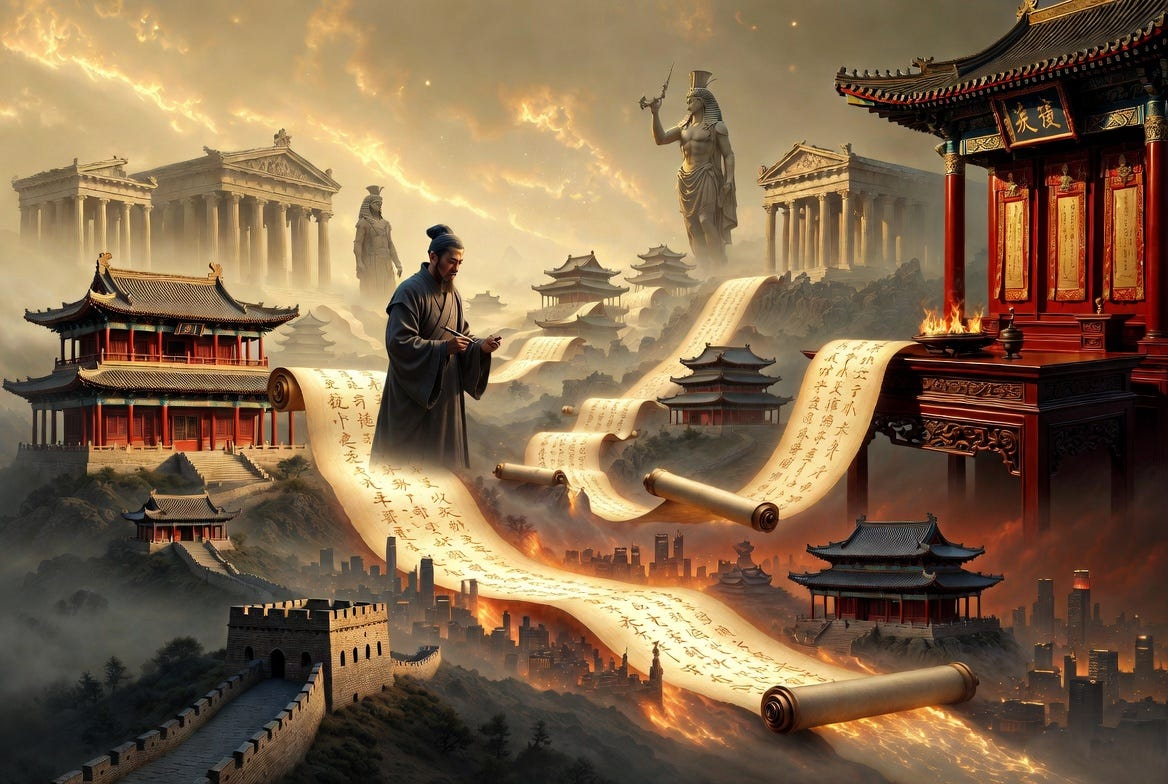
Every great civilization sought legitimacy in the heavens—except one that largely sought it in history.
Ancient Egypt looked to Ra. Mesopotamia revered Marduk. Greece had Zeus. Rome had Jupiter. Medieval Europe built itself around Christianity. The Islamic world around the Qur’an. Across history, political order and religious authority were usually inseparable.
China took a remarkably different path.
This is not to say China lacked religion. It never did. Chinese civilization has long included ancestor rites, folk religion, Daoism, Buddhism, and reverence for Heaven (Tian). Temples dotted the landscape, and millions practiced religious rituals.
But unlike most other great civilizations, China’s political order was never fundamentally organized around a revealed religion, a single prophet, or a sacred scripture claiming divine authority over the state.
For more than four thousand years, China’s deepest source of legitimacy has been something quieter:
history.
What if your country’s Bible were its history?
Imagine growing up believing that the greatest lessons about human nature did not come from revelation but from thousands of years of recorded experience.
That has largely been China’s intellectual tradition.
While many civilizations turned to sacred texts to understand God’s will, Chinese elites turned to historical records to understand human behavior, political success, and civilizational survival.
History became China’s greatest teacher.
Every dynasty studied the rise and fall of those that came before it. Every emperor knew posterity would judge him. Every official was expected to know not merely philosophy but centuries of historical precedent.
In China, the past was not simply remembered.
It governed.
No founder. No revelation.
China produced philosophers rather than prophets.
There was no Chinese Moses receiving divine commandments.
No Chinese Muhammad bringing God’s final revelation.
No Chinese Jesus establishing a universal church.
Confucius (551–479 BCE) never claimed divine inspiration. He described himself as a transmitter of ancient wisdom rather than its creator. His Analects contain remarkably little theology. Instead, they ask practical questions:
How should a ruler govern?
How should children treat their parents?
How should officials behave?
How does society remain stable?
These are political and ethical questions, not theological ones.
This distinction profoundly shaped Chinese civilization.
The state was built on ethics rather than salvation.
Beginning in the Han dynasty, Confucian learning became the ideological foundation of imperial government. For nearly two millennia, aspiring officials competed in one of history’s most demanding civil service examination systems. Advancement depended not on noble birth, military conquest, or religious authority, but on mastery of the Confucian classics, history, literature, and statecraft.
This did not make imperial China democratic in the modern Western sense. It did, however, produce an unusually sophisticated bureaucracy founded on the ideal that public office should be entrusted to the educated and the capable rather than inherited through aristocratic privilege.
Government rested less on divine right than on the conviction that officials, selected through rigorous examinations, should administer the empire according to established ethical principles and in pursuit of the people’s welfare. Merit never fully displaced privilege, but the ideal itself proved remarkably durable.
Echoes of this tradition can be seen in contemporary China, where a strong developmental state and long-term planning have helped lift hundreds of millions of people out of extreme poverty. This stands in contrast to trends in many Western democracies, where rising wealth inequality, the erosion of the middle class, and the growing influence of concentrated wealth over political institutions have fueled debate over whether these systems are drifting toward oligarchy or plutocracy.
Whether one accepts this comparison or not, it raises a broader question about the true source of political legitimacy: Is it derived primarily from periodic electoral competition, or from a government’s ability to govern competently, promote the common good, and improve the lives of its people?
The sacred became the family
Where many religions emphasize humanity’s relationship with God, Chinese civilization placed extraordinary emphasis on humanity’s relationship with its ancestors.
Ancestor remembrance was not simply religious ritual.
It was social architecture.
Families maintained ancestral tablets, preserved genealogies, and practiced filial piety (xiao). The individual existed within an unbroken chain stretching backward through generations and forward into the future.
The central moral obligation was not merely to obey God.
It was to honor one’s family, preserve social harmony, and leave the lineage stronger than one inherited it.
History became moral judgment
Perhaps no civilization has devoted as much effort to recording its own past.
Successive dynasties commissioned official histories of their predecessors. Court historians often enjoyed surprising independence because their records would become the standard by which future generations judged emperors.
Chinese rulers understood that they could manipulate politics in the present, but history would ultimately decide their reputation.
The Twenty-Four Histories, compiled over centuries, represent one of humanity’s most extensive continuous historical records.
In many respects, history assumed a role that sacred scripture played elsewhere: it became the repository of moral lessons, political legitimacy, and civilizational memory.
A civilization that absorbed religions without surrendering to them
China did not reject religion.
It absorbed it.
Buddhism arrived from India and became deeply influential. Daoism developed sophisticated religious traditions. Folk religions flourished across the countryside.
Yet none permanently displaced the Confucian state.
Religious belief largely remained compatible with a political order whose primary language was ethical governance, historical precedent, and bureaucratic administration rather than divine revelation.
This flexibility allowed China to incorporate new religious traditions while maintaining remarkable institutional continuity.
Four thousand years of continuity
Few civilizations have experienced as many invasions, dynastic collapses, rebellions, and foreign conquests as China.
Yet after each rupture, a familiar pattern re-emerged.
A unified state.
A Confucian bureaucracy.
Respect for ancestors.
Deep historical consciousness.
Even after the fall of the Qing dynasty, the Republican period, civil war, revolution, and the rise of the People’s Republic, appeals to Chinese history remained central to political legitimacy.
Today’s Chinese Communist Party is officially atheist, yet it frequently frames its mission within the broader narrative of Chinese civilization, national rejuvenation, and the “Century of Humiliation.”
The language has changed.
History remains.
Why this matters
Western observers often try to understand China through categories shaped by the Abrahamic religious tradition: belief, conversion, orthodoxy, heresy, salvation.
Those concepts explain part of Chinese civilization—but not its foundation.
China’s governing philosophy has historically been less concerned with humanity’s relationship to God than with humanity’s relationship to family, society, and the accumulated wisdom of history.
That difference helps explain why China has often appeared simultaneously familiar and profoundly foreign to Western observers.
It also helps explain why historical memory remains such a powerful force in Chinese political culture today.
China was never a civilization without religion.
But it was, to an unusual degree, a civilization built less on revelation than on history, ethics, and memory.
And that may be one of the most remarkable political experiments in human history.