
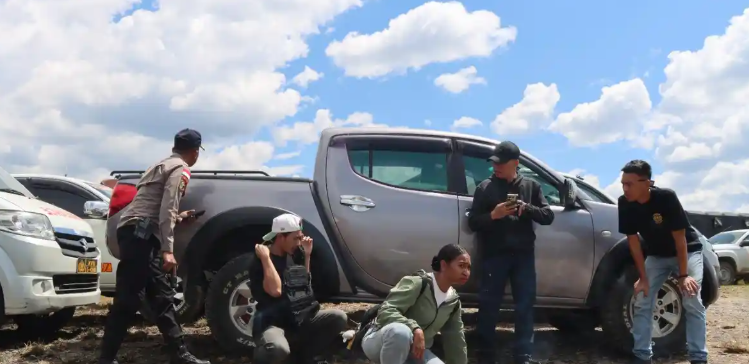
Two tourists were shot during the Baliem Valley Festival in West Papua on August 8, in an attack that brought the region’s most important cultural festival to an early end and highlights the deteriorating security situation across the Papua Highlands.
The shooting took place near the entrance to the 34th Baliem Valley Cultural Festival in Walesi, Jayawijaya Regency. The two tourists were wounded and taken to Wamena. for treatment. The festival was subsequently suspended as security forces secured the area.
The Baliem Valley Festival is the biggest cultural festival in West Papua and one of the main reasons foreign tourists travel to the Papua Highlands. Held annually in the Baliem Valley, it brings together Indigenous communities for traditional dancing, mock warfare, music and other cultural performances. The presence of international tourists at the festival is also important for a region where tourism remains relatively small and difficult because of the ongoing conflict.
Indonesian authorities have blamed the shooting on the Kodap III Ndugama Derakma faction of the West Papua National Liberation Army, or TPNPB. The faction operates in the highlands and is associated with commander Egianus Kogeya, one of the most prominent figures in the armed West Papuan independence movement.
Indonesia says the group opened fire near the festival and was responsible for the attack. This has not been independently verified. That matters in West Papua, where information surrounding armed incidents is often disputed and where access for independent journalists and observers remains highly restricted. Indonesian authorities have previously been accused by Papuan activists and human rights organisations of spreading misleading information about attacks involving independence groups.
Who Are the Alleged Attackers?
The Ndugama Derakma faction is one of the regional commands of the TPNPB, an umbrella term used by several armed Papuan groups fighting for independence. The faction has been associated with Egianus Kogeya and operates mainly in the mountainous interior of the Papua Highlands.
Kogeya became internationally known after his group kidnapped New Zealand pilot Philip Mehrtens in 2023. Mehrtens was held for more than a year before being released in September 2024. The faction has subsequently been involved in further attacks against Indonesian security forces and people working on infrastructure projects in the highlands.
The Indonesian government describes the TPNPB as a criminal and separatist organisation. West Papuan independence supporters describe it as part of an armed struggle for national liberation. Responsibility for the Baliem shooting therefore remains an allegation at this stage rather than an established fact.
The shooting also came after several days of demonstrations in West Papua. The Komite Nasional Papua Barat, or KNPB, had been holding demonstrations calling for West Papuan independence and protesting against brutal Indonesian rule and the increasing presence of Indonesian security forces in the lives of Papuan people.
There is no evidence that the KNPB demonstrations were directly connected to the shooting, but they provide important context. The attack happened during a period of increased political tension, rather than in an otherwise quiet period in the highlands.
West Papua’s Security Situation
Foreign tourists are rarely the specific targets of the West Papuan independence movement. Most attacks are directed at Indonesian soldiers, police, government officials and workers believed to be connected to the Indonesian state.
The problem is that the security situation has deteriorated rapidly over the last two years. There have been more armed attacks, military operations, demonstrations and displacement across the highlands, while the Indonesian government has increased its security presence in areas where armed independence groups operate.
The risks were illustrated again in July when American pilot Nicholas Goselin was shot and killed after landing at a remote airstrip in the Papua Highlands. The TPNPB claimed responsibility and said the aircraft had violated restrictions imposed by the group. Indonesian authorities rejected that explanation and described the flight as civilian. Seven Indigenous Papuan passengers survived the attack.
In August, five construction workers were also killed in Tolikara. The TPNPB claimed the men were Indonesian military intelligence personnel operating undercover, while Indonesian authorities said they were construction workers. Once again, the competing accounts have made independent verification difficult, with Indonesian authorities in particular being known for misinformation.
The violence has also caused large-scale displacement. Thousands of Papuans have been forced from their homes in areas affected by fighting between Indonesian security forces and armed independence groups, with the humanitarian situation becoming increasingly serious in parts of the highlands.
For tourists, the important point is that foreigners are not normally being hunted by Papuan armed groups. The danger is instead that the conflict is becoming less predictable. A tourist attending a cultural festival is not the traditional target of the insurgency, but the Baliem shooting demonstrates that being outside the main conflict does not necessarily mean being outside its consequences.
Click to read about the best bank cards for Nomads.
Why Does West Papua Have a Conflict?
The roots of the conflict go back to the end of Dutch colonial rule. Western New Guinea remained under Dutch control after Indonesia became independent, and a distinct Papuan political movement developed during the 1950s and early 1960s.
Indonesia claimed the territory and took control following the 1962 New York Agreement. In 1969, Indonesia organised the Act of Free Choice, in which 1,025 representatives selected by the Indonesian authorities voted unanimously for integration with Indonesia.
The United Nations accepted the result and Indonesia has treated the sovereignty question as settled ever since. West Papuan nationalists have never accepted the vote as a legitimate referendum. They argue that the population as a whole was denied the right to vote and that the selected representatives were subjected to Indonesian pressure.
For this reason, West Papuan independence supporters commonly refer to the event as the Act of No Choice.
The dispute over 1969 remains central to the modern independence movement. Indonesia considers West Papua an integral part of the country, while West Papuan nationalists argue that Indonesia took control of the territory without giving its population a genuine opportunity to choose independence.
That dispute has produced more than half a century of demonstrations, political repression, military operations and armed conflict.
A Conflict Few in the West Know About
The human cost has been considerable, although there is no agreed death toll. Restrictions on access and the remoteness of many conflict areas make independent documentation extremely difficult.
West Papuan sources and supporters have cited estimates of up to 200,000 people killed since the conflict began. That number cannot be independently confirmed and should therefore be treated as an estimate, but the scale of deaths and displacement resulting from the conflict is not in serious doubt.
Indonesian security forces have been accused of unlawful killings, arbitrary detention, torture and other abuses. Papuan armed groups have also killed Indonesian soldiers, police, workers and civilians. Indigenous communities have repeatedly found themselves caught between the two sides.
Despite the length and severity of the conflict, West Papua receives little sustained attention in Western media. Violence and displacement can continue for months with limited international coverage, while restrictions on journalists make independent reporting difficult.
The Baliem Festival shooting has now brought the conflict directly into an event attended by international visitors. The two tourists were not the usual targets of the insurgency, but their shooting demonstrates how quickly the deteriorating security situation can affect people outside the immediate political conflict.
Indonesia has blamed the Ndugama faction of the TPNPB for the attack. That claim still requires independent verification. What is beyond dispute is that West Papua remains in the middle of a conflict that has lasted for more than fifty years, and that the security situation across the highlands has become significantly worse in recent years. And things are likely to get much worse unless the world wakes up and starts talking about the plight of the Papuan people.