
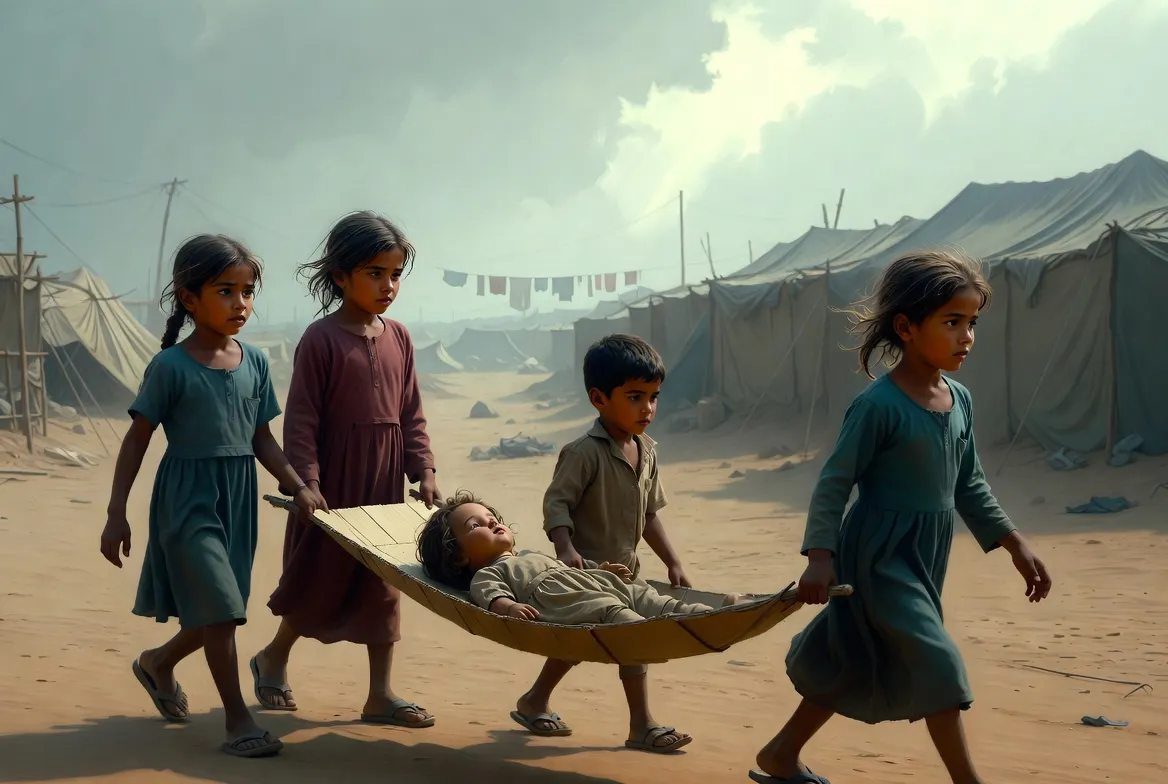
In Gaza, children are re-enacting the only reality they know—processing a lifetime of trauma through the lens of loss.
In a haunting video from a displacement camp in Gaza, four young girls and a boy are seen carefully hoisting a doll onto a makeshift stretcher. They aren’t playing house or hide-and-seek; they are reenacting a funeral.
This is “post-traumatic play”—a survival mechanism where imagination is replaced by imitation. For a generation growing up under constant bombardment, death is no longer an abstract concept; it is a daily ritual.
Child psychologists and organizations like UNICEF describe these reenactments as a “normal reaction to abnormal events.” Through this symbolic play, children attempt to navigate a world that has failed them:
- Processing the Unspeakable: Replaying traumatic scenes helps children integrate overwhelming experiences that they lack the vocabulary to express.
- Reclaiming Agency: In an environment of total helplessness, stepping into the roles of the adults they observe—even in mourning—offers a fleeting, desperate sense of control over their surroundings.
- A Language for Grief: For children who have watched countless processions, this play is a quiet, profound expression of a childhood reshaped by loss.
As of early 2026, humanitarian reports indicate that nearly every child in Gaza is in urgent need of psychological support. Experts warn that without safe havens and professional intervention, these repetitive cycles of traumatic play risk hardening into lifelong PTSD and deep emotional withdrawal.
It is a heartbreaking sight, made even more devastating by the fact that there is no end in sight to the violence imposed on the most vulnerable by the genocidal Zionist regime. For these children, the “game” isn’t a fantasy—it’s the only way to survive the reality of their own lives.
▪ ▪ ▪
Related:
- The Gaza Ghetto: A Modern Holocaust in Plain SightUnmasking German complicity and the media blackout surrounding the destruction of a Semitic people.
- EXCLUSIVE INTERVIEW WITH A SURVIVOR OF THE GAZA GHETTO — While his neighborhood was being bombed and razed to the ground, Antoun Ananias — whose Christian Orthodox family can trace and document its roots in Palestine back many centuries — survived alone in his apartment, surrounded by an army of starving rats. He disinfected his open wounds with his own urine.
- Warning: This Interview Features Graphic Images of a British Doctor Trying to Save the Lives of Civilians in Gaza who were Severely Injured and Deformed by Israeli Bombs.
- Evil in the Genes? German Elites’ 130-Year Record: Two World Wars, Six Genocides, Including Today’s Complicity in PalestineTracing the Long Arc of German State Crimes—from Namibia and China to Ukraine and Palestine
- The Forgotten Massacre: Germany’s Very First Genocide – in ChinaMass executions, village annihilations, and a blueprint for Namibia, the Holocaust, and Gaza
- Germany’s Second Genocide of the 20th Century – Before the Holocaust: The Forgotten Crime Story
Germany had cold-bloodedly and deliberately exterminated the Herero and Nama peoples in Namibia and attempted to suppress its moral guilt. Berlin has paid Israel reparations amounting to tens of billions. Namibia has received no reparations. Is this because they were ‘only’ Africans and black people and not Jews and white people? - The next German ruling party, led by a former BlackRock manager, has just declared war on Moscow and is stirring up anti-Russian sentiment, just as its predecessors did eighty years ago.
- Germany’s Dangerous Turn: Militarism, Missiles, and the Broken Promises of PeaceBerlin is seeking to reintroduce conscription, ignoring treaty restrictions and planning to attack Russia with long-range missiles. This time, it is doing so openly.
- Are Russians the New Jews?As at the beginning of National Socialism in Germany: ▪ Ethnic Group under General Suspicion ▪ Property Confiscated ▪ Presumption of Innocence Suspended ▪ Legal Hearing Denied
- Apartheid In Israel: Then And Now.Reasons Behind The Incessant Violence
- The History They Try to EraseEvidence from Antiquity That Affirms Palestine’s Deep Continuity and Indigenous Legacy
- Pioneers Turned PreyThe tragic arc of Jewish Bolsheviks—from revolutionary heroes to targets of the very terror they helped unleash
- The Invisible Hand: How Israel Orchestrates the Terror Groups It Claims to FightUncovering why ISIS and Al-Qaeda never attack Israel and how state-sponsored terrorism fuels the “Greater Israel” project—amid a seemingly coordinated media blackout keeping the issue under wraps.
- From “Greater Israel” to global domination: Benjamin Netanyahu’s ruthless expansionist vision, which will drive millions of refugees to Europe.Israel’s war against Iran and its ongoing conquests in the region are turning the Middle East upside down—and will trigger a humanitarian catastrophe under whose weight Europe could collapse.