
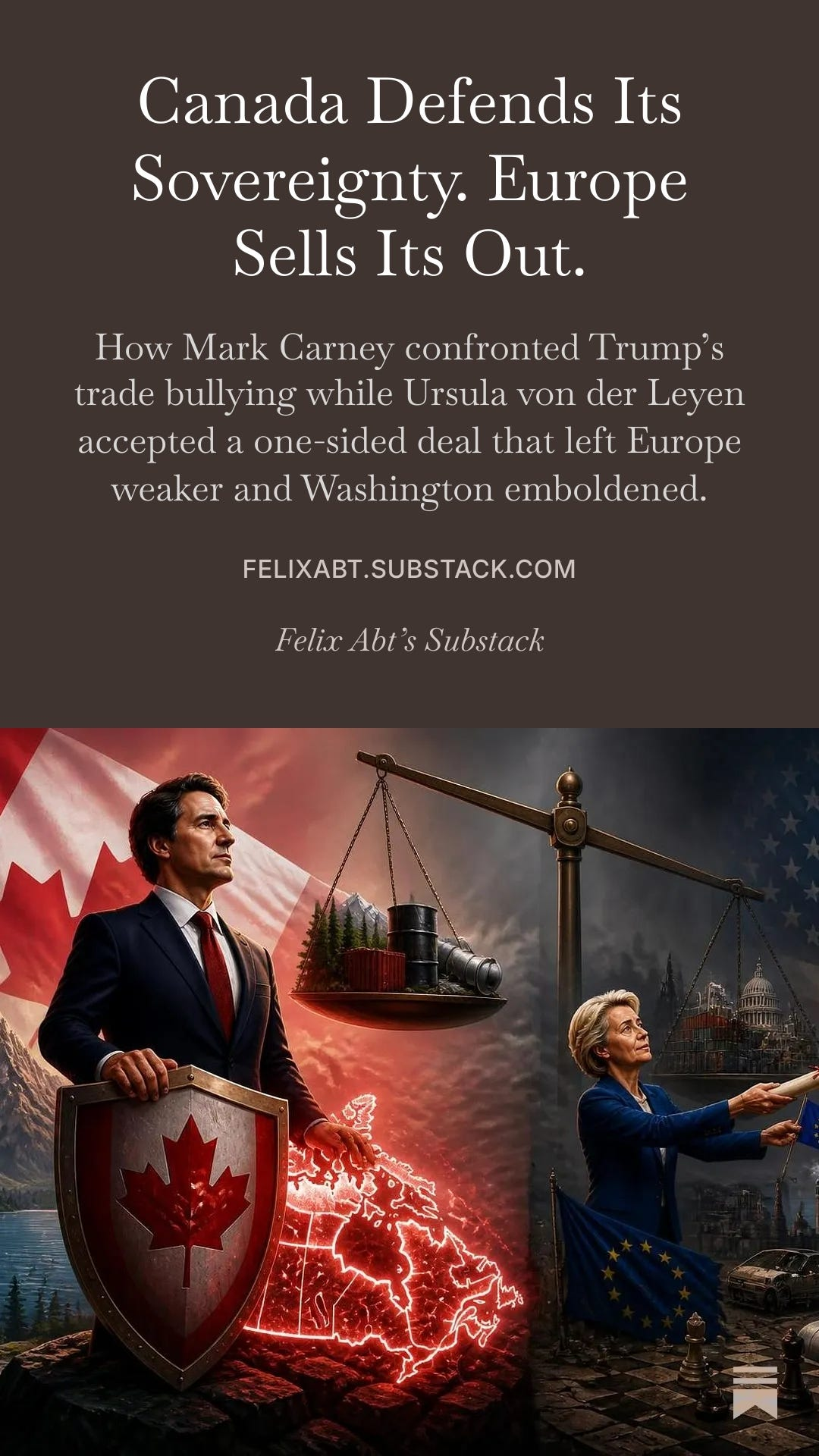
A Power Play Against Key Allies
A new trade dispute stems from the Trump administration’s decision to abandon the United States–Mexico–Canada Agreement (USMCA)—a deal Trump himself negotiated and praised during his first term as “the best and most important trade deal ever.” Upon returning to office, however, Trump declared the agreement insufficient, threatened high tariffs on Canadian products, and demanded an entirely new deal.
This aggressive approach reflects Trump’s characteristic negotiating style: announce an agreement, then issue last-minute demands designed to bully the other side into granting major concessions. Canadian Prime Minister Mark Carney, a former central banker and Goldman Sachs executive, sharply criticized the tactic as a “power play” that undermined the reliability of any agreement. Carney argued that the United States had “asked too much and offered too little,” portraying the demands as a direct attack on Canada’s sovereignty.
Unlike European Commission President Ursula von der Leyen, who had capitulated to Trump’s pressure and accepted an unfavorable agreement, Carney—an elected Canadian leader—chose to defend his country’s sovereignty. His response underscored a fundamental contrast: Canada confronted the bullying, while the European Union rewarded it.
Europe’s Unfavorable Deal
The European Union’s agreement with the Trump administration has drawn criticism because it offered Washington substantially more than it secured for Europe. Under the framework, the United States imposed a 15 percent tariff ceiling on most European exports, while the EU agreed to eliminate tariffs on US industrial goods and provide expanded access for American agricultural and seafood products.
Although the arrangement restored some predictability for European exporters, it did not establish genuinely reciprocal terms. The EU largely surrendered its tariff leverage while accepting a broad new burden on its own producers.
The agreement also included significant purchasing and investment commitments. European countries pledged to purchase an estimated $750 billion in US energy products and invest an additional $600 billion in the United States by 2028. The EU also committed to buying roughly $40 billion in American artificial-intelligence chips and to substantially increasing its procurement of US military and defense equipment.
European officials have described many of these figures as aspirational rather than legally binding. That distinction may offer little protection, however, if the Trump administration later treats any shortfall as grounds for imposing higher tariffs. In practice, the agreement is committing Europe to financing the American economy while continuing to expose European exporters to substantial US trade barriers.
Observers have therefore described the deal as economic submission dressed up as stability. France’s prime minister called it a “submission,” while German officials warned that the arrangement could impose serious costs on Europe’s industrial base and public finances. The agreement also accepts Washington’s premise that the United States may abandon its World Trade Organization commitments in pursuit of a more “balanced” trade relationship.
In return, Europe received tariff relief compared with some other US trading partners—but not free trade and not equal treatment.
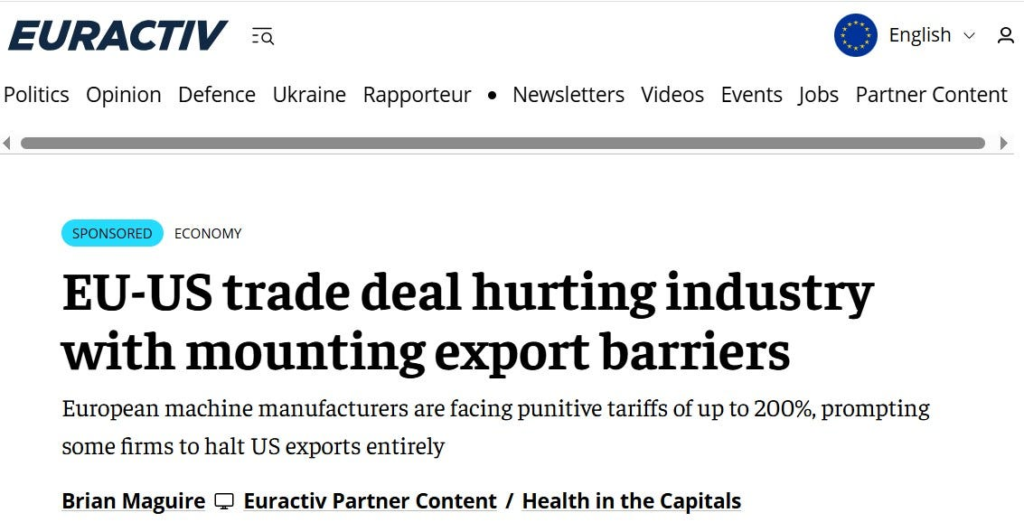
EURACTIV reports that Kathleen Van Brempt, vice-chair of the European Parliament’s international trade committee, delivered a blunt assessment: “It’s not a trade deal… This is not a good deal. It is neither fair nor balanced.”
The imbalance is particularly apparent in strategic sectors. European manufacturers still face substantial US tariffs on machinery, electrical equipment, steel, aluminum, and related products. In some cases, effective tariff rates on important European exports remained close to or above 14 percent even after the agreement took effect. The deal therefore did not eliminate the pressure on Europe’s industrial exporters; it primarily placed a ceiling on how much further Washington could escalate.
This is why the comparison with Canada is politically important. Mark Carney rejected the idea that Canada should surrender control over its trade policy, critical minerals, language protections, or economic future in exchange for temporary relief from American tariffs. Instead, he responded with reciprocal measures and a strategy of diversification.
Von der Leyen, by contrast, negotiated on behalf of the European Commission, whose president is not elected by European voters. Analysts explain that she viewed Trump’s threats more as a reason to give in than as a challenge to be resisted. Instead of responding to American pressure with coordinated European countermeasures, the agreement obligated Europe to unilaterally open its market, purchase vast quantities of American energy, invest hundreds of billions of dollars in the US economy, and accept a tariff system that continues to disadvantage many European exporters.
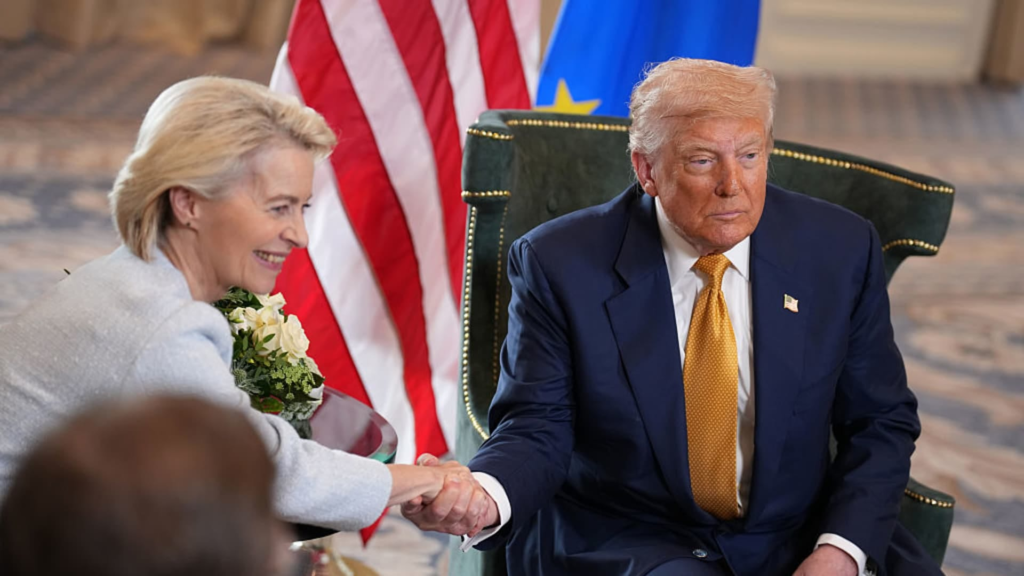
The European Commission defended the agreement as the best available option to prevent a wider transatlantic trade war and to ensure predictability for European companies. This rather weak argument refers to the agreement, which limited tariffs to 15 percent and included mechanisms that allowed the EU to suspend concessions if Washington failed to meet its commitments.
Nevertheless, the political reality remains uncomfortable. Europe paid a high price to obtain protection from a crisis that Washington itself created, while Canada chose to confront the pressure and effectively defend its sovereignty.
The contrast could hardly be clearer: Canada viewed Trump’s demands as an unacceptable attack on its independence, while the EU saw them as an opportunity for negotiation and ultimately accepted a one-sided agreement that was detrimental to European interests. Carney’s reaction showed that resistance was possible. Von der Leyen’s approval underscored the consequences of capitulation.
Unreasonable Demands: Economic Colonialism
The specific demands made by the US government to Canada at the last minute were astonishing and led many observers to conclude that they were attempts at economic colonialism:
- Restrictions on trade agreements: The United States demanded that Canada agree not to pursue trade deals with other countries, effectively attempting to dictate Canada’s foreign-trade policy.
- First right of refusal on critical minerals: Washington insisted on priority access to Canadian critical minerals, which could have forced Canada to sell to the United States regardless of competing offers.
- An attack on French-language protections: The United States demanded that Canada weaken or abandon the protection of French, an official language central to Canadian identity and particularly important in Quebec. US corporations rejected the protection of the French language, citing alleged trade barriers, as it actually increased their product packaging costs.
These demands angered the Canadian government and helped unite Canadians across the political spectrum. Premiers from different political parties, including those of Quebec and British Columbia, publicly condemned the US actions as an attack on Canadian sovereignty. The premier of British Columbia went further, warning that such demands could reduce Canada to “the economic equivalent of the 51st state.”
That sentiment echoes Trump’s own rhetoric. He has repeatedly referred to Canada as the “51st state” and even posted altered images depicting Canada beneath the US flag. Canadians have not taken those threats lightly: polling has reportedly found that three-fifths now view the United States as the greatest threat to their country.
US Transportation Secretary Sean Duffy added fuel to the fire by threatening a potential military conflict with Canada, absurdly claiming that Canada “has no military” while simultaneously ridiculing its universal healthcare system. Ironically, according to his logic, Canadians would be better off than Americans, who lack this system and cannot afford adequate healthcare.
Canada’s Leverage: The Oil Card and Beyond
Despite Trump’s claim that “we don’t need Canada; they need us,” Canada possesses significant economic leverage. Trump has also exaggerated the extent of Canada’s dependence on the United States, claiming that 95 percent of Canadian business is conducted with the US. The actual figure for Canadian exports is closer to 64 percent.
Canada’s greatest advantage may be its energy relationship with the United States. Although the US is the world’s largest oil producer and a net exporter, it cannot produce enough heavy sour crude—a type of oil required by many American refineries, particularly in the Midwest. Canada, especially Alberta, is a major supplier of this resource.
Canada is by far the largest provider of crude oil to the United States, supplying roughly 60 percent of US crude imports in 2023, up from 33 percent a decade earlier. Because of this energy relationship, the United States runs a trade surplus with Canada when oil is excluded.
That vulnerability is particularly serious amid the current global energy crisis. The world is experiencing one of the most significant oil-supply disruptions in modern history, much of it linked to the Trump administration’s illegal and unprovoked military and economic war of aggression against Iran. US strategic petroleum reserves are reportedly at their lowest level in four decades, and Trump himself acknowledged in June that global oil supplies could last only “four weeks.”
With the Strait of Hormuz shut down—a vital oil-transit chokepoint—any disruption to Canadian oil supplies could prove catastrophic for the United States. Gasoline prices could soar just months before the midterm elections, creating a major political liability for the Trump administration.
Beyond oil, Canada supplies the United States with other essential resources, including potash, aluminum, and auto parts. Saskatchewan alone holds more than a third of the world’s potash supply, making Canada indispensable to US agriculture and industry.
Canada Fights Back
Unlike the European Union, which largely capitulated to Trump’s previous trade demands, Canada has chosen to resist. Prime Minister Carney announced that Canada would match US tariffs “dollar for dollar,” demonstrating a level of resolve that was completely absent from the EU’s response.
Carney has also challenged the assumptions behind the rules-based international order, calling it a “fiction” in which the strongest countries exempt themselves from the rules. “When the rules no longer protect you, you must protect yourself,” he has argued.
That position has encouraged Canada to diversify its trade relationships and reduce its dependence on the US market. During a historic trip to China in January—the first visit by a Canadian prime minister in nearly a decade—Carney announced a “new strategic partnership” focused on trade, energy, and agriculture. The goal, he said, was to build “a stronger, more independent, and more resilient economy.”
Carney has warned that the United States is “weaponizing trade” and that its agreements can no longer be trusted. By standing up to Washington rather than yielding to intimidation, Canada is attempting to transform a moment of vulnerability into a long-term strategy for economic independence.
Why the Trade War Could Backfire on the United States
Major US media outlets, including Fortune, have warned that the United States is “unlikely to win its dumb trade war with Canada.” Several factors support that assessment:
- Legal challenges: The US Supreme Court has previously ruled against Trump’s unilateral tariffs, asserting that Congress—not the president alone—holds the constitutional authority to impose them.
- Economic vulnerability: The United States depends heavily on Canadian oil, critical minerals, and industrial components, leaving it exposed to reciprocal tariffs and supply disruptions.
- Political fallout: A sharp rise in gasoline prices caused by energy-supply shocks would be a serious political liability for the Trump administration, particularly before the midterm elections.
- Canada’s resilience: Canada’s efforts to diversify its trade and strengthen its economic independence have left it better positioned to withstand US pressure than in the past.
- Historical precedent: Trump’s previous trade war with China, which ultimately failed to produce the promised victory, demonstrates that aggressive tariff tactics do not guarantee success.
Conclusion: A Risky Gamble
The Trump administration’s trade war with Canada is a risky gamble, driven by aggressive negotiation tactics and disregard for established agreements and international norms. Although the conflict poses real challenges for the Canadian economy, Canada’s strategic leverage—particularly in energy—combined with its determination to defend its sovereignty and diversify its trade relationships, could allow it to withstand US pressure.
The contrast with Europe is striking. Ursula von der Leyen, a president of the European Commission not elected by European voters, shamefully bowed to American pressure and accepted a bad deal. Mark Carney, on the other hand, was elected to represent the Canadians – and chose to defend their sovereignty rather than surrender it.
In a world already grappling with geopolitical and economic instability, the deepening oil crisis and the estrangement from a key ally appear less like a sign of strength and more like a self-inflicted failure on the part of the United States. Europe, meanwhile, having relinquished much of its sovereignty and grown increasingly weaker, has largely lost its significance on the world stage anyway.